Stair climber
Also called stair machine, stepmill, stair stepper.
What does stair-climber training do?
A stair climber is a cardio machine that keeps you stepping upward on revolving steps or moving pedals. Your legs alternate as they would on a staircase while the machine controls how the steps move. It can be used for different kinds of cardio sessions, so the appropriate setting and length depend on why it is in your workout rather than on one standard prescription.
How do you use a stair climber?
Set up
- Use the rails for balance as you step onto the machine, then start it with the controls when you are ready.
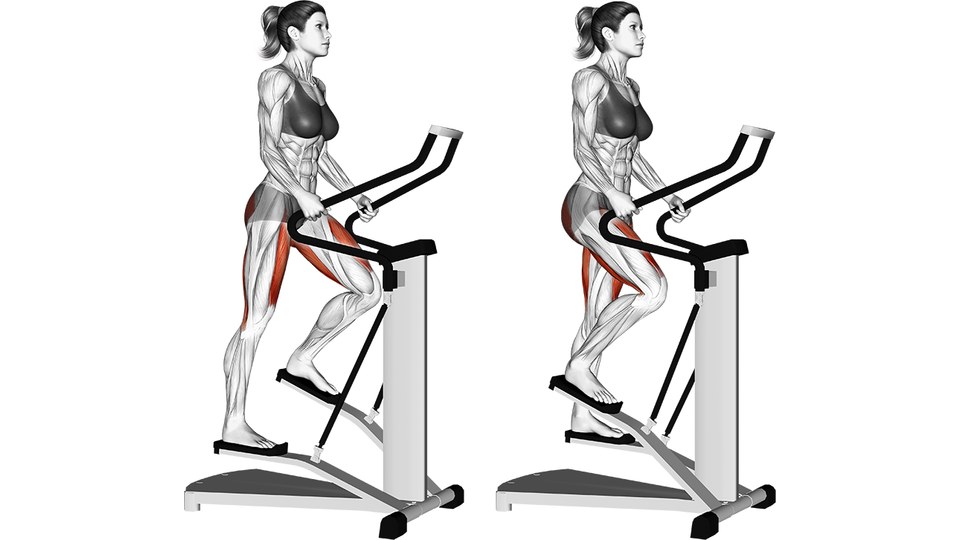
- Stand upright over the steps with your feet facing forward and your hands resting lightly on the rails.
Execution
- Step with alternating feet, placing enough of each foot on the step to feel secure before shifting your weight.
- Let your legs carry your weight and use the rails only for balance while you follow the session you planned.
- When you are finished, stop the machine with its controls and step off after the steps have stopped moving.
Common mistakes
Leaning heavily on the rails
Supporting your body through your arms changes how much weight your legs move and can pull you into an awkward position. Stop and reassess if you cannot stay balanced with only a light touch.
Taking steps you cannot place securely
Reaching or rushing makes it easier for the foot to slip off the moving step. Pause if each foot cannot land securely before your weight moves onto it.
Stepping off while the machine is still moving
The steps can keep travelling after you decide the session is over. Stop them with the controls, wait, and then dismount.
Where it fits in a session
Wherever cardio fits in the session. Whether it comes before lifting, after lifting or on its own depends on what the session is for.
Use the controls to match the session you planned. Duration, speed, resistance and effort are intentionally not prescribed here because they change with the purpose of the cardio.
Muscles worked
- quadriceps
- gluteus maximus
- hamstrings
- gastrocnemius and soleus
This is a cardio machine rather than a resistance exercise aimed at one muscle. The legs repeat the work of stepping upward: the knee and hip extend as you rise, and the calf supports the ankle as you stand on each step. The list is unranked because machine design, step height and how the user moves all change the share of work.
Variations
- Stepmill — A rotating staircase with full steps that move downward as you climb.
- Pedal stair stepper — Two pedals move under the feet instead of presenting a revolving staircase.
- Stair climbing — Uses a fixed staircase rather than a machine.
Frequently asked questions
What muscles does a stair climber work?
Stair climbing uses the quadriceps, gluteus maximus and hamstrings to extend the knee and hip as you rise, while the gastrocnemius and soleus support the ankle on each step. It is still primarily cardio rather than a way to isolate one of those muscles.
Is a stair climber good cardio?
It can be. Continuous stepping asks the heart and lungs to support repeated work by the legs. How demanding it becomes depends on the machine setting, the length of the session and your own effort, so there is no single stair-climber workout that suits every goal.
Should I hold the rails on a stair climber?
Use them for balance when getting on, getting off or whenever you need them. During steady stepping, a light touch preserves balance without making the arms carry part of your bodyweight. If you need to lean on the rails continuously, stop and reassess before continuing.
What is the difference between a stair climber and a stepper?
A stepmill presents a revolving staircase with full steps. A pedal stepper has two platforms that travel up and down under your feet. Both create repeated stepping, but the feel and available foot placement are different.
How long or how fast should I use a stair climber?
That depends on why you are using it. A warm-up, a cool-down, a general cardio session and preparation for an event call for different choices. Follow the plan for that session rather than treating one duration or machine setting as universally correct.
Sources
- Bordoni B, Varacallo M. Anatomy, Bony Pelvis and Lower Limb: Thigh Quadriceps Muscle. StatPearls. https://www.ncbi.nlm.nih.gov/books/NBK513334/
- Hu Y, Raja A. Anatomy, Bony Pelvis and Lower Limb, Hamstring Muscle. StatPearls. https://www.ncbi.nlm.nih.gov/books/NBK546688/
- Elzanie A, Borger J. Anatomy, Bony Pelvis and Lower Limb, Gluteus Maximus Muscle. StatPearls. https://www.ncbi.nlm.nih.gov/books/NBK538193/
- Bordoni B, Varacallo M. Anatomy, Bony Pelvis and Lower Limb: Gastrocnemius Muscle. StatPearls. https://www.ncbi.nlm.nih.gov/books/NBK532946/
- Binstead JT, Varacallo M. Anatomy, Bony Pelvis and Lower Limb: Calf. StatPearls. https://www.ncbi.nlm.nih.gov/books/NBK459362/