
Suitcase carry
Also called suitcase walk, dumbbell suitcase carry.
What is a suitcase carry?
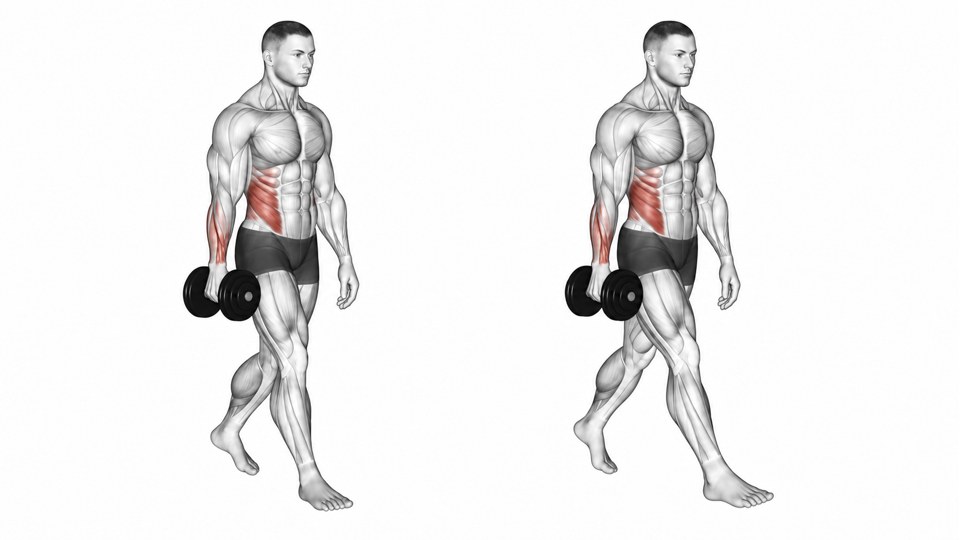
A suitcase carry is a walk with one weight hanging from one hand at your side. This guide uses a dumbbell. Your grip holds the load while your trunk muscles work to keep you upright under the uneven weight.
How do you perform a suitcase carry?
Set up
- Clear a walking route with room for the dumbbell beside your leg. Place one dumbbell beside you and choose a load you can hold without tilting your body.
- Bend at your hips and knees, grip the handle with one hand, and stand up. Let the weight hang from a straight arm with your wrist aligned with your forearm.
Execution
- Walk along the route at a pace that lets you keep your shoulders and hips level. Let the empty arm move naturally while keeping the dumbbell close to your side without knocking your leg.
- At the end of the carry, stop walking, bend your hips and knees, and place the dumbbell down under control.
- Pick it up with the other hand and repeat the planned distance or time on that side.
Common mistakes
Leaning sideways throughout the walk
If you cannot keep a reasonably upright posture, shorten the carry or use a lighter dumbbell.
Rushing the turn
Stop or take a wider, slower turn so the weight stays controlled.
Letting the handle slip toward the fingertips
Finish the carry and set the weight down before your grip opens.
Where it fits in a session
Use it for loaded walking or grip and trunk work within your planned session.
Log the load in the one working hand and either distance or time. Keep the route and logging convention consistent when comparing sessions.
Muscles worked
Primary
Secondary
Schematic surface view. Some muscles are partly visible or not shown.
The obliques and back muscles help hold the trunk upright while the hand grips the weight.
Variations
Frequently asked questions
How is a suitcase carry different from a farmer's walk?
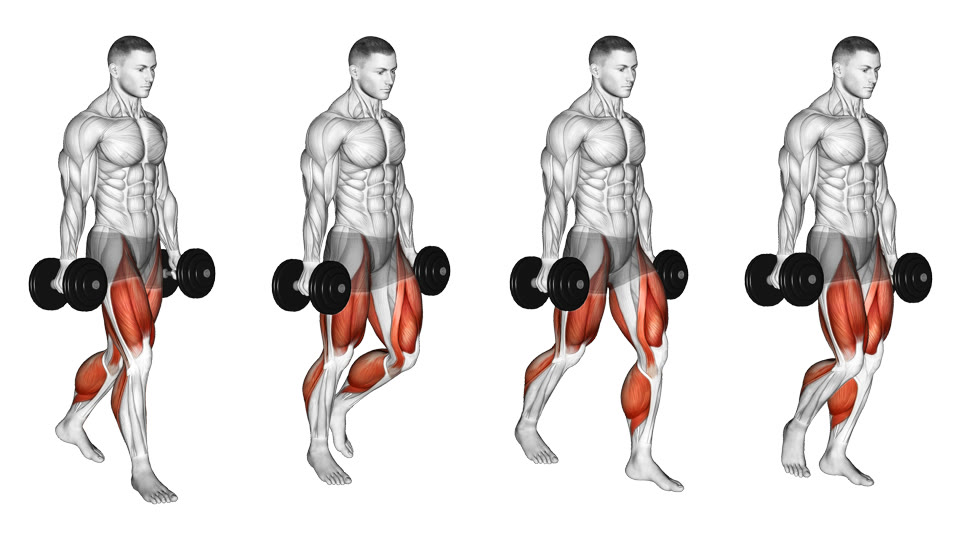
A suitcase carry uses one weight on one side. A farmer's walk carries a weight in each hand. Keep them as separate exercises in your training log.
Can I use a kettlebell?
Yes. Hold it by the handle beside your body and use the same walking approach. This page illustrates a dumbbell.
Should I bend toward the weight?
Aim to walk upright rather than deliberately leaning to either side. If the weight keeps pulling you off that position, reduce the load or end the carry.
How do I count a carry on each side?
Record each side separately or label the distance or time as a total for both sides. Pick one convention and use it consistently.
Sources
- Ellestad SH, et al. The Quantification of Muscle Activation During the Loaded Carry Movement Pattern. 2024. https://pmc.ncbi.nlm.nih.gov/articles/PMC11042841/