Suspension fallout
Also called TRX fallout, standing suspension rollout.
What is a suspension fallout?
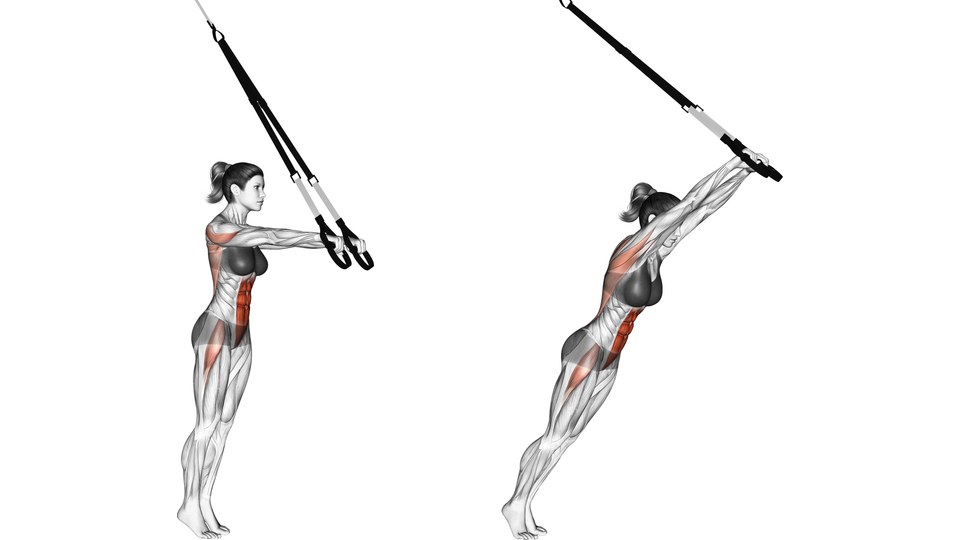
A suspension fallout is a standing exercise in which you lean forward while reaching the handles overhead, then return without bending at the hips. Your feet stay on the floor and your arms remain nearly straight. This guide covers the standing version.
How do you perform a suspension fallout?
Set up
- Install the trainer on a secure anchor using its manufacturer’s instructions, check the straps and handles, and clear the floor around you. Set both straps to equal length.
- Face away from the anchor, hold the handles in front of you and stand with your feet about hip-width apart. Keep your elbows nearly straight, tighten your midsection and begin with the straps taut.
Execution
- Let your whole body lean forward from the ankles as the handles travel upward in front of you. Keep your ribs over your pelvis rather than letting the lower back arch.
- Stop the reach while you can still hold your trunk and legs in line. You do not need to match the long reach shown in the illustration.
- Bring the handles back down in front as you return to the starting stance, keeping the elbows nearly straight. Stand securely before releasing the handles.
Common mistakes
Arching the back to reach farther
Shorten the reach and start with a smaller forward lean. End the repetition before the ribs lift away from the pelvis.
Bending the elbows to pull yourself upright
Reduce the range and return with nearly straight arms. Do not turn the return into a press.
Where it fits in a session
Include this movement where it fits the strength session you have planned.
Track the foot position, strap length and reaching distance. Keep them consistent when comparing repetitions.
Muscles worked
Primary
Secondary
Schematic surface view. Some muscles are partly visible or not shown.
These abdominal muscles help hold the trunk steady during the reach. The list is not an activation ranking or a complete list of every muscle involved.
Frequently asked questions
Is this done on the knees?
This guide uses the standing version. A kneeling suspension rollout starts from a different support position and should be tracked separately.
Must my arms reach all the way overhead?
No. Start with a short reach and stop before you lose your body line. The illustration shows one available range, not a depth you must reach.
Sources
- Betts et al. Anatomy and Physiology 2e. OpenStax, 2022. https://openstax.org/books/anatomy-and-physiology-2e/pages/11-4-axial-muscles-of-the-abdominal-wall-and-thorax