
Tibialis raise
Also called wall tibialis raise, wall toe raise.
What is a tibialis raise?
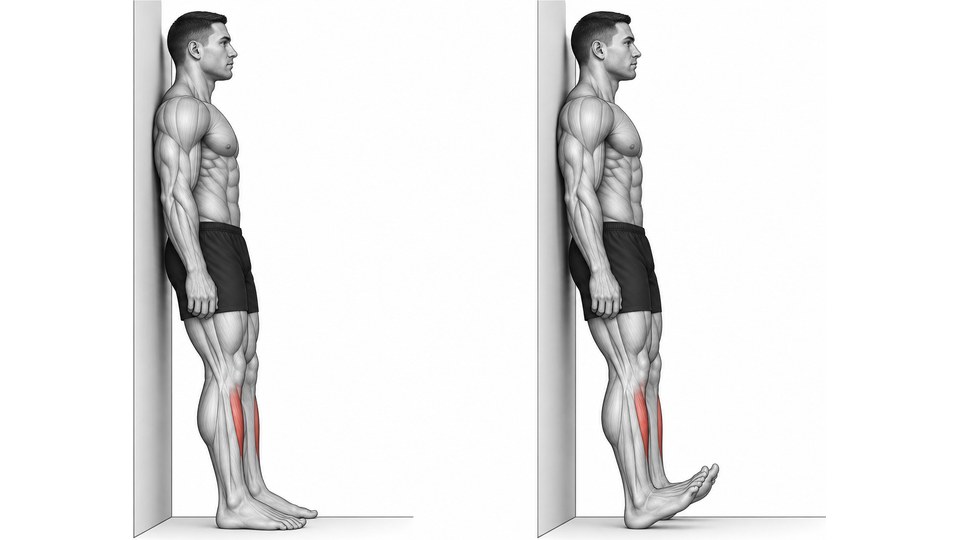
A tibialis raise is an exercise for the front of the lower leg. With your back against a wall and your heels on the floor, you lift your forefeet toward your shins and lower them again. This wall-supported version trains the tibialis anterior through ankle dorsiflexion.
How do you perform a tibialis raise?
Set up
- Lean your back against a solid wall and place your feet about hip-width apart, a short step in front of you.
- Keep your heels planted and your knees nearly straight without locking them. Start with both feet flat.
Execution
- Lift the fronts of both feet toward your shins while keeping your heels in place.
- Pause briefly at the top without lifting your heels or bending your knees to move the feet.
- Lower your forefeet slowly until they touch the floor, then repeat.
Common mistakes
Rising onto the toes
That reverses the intended movement. Keep your heels on the floor and lift the forefeet instead.
Bending the knees to lift the feet
Hold your knee position steady and move through the ankles.
Where it fits in a session
Use it as direct lower-leg work with slow, repeatable repetitions.
Keep the heel position and distance from the wall consistent when comparing sets.
Muscles worked
Primary
Secondary
- None listed in this guide
Schematic surface view. Some muscles are partly visible or not shown.
The tibialis anterior lifts the front of the foot toward the shin.
Frequently asked questions
Is this a calf raise?
No. A calf raise lifts your heels. A tibialis raise keeps the heels down and lifts the forefeet toward the shins.
How far should my feet be from the wall?
Start close enough that you can lift and lower both forefeet with control while your back stays against the wall. Adjust the distance between sets rather than shuffling during a repetition.
Sources
- OpenStax. Anatomy and Physiology 2e. Appendicular Muscles of the Pelvic Girdle and Lower Limbs. https://openstax.org/books/anatomy-and-physiology-2e/pages/11-6-appendicular-muscles-of-the-pelvic-girdle-and-lower-limbs