Turkish get-up
Also called kettlebell Turkish get-up, Turkish getup, TGU.
What is a Turkish get-up?
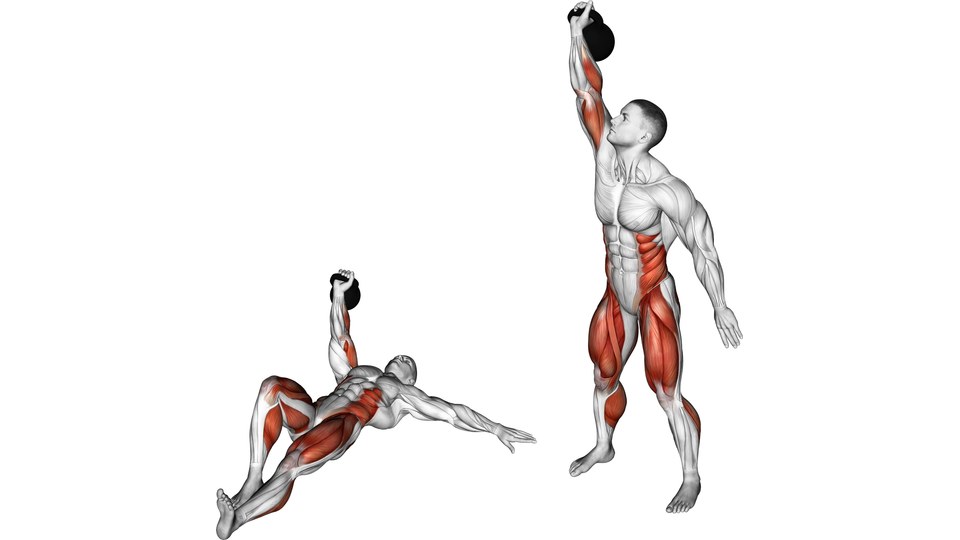
A Turkish get-up is a controlled move from lying on your back to standing and back down while holding a weight overhead in one hand. This guide uses a kettlebell and a leg sweep into a half-kneeling position before you stand.
How do you perform a Turkish get-up?
Set up
- Practise the sequence without weight first. Clear space around you, then lie beside a light kettlebell on your right side and hold its handle with both hands.
- Roll onto your back with the bell close to your chest. Use both hands to help position it above your right shoulder, straighten your right arm, and keep your wrist nearly straight. Plant your right foot with that knee bent; extend your left leg and left arm slightly out to the side.
Execution
- Keep watching the bell. Push through your right foot and roll onto your left forearm, keeping the loaded arm vertical.
- Press your left palm into the floor and straighten that supporting arm to sit tall.
- Lift your hips enough to sweep your left leg underneath you, placing the left knee on the floor beneath your hip. Keep your left hand planted and the bell above your right shoulder.
- Bring your torso upright and lift your left hand from the floor. Adjust the rear leg into a stable half-kneeling stance with your right foot in front, then look forward.
- Stand up from the lunge with the bell overhead, bringing your feet together into a comfortable stance. Pause until steady.
- Step your left foot back and lower the left knee. Turn the lower leg as needed, hinge sideways and replace your left hand on the floor; look back toward the bell.
- Support yourself through the left hand and right foot, sweep the left leg forward, and lower your hips to sit. Move down to your left forearm, then onto your back.
- Bring your left hand to the bell, lower it to your chest with both hands, then roll onto your right side to set it down. Reposition to practise the other side.
Common mistakes
Trying a heavy bell before learning the sequence
Practise each transition unloaded until you can pause and reverse it without guessing where the next hand or foot goes.
Rushing the leg sweep
Make space under your hips, place the knee deliberately, then settle before lifting your supporting hand.
Bending the loaded elbow during a transition
Use a lighter bell and reset rather than continuing through the next position with an unstable overhead hold.
Where it fits in a session
Practise while you can give each transition your full attention.
Start with unloaded repetitions. Add a light bell only when both the ascent and descent are controlled; count one ascent plus descent as one repetition and record each side consistently.
Muscles worked
Primary
Secondary
Schematic surface view. Some muscles are partly visible or not shown.
The exercise changes position throughout the repetition; this list is not a ranking of muscle activity at every stage.
Frequently asked questions
Does a repetition include coming back down?
For this guide, yes: stand up, then reverse the sequence to the floor. Use that same counting convention in your workout log.
Should I start without a kettlebell?
Yes. Rehearse the support changes with an empty hand before adding weight. If you keep losing the sequence, practise individual transitions with a coach.
Does the picture show every step?
No. It shows the lying start and standing finish. Follow the written sequence for the elbow, hand, leg sweep and half-kneeling positions between them.
Do I have to keep looking up once I am standing?
Watch the bell through the floor transitions. Once upright and steady, you can look forward; the illustration shows the alternative of continuing to watch the bell. Choose a comfortable gaze without craning your neck.