
Weighted plank
Also called weighted front plank.
What is a weighted plank?
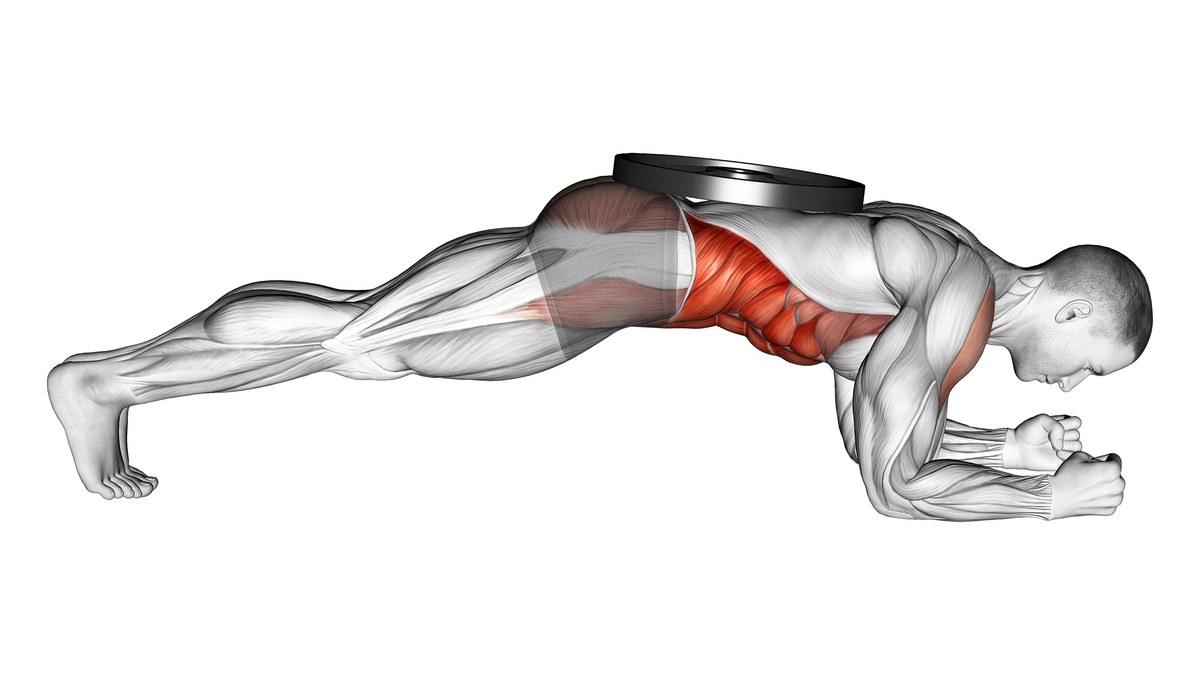
A weighted plank is a front plank held with external weight on the torso. This guide uses a plate across the lower back just above the hips, with a partner handling the plate. Your forearms and toes support you while your abdominal muscles keep the trunk from sagging. Learn the bodyweight front plank before adding a load.
How do you perform a weighted plank?
Set up
- Rehearse without weight: set your elbows below your shoulders, extend your legs, and hold your body straight on your forearms and toes while breathing. Lower your knees before setting up the plate.
- Choose a light plate and a partner who will load it, stay beside you, and remove it at the end. Agree on a clear stop signal.
- On forearms and knees, brace your abdomen. Have your partner set the plate flat across your lower back just above your hips, checking that it does not tip or press uncomfortably.
Execution
- Lift your knees and straighten your legs, keeping the plate still and your head, trunk and legs aligned.
- Hold that shape with small, regular breaths. Keep your elbows beneath your shoulders and your hips from sinking or rising.
- Signal your partner before you lose position, or immediately if the plate shifts or feels uncomfortable. Have them steady the plate as you lower your knees.
- Stay supported on both forearms and knees while your partner lifts the plate completely away. Then sit up.
Common mistakes
Reaching around to adjust the plate
Keep both forearms planted. Ask your partner to remove the plate, then reset rather than twisting under it or trying to catch a sliding load.
Adding weight before the bodyweight hold is steady
Return to an unloaded front plank if you cannot keep the same shape while breathing. Practise that position before trying the plate again.
Keeping the clock running after the hips drop
Count only the time spent in the intended position. Signal for the finish while you can still lower your knees with control.
Standing up before the plate is removed
Finish on your forearms and knees and let your partner lift the plate away. Do not try to roll it off your back or tip it onto the floor.
Where it fits in a session
Use it in a core session or after your main lifts, with a partner available for every loaded set.
Choose a hold you can repeat with the same body position and regular breathing. Once that is consistent, add a little time or a small amount of weight, changing one at a time. Keep the plate position and support points the same when comparing sessions. If the setup becomes awkward, reduce the load or return to bodyweight rather than stacking more plates.
Muscles worked
Primary
Secondary
Schematic surface view. Some muscles are partly visible or not shown.
The rectus abdominis runs along the front of the abdomen; the external obliques lie at its sides. In this hold, they help keep the trunk still. The target list does not include every muscle supporting the position.
Variations
- Bodyweight front plankRemove the plate and practise the same forearm-and-toe hold. If that is too difficult, keep your knees on the floor.

Frequently asked questions
What muscles does a weighted plank work?
The rectus abdominis at the front of the abdomen and the external obliques at the sides help hold the trunk still. The goal is to resist sagging and twisting while you hold the position, rather than curl the torso through repeated reps.
When should I add weight to a plank?
First learn a bodyweight front plank with steady shoulders and hips while breathing normally. Then try a light plate with a partner. Use your ability to repeat that position as the starting point, rather than a compulsory hold time or percentage of bodyweight.
Where should the plate go?
The illustrated setup uses one plate across the lower back just above the hips. Have a partner place it while your forearms and knees are supported and check that it rests flat without tipping or uncomfortable pressure. If it will not stay there, use the unloaded version. The position shown is a setup choice, not a claim that one spot suits everyone's body or plate.
Can I do this without a partner?
Use a bodyweight front plank when you train alone. The plate setup taught here relies on someone else to place, steady and remove the load. Avoid reaching behind yourself to balance it or letting it fall off at the finish.
Should I add weight or hold for longer?
Pick one change at a time. For a loaded hold, keep the same plate position and aim for a repeatable duration before making a small load increase. End the set when your position changes, even if the planned time is not up. You can continue practising with bodyweight instead.
Sources
- van den Tillaar R, Saeterbakken AH. Comparison of Core Muscle Activation between a Prone Bridge and 6-RM Back Squats. Journal of Human Kinetics. 2018;62:43–53. https://pmc.ncbi.nlm.nih.gov/articles/PMC6006542/
- Flynn W, Vickerton P. Anatomy, Abdomen and Pelvis: Abdominal Wall. StatPearls. Updated July 24, 2023. https://www.ncbi.nlm.nih.gov/sites/books/NBK551649/