
Wrist roller
What is a wrist roller?
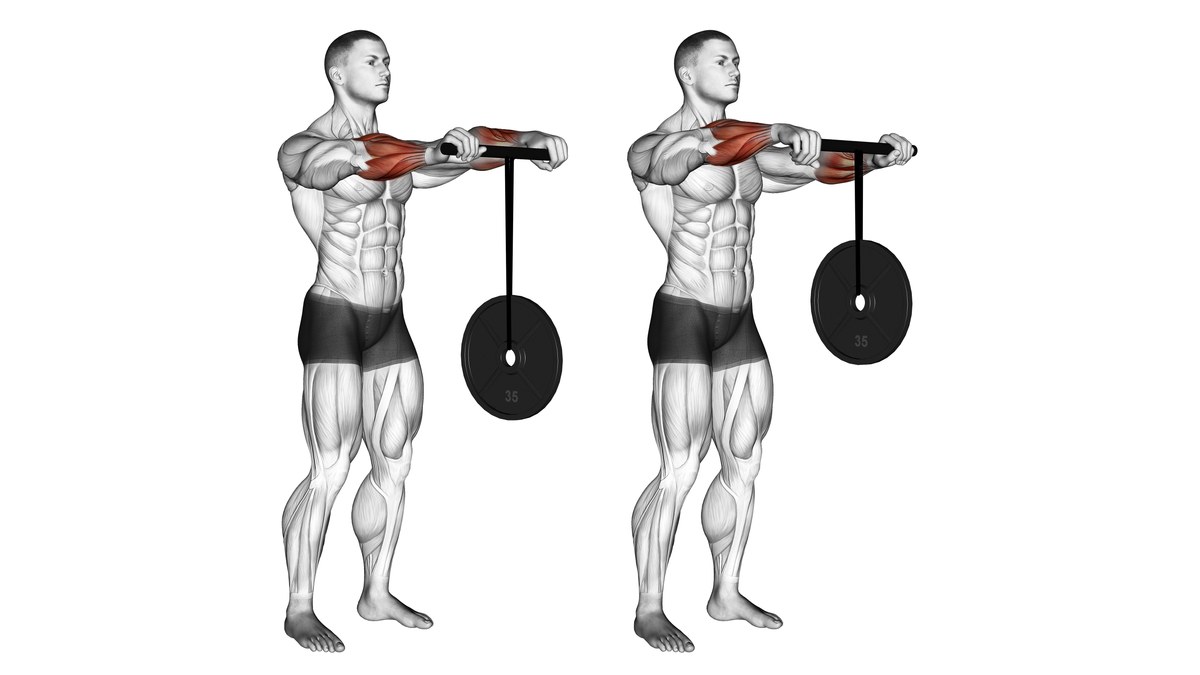
A wrist roller is a handle with a cord that suspends a weight. You turn the handle with alternating wrist movements to wind the cord and raise the load, then unwind it under control. The version here uses an overhand grip and upward wrist turns to work the forearm extensors, with the finger flexors holding the handle.
How do you use a wrist roller?
Set up
- Secure a light weight plate to the roller's cord with its intended plate attachment. Check the cord and attachment before lifting.
- Stand with your feet about shoulder-width apart. Hold the handle with your palms down and one hand on each side of the cord.
- Raise the handle in front of you to about shoulder height, with your arms nearly straight. With the cord unwound, check that the plate hangs clear of the floor and ahead of your toes.
Execution
- Keep the handle at that height and take turns bending each wrist back, lifting your knuckles to turn the handle. Regrip between turns while the other hand holds it steady.
- Keep winding until the plate approaches the handle, stopping before it hits your hands. Keep your torso still rather than lifting the weight with your arms.
- Reverse the small hand turns to feed the cord out slowly. Keep hold of the handle throughout the descent.
- Once the cord is unwound, repeat the winding and lowering for your planned repetitions. To finish, lower the handle until the plate rests on the floor before releasing your grip.
Common mistakes
Letting the roller spin through your hands on the way down
You lose control of the plate. Use small turns to lower it, and reduce the load if you cannot keep hold of the handle.
Raising and dropping your arms with each turn
The plate can rise without much winding. Keep the handle in one place so the cord, rather than your arm movement, lifts it.
Starting with a load you cannot bring back down
The set includes lowering the plate. Choose a load you can unwind smoothly as well as wind up.
Where it fits in a session
Place it after the lifting for which you want a fresh grip.
Count one controlled ascent and descent as one repetition. Start with a light plate and a short set; keep the cord length and winding direction consistent when comparing sessions. Increase the load only when every descent stays controlled.
Muscles worked
Primary
Secondary
Schematic surface view. Some muscles are partly visible or not shown.
These targets describe winding the weight up by bending the wrists back. The wrist extensors move the handle, while the finger flexors keep hold of it. Winding in the other direction uses wrist flexion instead.
Frequently asked questions
What muscles does a wrist roller work?
The upward winding taught here uses the wrist extensors on the back of the forearm. The finger flexors hold the handle. Turning the handle the other way to raise the plate uses the wrist flexors on the palm side of the forearm.
Should I roll in both directions?
You can include both directions as a training choice. Finish lowering the plate, then wind it up in the opposite direction for the next repetition. The instructions on this page teach the upward wrist turn first; reversing the winding direction changes the wrist action.
How heavy should the plate be?
Begin with a light plate that you can raise and lower without the handle dropping or the plate swinging. If your grip starts to open during the descent, end the set and use less weight. The number printed on the illustrated plate is not a recommended starting load.
How is a wrist roller different from a wrist curl?
With a roller, both hands take turns rotating one handle to gather a cord and lift a hanging weight. A wrist curl moves a weight directly by bending the wrist, without winding a cord. They are different movements, even though both involve the forearms.
Sources
- Reeves N, Crow T, Varacallo MA. Anatomy, Shoulder and Upper Limb, Wrist Extensor Muscles. StatPearls. Updated 2026. https://www.ncbi.nlm.nih.gov/books/NBK534805/
- Fazal ZL, Hafeez AM, Sinkler MA, Arain A. Anatomy, Shoulder and Upper Limb, Forearm Compartments. StatPearls. Updated 2023. https://www.ncbi.nlm.nih.gov/books/NBK539784/