
Air bike
Also called fan bike, AssaultBike.
What is an air bike?
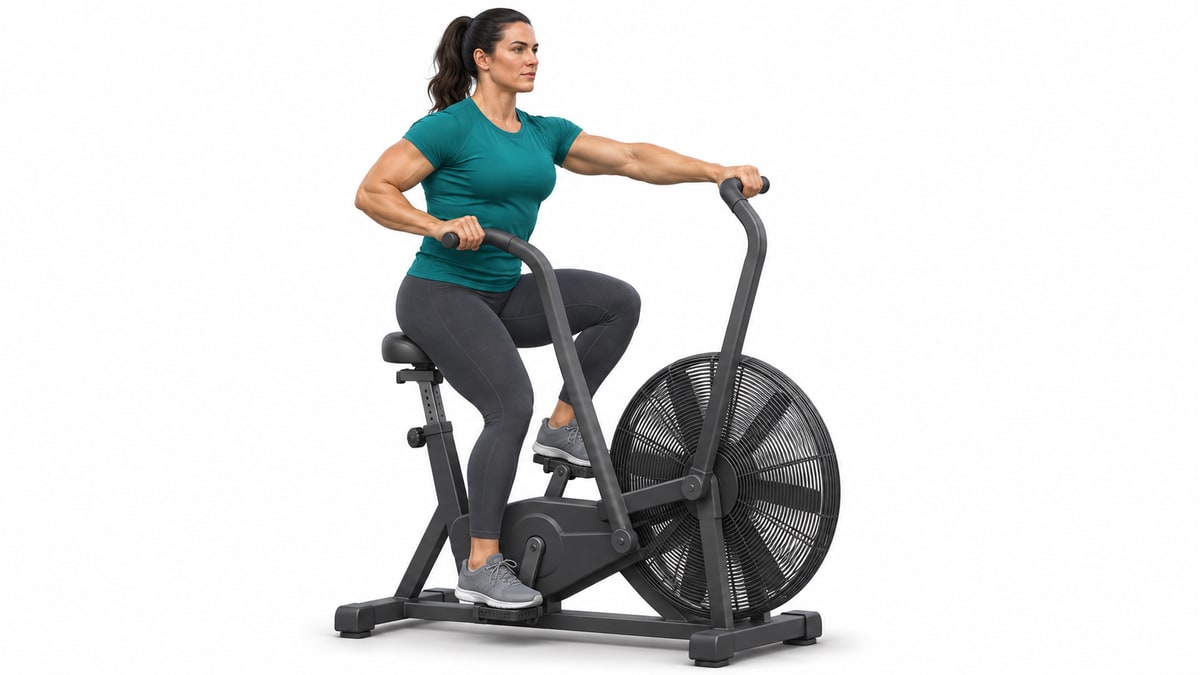
An air bike is a stationary cardio bicycle with a fan for resistance and two handles that move back and forth with the pedals. You stay seated, turn the pedals and alternately push and pull the handles. A fan bike differs from a fixed-handle exercise bike because the arms actively join the pedalling movement.
How do you use an air bike?
Set up
- Check that the bike stands firmly on a level floor, with space around the moving handles and pedals. Do not use it if a pedal, handle or seat is loose.
- With the bike stopped and unoccupied, set the saddle height so your knee stays slightly bent at the lowest pedal position. Adjust the seat forward or back for a comfortable reach, then engage and tighten its adjustment locks.
- Hold the handle grips and position the pedal nearest you at the bottom. Place that foot on it, bring your other leg over the back of the saddle, sit down and place the other foot on its pedal. Keep the bike still as you get on.
Execution
- Begin turning the pedals slowly while pushing one handle away and drawing the other toward you. Follow their linked movement rather than trying to move both handles together.
- Stay seated with your torso upright and your hands aligned with your forearms. Keep your feet on the pedals and continue the coordinated push, pull and pedal action for your planned session.
- To finish, ease off your pushing and pedalling effort while keeping hold of the grips and keeping your feet on the pedals. Bring the pedal on your exit side to the bottom, then wait until the handles and pedals are completely still.
- Hold the grips, lift the foot opposite your exit side off its pedal and bring that leg back over the saddle. Step down on your exit side, then take your remaining foot off the lower pedal.
Common mistakes
Reaching for each handle with the whole torso
If you have to rock forward and back to follow the grips, stop and reassess the seat position. Choose a reach that lets your arms move while you remain seated and upright.
Leaving a seat adjustment partly engaged
Seat posts and slides need their pins or clamps fully engaged and tightened. Make adjustments off the bike and check the lock before starting again.
Stepping off while the pedals are still turning
The handles and pedals move together and may keep moving after you reduce your effort. Wait on the saddle until both have stopped instead of trying to jump clear.
Where it fits in a session
Use the air bike wherever your existing session plan places it.
Keep the movement coordinated at the effort called for by your session.
Muscles worked
Primary
Secondary
- None listed in this guide
Schematic surface view. Some muscles are partly visible or not shown.
The legs turn the pedals while the chest, back and arms contribute to the linked handle movement. These are some of the muscles involved in a coordinated cardio activity, listed together rather than ranked by effort. This is not an isolation exercise or a complete list of every muscle involved.
Variations
- Fixed-handle stationary bikeThe legs pedal while the hands rest on handlebars that stay in place. It has a separate guide because the arm action differs.

Frequently asked questions
What muscles does an air bike work?
The quadriceps help straighten the knees and the gluteus maximus helps extend the hips as you pedal. The chest and latissimus dorsi contribute to moving the upper arms, while the biceps and triceps help bend and straighten the elbows at the handles. These describe muscle functions within the movement, not a measured ranking of activity or a promise of muscle growth.
Is an AssaultBike the same exercise as an air bike?
AssaultBike is a brand of fan-resistance bike with moving handles. This guide covers that seated push, pull and pedal action, including similar fan bikes. A bicycle with fixed handlebars uses a different arm position, even if it also uses air resistance.
How should I adjust the seat?
Set the height with the bike stopped, leaving a small bend in the knee when the pedal is lowest. Adjust the forward or backward position so you can follow the handle travel without rocking your body. Get off before changing a setting, then fully engage and tighten the locks. Use the adjustment instructions for the model in front of you.
How do I change the resistance?
On the fan-bike design covered here, turning the fan faster increases the air resistance. Your leg drive and handle push and pull contribute to that movement. Choose an effort that fits the session you planned; the guide does not prescribe a fan speed or interval pattern.
Can I get off as soon as I stop pushing?
Wait until the handles and pedals have stopped. Reducing your effort lets the mechanism slow down, but it does not make the moving parts stop immediately. Keep your hands on the grips and feet on the pedals as it slows, then dismount. Follow the stopping instructions on your model rather than assuming a console button acts as a brake.
Sources
- Betts JG, et al. Anatomy and Physiology 2e, 11.5: Muscles of the Pectoral Girdle and Upper Limbs. OpenStax. https://openstax.org/books/anatomy-and-physiology-2e/pages/11-5-muscles-of-the-pectoral-girdle-and-upper-limbs
- Betts JG, et al. Anatomy and Physiology 2e, 11.6: Appendicular Muscles of the Pelvic Girdle and Lower Limbs. OpenStax. https://openstax.org/books/anatomy-and-physiology-2e/pages/11-6-appendicular-muscles-of-the-pelvic-girdle-and-lower-limbs