Assisted chin-up
Also called machine-assisted chin-up, assisted chinup, counterweighted chin-up.
What is an assisted chin-up?
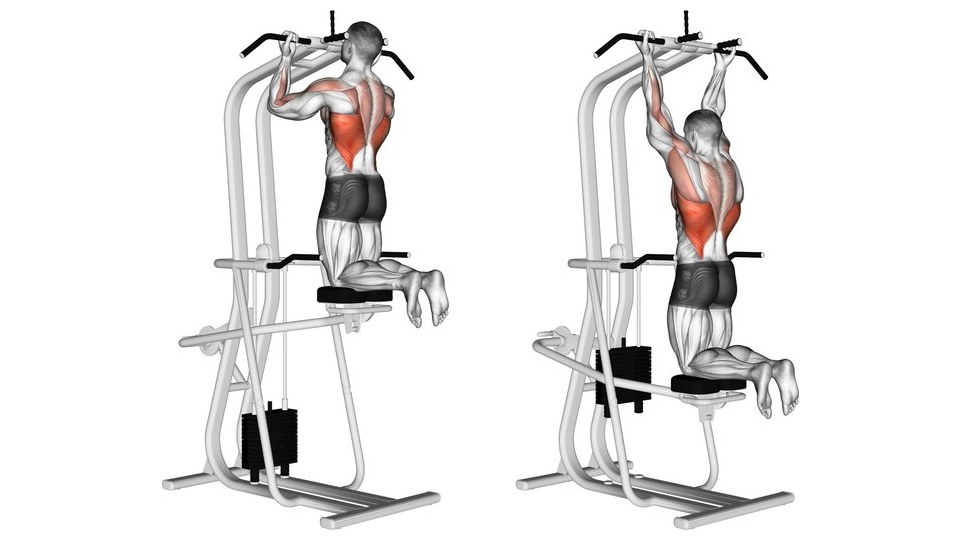
An assisted chin-up is an underhand vertical pull performed on a machine whose counterweighted pad supports some of your bodyweight. You kneel on the pad and pull your body toward the handles while the pad travels with you. An unassisted chin-up has no counterweight, while an assisted pull-up uses an overhand grip instead of an underhand one.
How do you perform an assisted chin-up?
Set up
- Choose an assistance setting, step onto the machine, and take the inward-angled handles with your palms facing you and your hands about shoulder width apart.
- Keep hold of the handles as you place one knee and then the other on the pad; let the pad lower smoothly until your arms are straight.
Execution
- Start the pull by drawing your shoulder blades down, then bend your elbows toward your sides.
- Lift until your chin reaches the height of the handles, keeping both knees on the pad and your body quiet.
- Lower with control until your arms are straight and the pad stops moving, then let your body settle before the next rep.
- After the final rep, keep hold of the handles, move one foot and then the other to the machine's step, and guide the unloaded pad back up.
Common mistakes
Climbing onto or off the pad without a secure handhold
The counterweighted pad moves as your bodyweight transfers to or from it. Hold the handles and move one knee or foot at a time so the change is controlled.
Letting the knees lose contact with the pad
The selected assistance reaches you through the pad. Keep both knees in place rather than bouncing away from it during the pull.
Reaching the head forward to finish the rep
Moving the neck can imitate a higher finish without moving the torso. Keep the neck comfortable and raise the body to the handles instead.
Where it fits in a session
Early in an upper-body or pulling session, before fatigue makes it harder to keep the grip, torso and moving pad under control.
Record both the machine and its assistance setting so later sessions are comparable; the numbers on different machine designs do not necessarily represent the same amount of help.
Muscles worked
- latissimus dorsi
- biceps brachii
- brachialis
- teres major
- brachioradialis
- trapezius (middle and lower fibres)
- rhomboids
- posterior deltoids
The latissimus dorsi and teres major move the upper arms down toward the torso. The biceps brachii, brachialis and brachioradialis bend the elbows, while the muscles around the shoulder blades help control the pull. The machine changes how much bodyweight the lifter has to move; it does not turn the exercise into a different pulling pattern.
Variations
- Chin-up — Uses the same underhand pulling pattern without a machine offsetting part of your bodyweight.
- Assisted pull-up — Uses the machine's assistance pad with an overhand grip, palms facing away.
- Band-assisted chin-up — Uses an anchored resistance band for support instead of a counterweighted knee pad.
- Neutral-grip assisted pull — Uses parallel handles so the palms face each other throughout the repetition.
- Negative chin-up — Starts at the top without machine assistance and trains only the controlled lowering phase.
Frequently asked questions
What muscles do assisted chin-ups work?
Assisted chin-ups train the latissimus dorsi and teres major as the upper arms move toward the torso, the biceps brachii, brachialis and brachioradialis as the elbows bend, and the middle and lower trapezius, rhomboids and rear deltoids around the shoulder blades.
How is an assisted chin-up different from a chin-up?
Both use an underhand grip and the same vertical pulling movement. On this version, a counterweighted pad supports part of your bodyweight; in an unassisted chin-up, your arms move your full bodyweight.
What is the difference between an assisted chin-up and an assisted pull-up?
The grip. Your palms face you for an assisted chin-up and face away for an assisted pull-up. The machine may offer both choices on the same set of handles, but the names describe different hand positions.
Is a machine-assisted chin-up the same as a band-assisted chin-up?
No. The machine supports your knees on a moving counterweighted pad. A band stretches from the bar to a foot or knee and changes its help as its length changes. Both reduce the bodyweight you have to move, but the setup and feel are different.
How much assistance should I select?
Choose a setting that lets you move between straight arms and the handles without bouncing, swinging or losing contact with the pad. Check the machine's instructions before changing the stack because assistance scales and mechanisms vary between models.
Can I stand on the assistance platform instead of kneeling?
Only if that machine is designed for standing use. The version in this guide has a knee pad, so both knees stay on it throughout the set and the machine's step is used only to mount and dismount.
Sources
- Jeno SH, Varacallo MA. Anatomy, Back, Latissimus Dorsi. StatPearls. https://www.ncbi.nlm.nih.gov/books/NBK448120/
- Syros A, Rizzo MG. Anatomy, Shoulder and Upper Limb, Teres Major Muscle. StatPearls. https://www.ncbi.nlm.nih.gov/books/NBK580487/
- Tiwana MS, Charlick M, Varacallo MA. Anatomy, Shoulder and Upper Limb, Biceps Muscle. StatPearls. https://www.ncbi.nlm.nih.gov/books/NBK519538/
- Card RK, Lowe JB, Launico MV. Anatomy, Shoulder and Upper Limb, Elbow Joint. StatPearls. https://www.ncbi.nlm.nih.gov/books/NBK532948/