Chin-up
Also called chinup, chin up, underhand pull-up, supinated pull-up.
What is a chin-up?
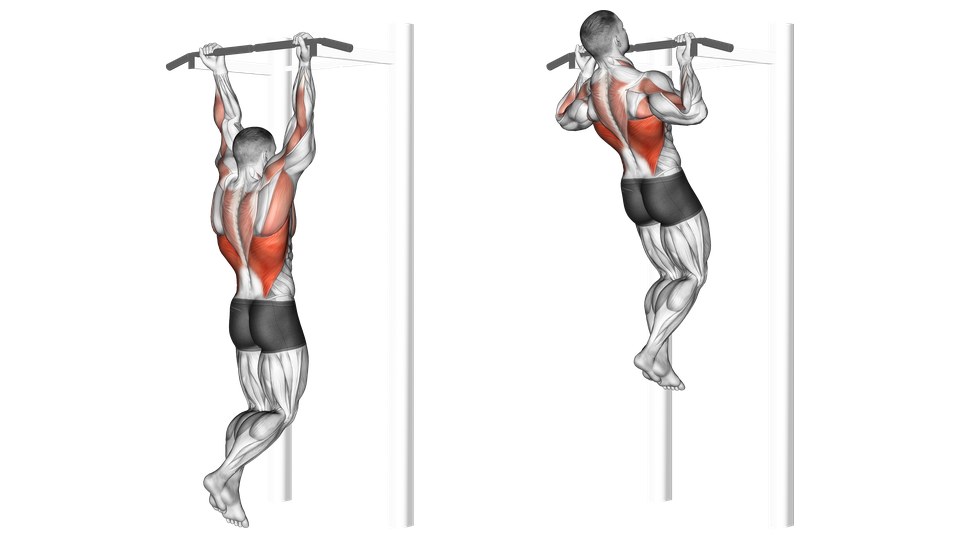
A chin-up is a bodyweight vertical pull from a straight-arm hang to the bar, using an underhand grip with your palms facing you. It trains the latissimus dorsi and other upper-back muscles together with the elbow flexors, including the biceps brachii. A pull-up uses an overhand grip; an assisted chin-up keeps the underhand movement but a band or machine offsets part of your bodyweight.
How do you perform a chin-up?
Set up
- Use a stable step if the bar is out of reach, then take the bar with your palms facing you and your hands about shoulder width apart.
- Step clear and hang with straight arms, your feet off the floor and your body still.
Execution
- Begin the pull by drawing your shoulder blades down, then bend your elbows toward your sides.
- Raise your body until your chin clears the bar without kicking or reaching with your neck.
- Lower under control until your arms are straight again, let your body settle, and begin the next rep.
Common mistakes
Kicking or swinging to get over the bar
Momentum changes the movement and makes one repetition hard to compare with the next. Stop the swing before beginning another strict rep.
Reaching the chin forward at the top
Moving only the head can make it look as though the body reached the bar. Keep the neck comfortable and finish by lifting the body instead.
Dropping out of the top position
A sudden drop removes control from the lowering phase and can restart the next repetition with a swing. Lower until the arms are straight and let the body settle.
Where it fits in a session
Early in an upper-body or pulling session, while the hands and elbow flexors are still fresh enough to hold the bar and keep each rep strict.
Use assistance when full bodyweight prevents a controlled repetition. Once bodyweight repetitions are repeatable, additional reps or a weighted variant can change the challenge without changing the underhand movement.
Muscles worked
- latissimus dorsi
- biceps brachii
- brachialis
- teres major
- brachioradialis
- trapezius (middle and lower fibres)
- rhomboids
The latissimus dorsi moves the upper arm and helps lift the body when the hands are fixed overhead. The biceps brachii, brachialis and brachioradialis bend the elbow, while teres major and the muscles around the shoulder blades assist the pull. The groups are not ranked within the primary and secondary lists: anatomy and the available chin-up research establish involvement, not a precise share of the work.
Variations
- Pull-up — Uses an overhand grip with the palms facing away instead of the chin-up's underhand grip.
- Neutral-grip chin-up — Uses parallel handles so the palms face each other throughout the repetition.
- Assisted chin-up — A band or assisted machine offsets part of your bodyweight; the standard chin-up does not.
- Weighted chin-up — Adds external load with a belt, vest or securely held weight.
- Negative chin-up — Begins at the top using a step or platform and trains only the controlled lowering phase.
- Ring chin-up — Uses gymnastic rings, allowing the hands to rotate instead of staying fixed on a bar.
Frequently asked questions
What muscles do chin-ups work?
Chin-ups train the latissimus dorsi and teres major as the upper arms move down toward the torso, the biceps brachii, brachialis and brachioradialis as the elbows bend, and the middle and lower trapezius and rhomboids as the shoulder blades move during the pull.
What is the difference between a chin-up and a pull-up?
Hand position. In a chin-up your palms face you; in a pull-up they face away. Both are bodyweight vertical pulls and train much of the same back and arm musculature. In a study of twenty-five adults, biceps activity was higher in the chin-up, while latissimus-dorsi activity did not differ significantly between the two grips.
Are chin-ups easier than pull-ups?
Not for everyone. The underhand grip lets the biceps contribute strongly, which can make chin-ups feel more manageable for some people, but grip comfort, bodyweight and practice all affect which version feels easier.
Does your chin have to go over the bar?
Use the chin clearing the bar as a consistent top position, but reach it by lifting your body rather than stretching your neck forward. Keeping the same top and bottom positions makes repetitions easier to compare.
What if I cannot do a bodyweight chin-up yet?
An assisted chin-up preserves the underhand pulling pattern while a band, machine or partner offsets some of your weight. A negative chin-up starts at the top and trains the lowering phase. Both are variants; the standard chin-up in this guide moves your full bodyweight without assistance.
Sources
- Jeno SH, Varacallo MA. Anatomy, Back, Latissimus Dorsi. StatPearls. https://www.ncbi.nlm.nih.gov/books/NBK448120/
- Syros A, Rizzo MG. Anatomy, Shoulder and Upper Limb, Teres Major Muscle. StatPearls. https://www.ncbi.nlm.nih.gov/books/NBK580487/
- Tiwana MS, Charlick M, Varacallo MA. Anatomy, Shoulder and Upper Limb, Biceps Muscle. StatPearls. https://www.ncbi.nlm.nih.gov/books/NBK519538/
- Card RK, Lowe JB, Launico MV. Anatomy, Shoulder and Upper Limb, Elbow Joint. StatPearls. https://www.ncbi.nlm.nih.gov/books/NBK532948/
- Youdas JW, et al. Surface electromyographic activation patterns and elbow joint motion during a pull-up, chin-up, or Perfect-Pullup rotational exercise. J Strength Cond Res. 2010. https://pubmed.ncbi.nlm.nih.gov/21068680/