
ATG split squat
Also called ATG split squats, deep split squat.
What is an ATG split squat?
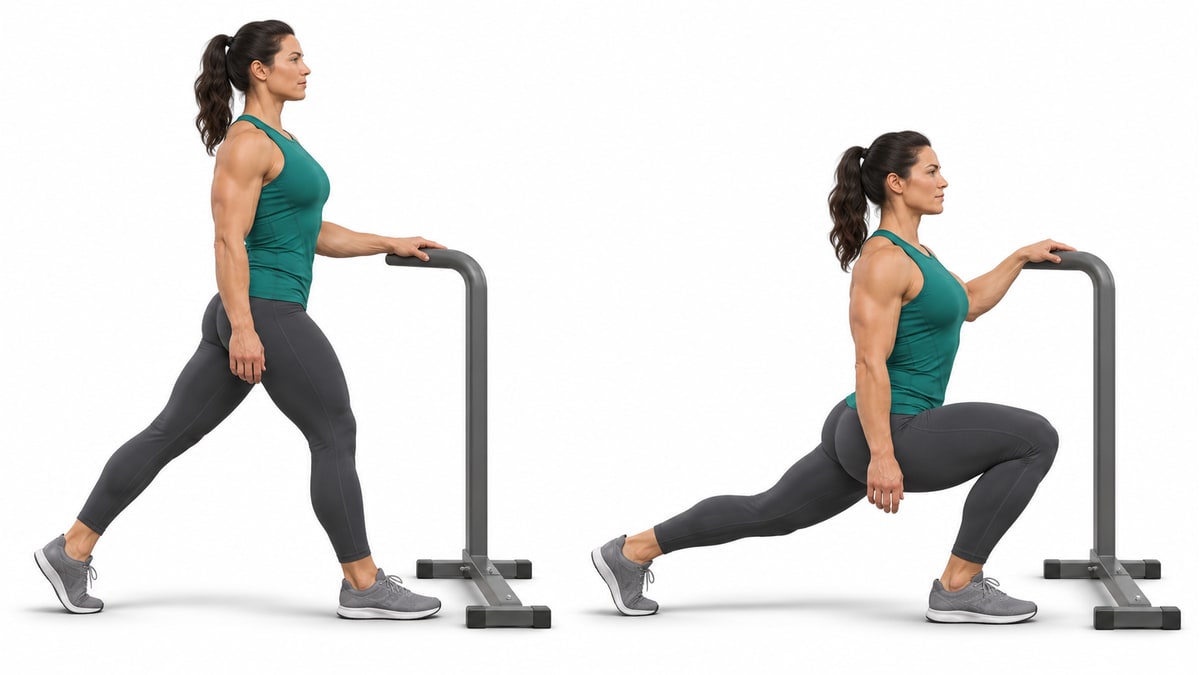
An ATG split squat is a deep split squat in which the front knee travels forward as you lower, while the rear leg reaches behind you and its foot stays on the floor. This guide starts without added weight. The quadriceps and gluteus maximus work as you rise. You can raise the whole front foot on a stable step to practise a more manageable version.
How to do an ATG split squat
Set up
- Stand beside a fixed support you can hold. Step one foot well behind you, keeping the feet about hip width apart from side to side and the rear heel raised.
- Keep the front foot flat and your chest lifted. Adjust the stance until you can start bending the front knee while the rear leg reaches back; use the support for balance or assistance.
Execution
- Lower slowly, letting the front knee follow your toes forward while your chest stays lifted. Keep the rear knee off the floor; the rear leg can bend slightly.
- Bring the front thigh toward the calf only as far as you can control without pain. Keep the front foot flat and stop before losing balance or posture; contact is optional.
- Press through the front foot to rise along the same path without stepping. Finish the repetitions on that side, then switch the feet.
Common mistakes
Forcing thigh-to-calf contact
Depth is a goal to approach, not a position to force. Shorten the descent or raise the whole front foot on a secure step if you cannot reverse smoothly.
Turning the set into a lunge
Keep the feet in their starting positions while the body moves. Reset your stance between sets rather than taking a new step on each repetition.
Reaching depth by losing foot contact or posture
For this flat-front-foot setup, stop before the heel lifts unexpectedly or your lower back arches to keep descending. Use hand assistance or front-foot elevation to find a position you can control.
Where it fits in a session
Use it as controlled split-squat practice or as part of your planned leg training. Begin without added weight and keep a fixed support within reach.
Record the front-foot height, hand assistance and depth so you can repeat the setup. Make one change at a time rather than lowering the step and adding weight together.
Muscles worked
Primary
Secondary
- None listed in this guide
Schematic surface view. Some muscles are partly visible or not shown.
The quadriceps straighten the front knee, while the gluteus maximus helps straighten the front hip as you rise.
Variations
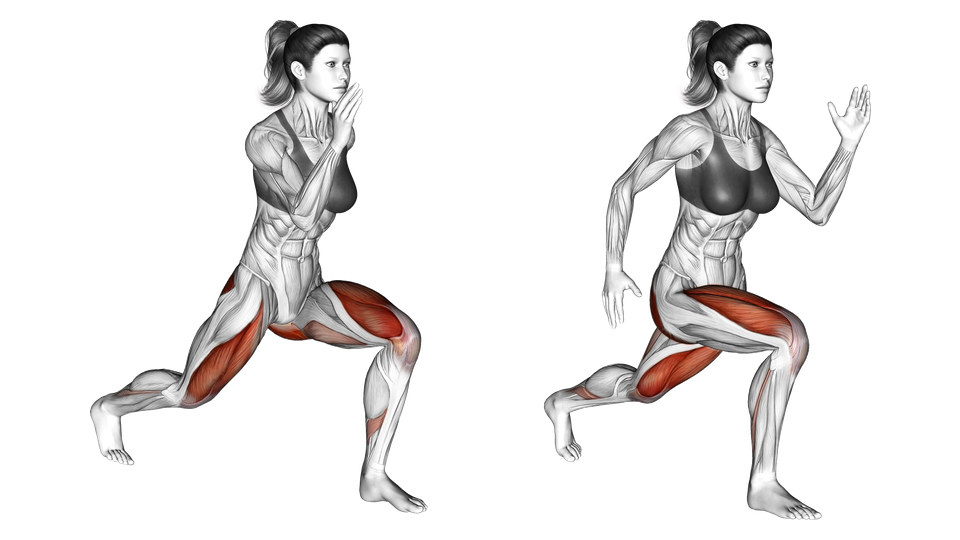
- Bodyweight split squatUses a comfortable stationary split stance with both knees bending, without aiming for the deep forward-knee position taught here.
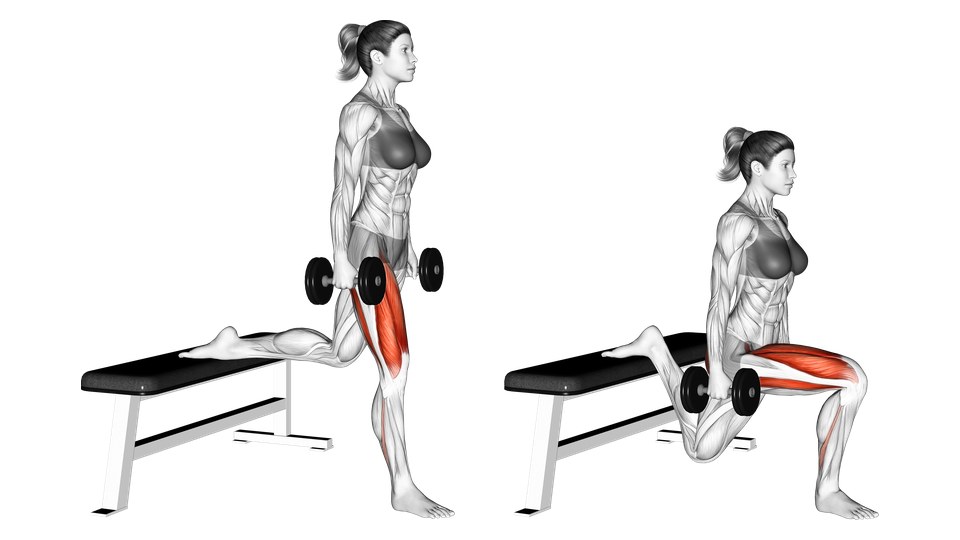
- Bulgarian split squatSupports the rear foot on a bench. This is different from keeping the rear foot on the floor or raising the front foot.
Frequently asked questions
How is an ATG split squat different from an ordinary split squat?
The ATG version deliberately uses a deep front-knee bend with the knee travelling forward and the rear leg reaching back. The feet still stay in place. An ordinary split squat does not require that deep position.
How do I use front-foot elevation to make it easier?
Put the whole front foot on a broad, stable exercise step that will not slide or tip. Keep the rear foot on the floor and hold a fixed support. Choose a height at which you can lower and return comfortably; lower the step gradually only when that setup is controlled. Raising just the heel is a different adjustment.
Does my front heel have to stay down?
These instructions use a flat front foot as a repeatable starting setup. Some versions allow a deliberate heel rise. You do not have to copy that option: use a shorter descent or raise the whole front foot if keeping it flat is difficult. Avoid changing foot contact unexpectedly during the rep.
What muscles does an ATG split squat work?
The main muscles covered here are the quadriceps and gluteus maximus. They help straighten the front knee and hip as you come back up. This does not mean every part of the quadriceps is trained equally.
Should I push through pain to get deeper?
No. Stop the repetition if it hurts. Try less depth, more hand assistance or a raised front foot, and stop the exercise if those changes do not make it comfortable.
Sources
- Bordoni B, Varacallo MA. Anatomy, Bony Pelvis and Lower Limb: Thigh Quadriceps Muscle. StatPearls; updated May 8, 2023. https://www.ncbi.nlm.nih.gov/sites/books/NBK513334/
- Elzanie A, Borger J. Anatomy, Bony Pelvis and Lower Limb, Gluteus Maximus Muscle. StatPearls; updated April 1, 2023. https://www.ncbi.nlm.nih.gov/sites/books/NBK538193/