
Band-assisted pull-up
Also called banded pull-up, resistance band pull-up.
What is a band-assisted pull-up?
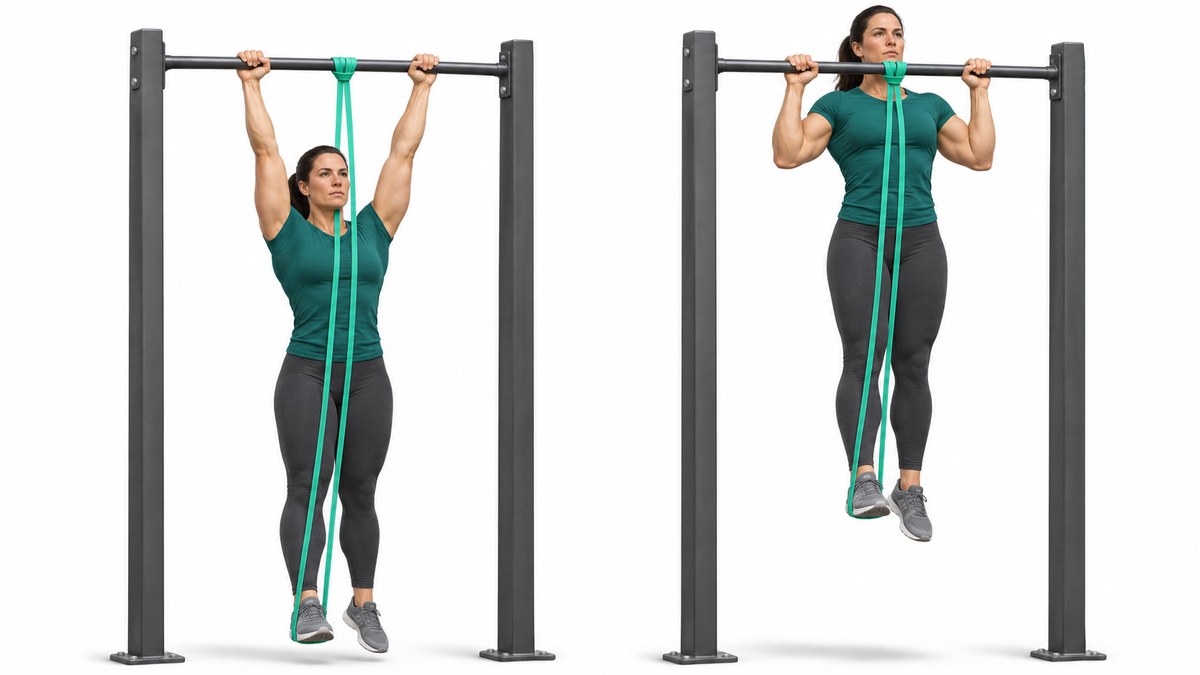
A band-assisted pull-up is an overhand pull-up with a resistance band taking part of your weight. This guide uses a long closed-loop band attached to the bar and supporting one foot. Pull toward the bar, then lower to a straight-arm hang with your legs still.
How do you perform a band-assisted pull-up?
Set up
- Use an undamaged long loop band intended for pull-up assistance and a secure bar. Put a stable step beside the hanging band, high enough to reach the bar and stand with the band slack.
- Pass the loop over the centre of the bar, thread one end through the other and pull it snug. Follow the band maker’s attachment and stretch limits. Stand on the step and place the arch of one shoe in the lower loop.
- Keep your other foot on the step. Grip the bar just outside shoulder width with palms facing away and thumbs wrapped around it. Check that the band sits securely under your shoe before loading it.
Execution
- Ease your free foot off the step into a straight-arm hang. Keep the supported leg long, the band under your shoe and the free leg quiet beside it.
- Pull upward, bringing your elbows down until your chin reaches bar height. Keep your head aligned with your torso rather than tipping it back to reach the bar.
- Lower smoothly until your arms are straight again. Repeat without kicking or swinging, keeping the supported leg in the same position. Finish while you can still return to the step under control.
- Put your free foot back on the step, then bring the other foot onto it while holding the bar. Once standing securely with the band slack, release the bar and hold the band as you take your foot out.
Common mistakes
Using the wrong band or attachment
Use a long closed-loop band intended for this setup, not a short mini band or clip-on tube. Check for damage and follow its maker’s directions before each set.
Kicking through the repetition
Keep the legs quiet so you can repeat the same pull. If you need a kick to reach bar height, return to the step and adjust the assistance before the next set.
Taking your foot out under tension
Stand securely on the step and let the band go slack first. Hold the loop as you remove your foot so it does not snap upward.
Where it fits in a session
Practise these while your grip and pulling control are fresh.
Choose enough assistance to make your planned repetitions controlled from the hang to bar height. Record the band, attachment and support position. Try less help only when you can keep that same movement and finish with a controlled return to the step.
Muscles worked
Primary
Secondary
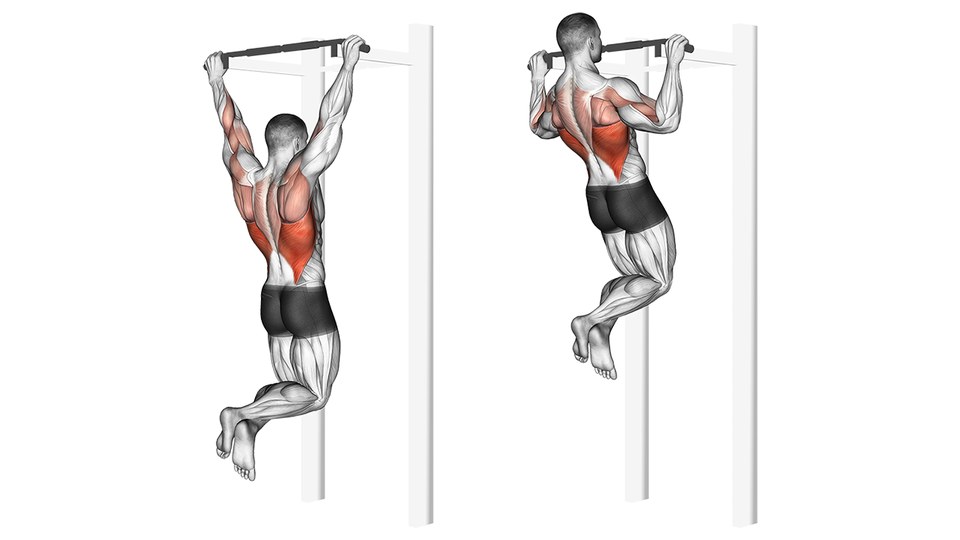
Schematic surface view. Some muscles are partly visible or not shown.
The lats act at the shoulders, while the biceps, brachialis and brachioradialis bend the elbows.
Variations
- Knee-in-loop assistance — Supports a bent knee instead of a foot. Follow the band maker’s setup directions; the illustration here shows one foot in the loop.
Frequently asked questions
What muscles do band-assisted pull-ups work?
They use the lats at the shoulders and the biceps, brachialis and brachioradialis to bend the elbows. The band supplies assistance; you still perform the pull.
Which band should I use?
Use a long closed-loop band made for pull-up assistance. Choose enough help to pull from straight arms to bar height without kicking, then lower smoothly. Keep the exact band and setup consistent when comparing sessions.
Can I put a knee in the loop instead?
Yes, if the band is intended for that setup and fitted according to its maker’s directions. Keep the bent-knee position consistent throughout the set. The steps and illustration on this page use one foot in the loop.
How do I get into and out of the band?
Use a stable step to fit the loop under your shoe before easing into the hang. Return both feet to the step and stand securely before removing the slack band. If you cannot reach the bar, control the band and return to the step alone, have someone help or choose another assisted setup.
Is this the same as a machine-assisted pull-up?
No. This loop band supports a foot, while a counterweight machine supports you on a moving pad. Use the instructions for the equipment you actually have.
Sources
- Elsevier Complete Anatomy. Latissimus Dorsi Muscle: Quick Facts and Actions & Testing. https://www.elsevier.com/resources/anatomy/muscular-system/muscles-of-back/latissimus-dorsi-muscle/20795
- J. Gordon Betts et al. Anatomy and Physiology 2e, 11.5: Muscles of the Pectoral Girdle and Upper Limbs. OpenStax, 2022. https://openstax.org/books/anatomy-and-physiology-2e/pages/11-5-muscles-of-the-pectoral-girdle-and-upper-limbs