
Band chest fly
Also called resistance band chest fly, standing resistance band chest fly, single-arm band chest fly.
What is a band chest fly?
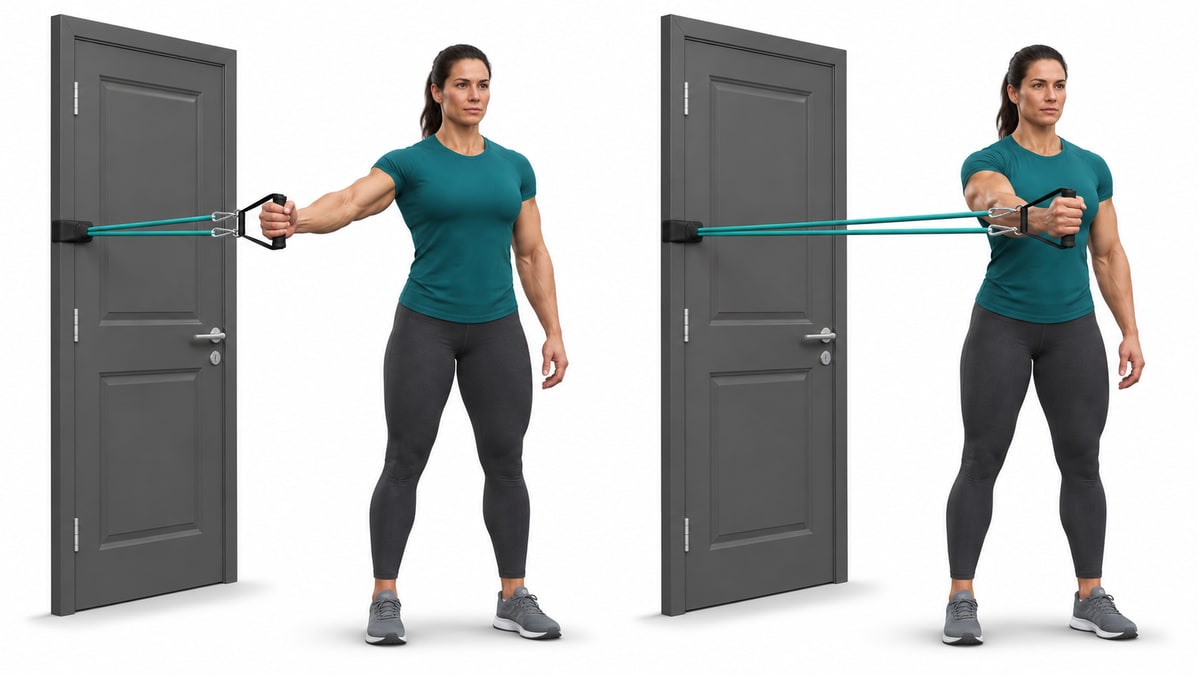
A band chest fly moves your upper arm across your chest against elastic resistance while you hold a small bend in the elbow. This guide teaches a standing, single-arm version with clip-ended tubing doubled through one chest-height door anchor and both ends attached to one handle. The pectoralis major in the chest is the main target, with the anterior deltoid assisting at the shoulder.
How do you perform a band chest fly?
Set up
- Inspect the tubing, clips, handle and anchor for damage. Fit the door anchor at chest height on the hinge side of a suitable sturdy door, then close and lock the door.
- Thread the tubing through the anchor's padded loop and clip both ends to the metal ring of one handle, following your kit's instructions. Hold that handle in one hand.
- Stand with your working side nearest the door, your feet about shoulder-width apart and your torso upright.
Execution
- Hold your working arm out toward the anchor at chest height, palm forward and elbow slightly bent, then adjust your distance to take up the slack.
- Circle the arm forward until your hand is in front of your chest, keeping the same small elbow bend and your torso facing ahead.
- Guide the arm back toward the anchor slowly, stopping out to your side at chest height instead of letting it drift behind your torso.
- After the set, move toward the anchor until the tubing is slack before releasing the handle, then reposition to train the other side.
Common mistakes
Bending and straightening the elbow during the sweep
That changes the fly into a pressing movement. Use a lighter tube if you cannot keep the arm's curve steady as the hand comes forward.
Reaching back for a deeper opening
Do not use the band's pull to force your arm behind you. Keep the opening within the range you can control with your torso still.
Releasing the handle while the tubing is stretched
Keep hold of it and move closer to the anchor first. Finish unloading the tubing before you let go or change the attachment.
Where it fits in a session
Use it after your main presses when you want additional chest work.
Choose tubing that lets you finish each repetition without twisting or changing the elbow bend. Keep the same anchor height and starting distance when comparing sets.
Muscles worked
Primary
Secondary
Schematic surface view. Some muscles are partly visible or not shown.
The chest's pectoralis major brings the upper arm across the front of the body, with help from the anterior deltoid at the front of the shoulder. This action is called horizontal adduction.
Variations
- Cable crossoverUses a cable machine and two handles. The linked guide teaches a high-to-low path rather than this chest-height single-arm setup.
Frequently asked questions
What muscles does the band chest fly work?
The pectoralis major is the main chest muscle trained, and the anterior deltoid at the front of the shoulder assists. Both help move the upper arm across the front of the body.
How is a band chest fly different from a band chest press?
In a fly, your upper arm sweeps in an arc while the elbow stays slightly bent. A press starts with more elbow bend and straightens the elbow as you push. Choose a lighter band if you need to press the handle to finish a fly.
Where should I anchor the band?
For this version, use one padded door anchor at chest height with your working side nearest the door. Use a door and anchor that your kit's manufacturer permits, keep the door closed and locked, and check the attachment before loading it. A high or low anchor changes the arm path.
How much resistance should I use?
Start light enough to circle the arm forward and guide it back without leaning, twisting or pressing. If the tubing pulls you out of position, unload it and select a lighter tube. Stay within your manufacturer's stretch limit rather than stepping farther away to force more load.
Sources
- Hendrickson T. Massage for Orthopedic Conditions. Chapter 6: The shoulder, Table 6-2, p. 255. Lippincott Williams & Wilkins. https://downloads.lww.com/wolterskluwer_vitalstream_com/sample-content/9780781795746_Hendrickson/samples/Chapter06.pdf
- Solari F, Burns B. Anatomy, Thorax, Pectoralis Major Major. StatPearls. Updated July 24, 2023. https://www.ncbi.nlm.nih.gov/sites/books/NBK525991/