Cable crossover
Also called cable fly, standing cable fly, cable chest fly.
What is a cable crossover?
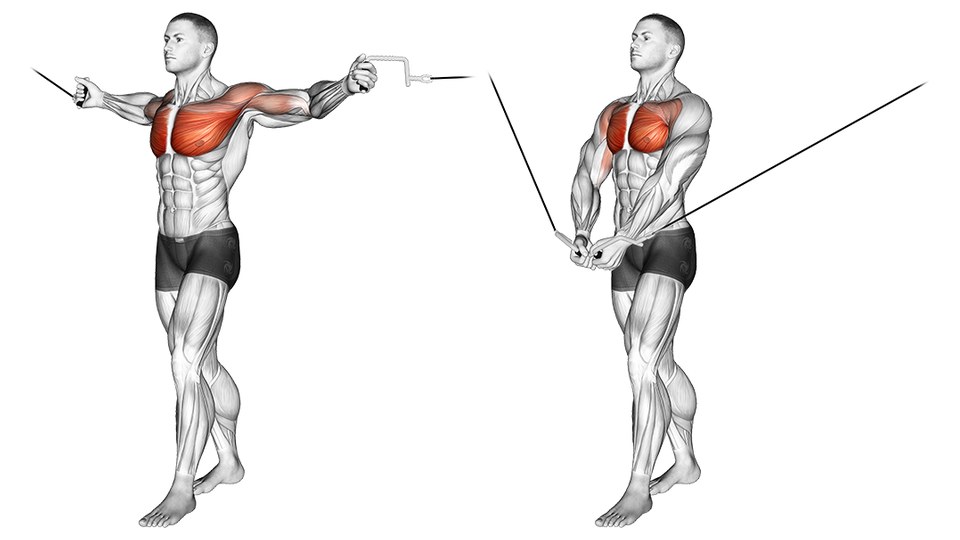
A cable crossover is a standing chest fly done between two pulleys. You take a handle in each hand, step forward into the middle of the machine and bring your hands together in front of you along a wide arc, holding a fixed slightly-bent elbow angle the whole way. It trains the pectoralis major, with the anterior deltoid and coracobrachialis assisting the arm across the body and the serratus anterior and pectoralis minor helping to control the shoulder blade while that happens. Because the elbow angle never changes, the chest does work that a press would share with the triceps through elbow extension.
How do you perform a cable crossover?
Set up
- Set both pulleys high, attach single handles and choose a weight you can control.
- Take a handle in each hand and step forward into a split stance, leaning slightly from the hips with your chest up.
- Open your arms until you feel a chest stretch, then keep a slight bend in your elbows.
Execution
- Sweep your hands down and forward in a wide arc while keeping your torso still and your elbows slightly bent.
- Bring the handles together, or cross them slightly, in front of your hips.
- Return along the same arc under control, stopping before your shoulders roll forward.
Common mistakes
Letting the elbows straighten as the hands come together
Once the elbows extend, the triceps start sharing the work and the arc narrows, turning the movement into a standing press rather than a fly.
Standing too far back, and too upright, in the machine
With no split stance and no forward lean, the cables pull you backwards and the set turns into an exercise in staying on your feet. Staggering the stance and leaning in puts your bodyweight against the line of pull, which is what lets you load the chest instead of bracing against it.
Chasing extra range by letting the shoulders roll forward at the finish
Crossing the hands is fine while the shoulder blades stay controlled. Reaching farther by rounding the shoulders changes your body position rather than extending the arm's path, and makes the loaded finish harder to control.
Loading it like a press
One joint is moving a long lever here, so a weight that feels ordinary on a press will drag your elbows straight or pull your torso into the rep. A crossover set is judged by whether the arc stayed wide, not by what was on the stack.
Where it fits in a session
After the pressing work on a chest or push day.
Single-joint work on a long lever, so it does not need to be heavy to be useful. Moderate reps taken close to failure with the elbow angle intact; when the angle starts to open, the set is over.
Muscles worked
- pectoralis major
- anterior deltoid
- coracobrachialis
- serratus anterior
- pectoralis minor
The anatomy supports the ranking here, so it is ranked. Pectoralis major is the mover: its sternocostal fibres perform horizontal and vertical adduction of the arm, which is the whole exercise. Anterior deltoid and coracobrachialis are secondary because that is how the references describe them — both contribute to adduction of the shoulder on the horizontal plane, the coracobrachialis as a weak adductor. Serratus anterior and pectoralis minor do not move the handles directly; they help control the shoulder blade while the arms travel, which is why they are listed last rather than left out. Where the pulleys sit shifts the work between the two heads of pectoralis major — clavicular fibres flex the humerus, sternocostal fibres adduct it — but that follows from what each head does, not from anyone having measured the setups against each other.
What lifters actually do
Cable crossovers usually appear alongside push-day exercises in RepCount. About three in ten regular RepCount users have logged one, but they appear in only around 3% of workouts — widely tried, lightly used. All five of the movements likeliest to share a session with a crossover are pushing work: bench press turns up in over four in ten of those workouts, then incline dumbbell press, triceps pushdowns, dumbbell lateral raises and incline bench press. Nothing pulling, nothing for legs. Those sessions run to about seven exercises and carry between three and four sets of crossovers.
Most often trained alongside
Share of cable crossover sessions that also include each exercise.
- Bench press42.5%
- Incline dumbbell press36.7%
- Pushdowns29%
- Dumbbell lateral raises25.3%
- Incline bench press20.5%
Figures come from workouts tracked in RepCount.
Variations
- Low-to-high cable crossover — Pulleys at the bottom, hands finishing in front of the chest instead of the hips.
- Chest-height cable fly — Pulleys level with the shoulders, so the arms travel straight across rather than down.
- Single-arm cable crossover — One handle at a time, which frees you to brace against the frame.
- Kneeling cable crossover — Removes the stance, so the cables cannot pull you off balance.
- Lying cable fly — Flat or incline bench set between the two stacks, with the back supported.
- Bent-over cable crossover — Deeper hinge at the hips, hands meeting below the chest.
Frequently asked questions
What muscles does the cable crossover work?
Mainly the pectoralis major. Its sternocostal fibres are the ones that perform horizontal adduction of the arm — bringing the arm across the front of the body — and that is the entire movement. The anterior deltoid and the coracobrachialis assist: anatomy references describe both as contributing to adduction of the shoulder on the horizontal plane, the coracobrachialis as a weak adductor. The serratus anterior and the pectoralis minor are working too, but as scapular muscles that help control the shoulder blade while the arms travel.
Should the pulleys be set high, low or at chest height?
This is a preference rather than a technique point, so take the illustration on this page as one option and not as the instruction. High pulleys with the hands finishing in front of the hips is the common setup, and low-to-high and chest-height versions are both standard. There is an anatomical reason to expect the emphasis to move between them — the clavicular fibres of the pectoralis major flex the humerus while the sternocostal fibres adduct it — but that is a reading of what each part of the muscle does, not a measured comparison of the setups. Use the height your shoulder is comfortable in, or rotate them.
Is a cable crossover the same thing as a cable fly?
In practice the two names often describe the same movement. "Crossover" commonly refers to a standing version where the hands meet or pass in front of the body. "Cable fly" is also used for other pulley heights and for versions done lying on a bench between the two stacks. Both keep a slight, fixed bend in the elbows while the arms move through the fly.
Can cable crossovers replace the bench press?
They both train the chest, but not in the same way. A crossover keeps the elbows fixed, so the triceps do not contribute through elbow extension; the anterior deltoid still assists at the shoulder. The load is also limited by the long arm position. Lifters often use the two together: a bench press is logged in more than four in ten of the workouts that contain a crossover.
Do I have to cross my hands at the bottom?
No. Crossing lets the hands travel a little further, and on machines whose pulleys are set wide they will not comfortably pass anyway. Either is fine — it is not the part of the rep that decides whether the set did its job.
Are cable crossovers worth doing?
About three in ten regular RepCount users have logged one at some point, and they show up in roughly 3% of workouts. That is the profile of an accessory: widely tried, lightly used. The five movements likeliest to share the session are all pushing exercises: bench press, incline dumbbell press, triceps pushdowns, dumbbell lateral raises and incline bench press.
How many sets should I do?
In RepCount, a session containing crossovers usually holds between three and four sets of them, inside a workout of about seven exercises. That describes what lifters log rather than prescribing a number. For single-joint accessory work the useful marker is whether the elbow angle held for every rep, not what was on the stack.
Sources
- Baig MA, Bordoni B. Anatomy, Shoulder and Upper Limb, Pectoral Muscles. StatPearls. https://www.ncbi.nlm.nih.gov/books/NBK545241/
- Wu JG, Bordoni B. Anatomy, Shoulder and Upper Limb, Scapulohumeral Muscles. StatPearls. https://www.ncbi.nlm.nih.gov/books/NBK546633/
- Alshammari SM, Bordoni B. Anatomy, Shoulder and Upper Limb, Arm Muscles. StatPearls. https://www.ncbi.nlm.nih.gov/books/NBK554420/
- Elzanie A, Varacallo MA. Anatomy, Shoulder and Upper Limb, Deltoid Muscle. StatPearls. https://www.ncbi.nlm.nih.gov/books/NBK537056/