
Band external rotation
Also called resistance band external rotation, band shoulder external rotation.
What is band external rotation?
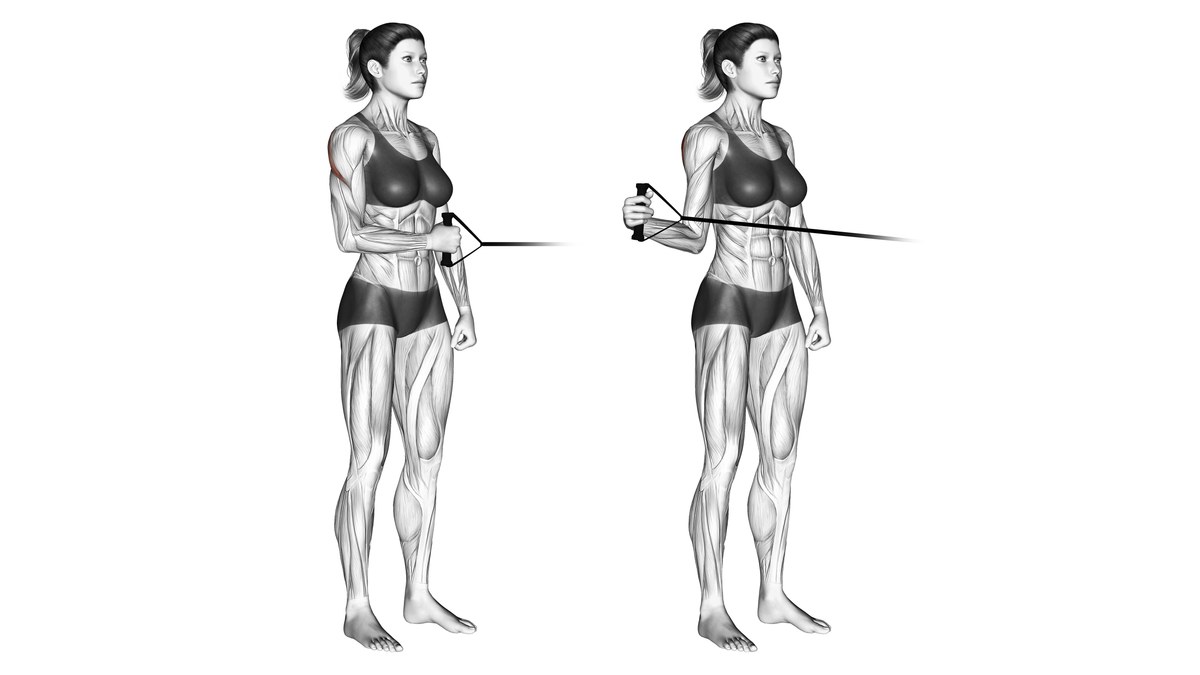
Band external rotation is a shoulder exercise in which you turn your upper arm outward against an anchored resistance band. Your elbow stays bent beside your torso while your hand travels away from the anchor. It trains the infraspinatus and teres minor, two of the rotator cuff muscles.
How to do band external rotation
Set up
- Check the band for damage and replace it if it has cuts or tears. Secure it to a sturdy anchor at elbow height using the band's attachment instructions, then test that it holds.
- Stand sideways to the anchor with your feet comfortably apart. Take the band or its handle in the hand farther from the anchor.
- Bend that elbow to a right angle beside your ribs, with your hand across your waist and your thumb up. Keep your wrist straight and move far enough from the anchor to take up the slack.
Execution
- Turn your hand outward, away from the anchor, while keeping the elbow bent beside your ribs and your torso still.
- Finish the outward movement before you need to turn your chest, pull the elbow back or lift it away from your side.
- Guide your hand back across your waist without letting the band recoil. After the set, keep hold and step toward the anchor until the band is slack before letting go or changing sides.
Common mistakes
Turning the whole body to move the band farther
Chest rotation adds distance without adding the same amount of shoulder rotation. Use a lighter band or stand closer to the anchor if you cannot finish with your torso still.
Lifting the elbow to shoulder height
That changes this into an elevated-arm rotation. Keep the elbow beside your ribs for the version described here.
Where it fits in a session
Begin with a light band and choose a resistance that lets you repeat the same path without moving your torso. Increase resistance only while you can keep that control; follow the band's stretch limit.
Muscles worked
Primary
Secondary
- None listed in this guide
Schematic surface view. Some muscles are partly visible or not shown.
These two muscles at the back of the shoulder turn the upper arm outward. They are two of the four rotator cuff muscles, which have different actions.
Variations
- Cable external rotationUses an elbow-height cable handle in place of an anchored elastic band.
Frequently asked questions
How far should I rotate my hand?
Use the range you can reach with your elbow beside your body and your chest facing forward. Stop before you have to move either to travel farther. The hand does not need to reach a fixed angle.
Which band should I use?
Start light enough to turn outward and return slowly without moving your elbow or torso. Follow your band's resistance and stretch guidance rather than choosing a color as a universal starting load.
Is this the same as a 90/90 external rotation?
No. In a 90/90 rotation, the upper arm is raised around shoulder height and the elbow is bent. This guide keeps the upper arm down beside the torso. Set up and log the two versions separately.
Sources
- Betts JG, Young KA, Wise JA, et al. Anatomy and Physiology 2e. OpenStax, 2022. Section 11.5: Muscles of the pectoral girdle and upper limbs. https://openstax.org/books/anatomy-and-physiology-2e/pages/11-5-muscles-of-the-pectoral-girdle-and-upper-limbs