
Cable external rotation
Also called cable shoulder external rotation.
What is Cable external rotation?
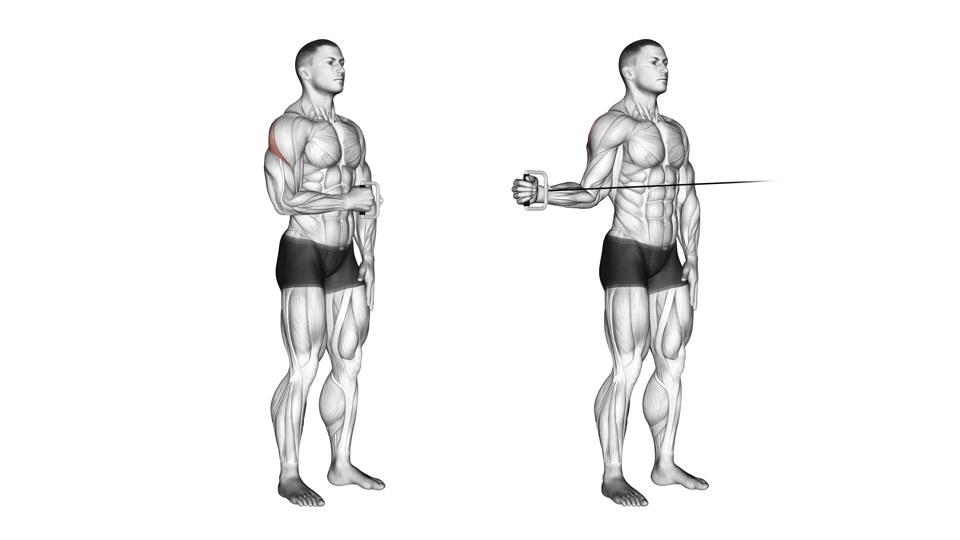
Cable external rotation trains the shoulder external rotators with one elbow held beside the body. The forearm turns outward against a cable while the upper arm stays still.
How to do Cable external rotation
Set up
- Set a single handle around elbow height and stand side-on, with the working arm away from the pulley.
- Hold the handle across your belly, bend the elbow to a right angle and keep it beside your ribs.
Execution
- Turn your forearm outward without moving the elbow away from your side.
- Stop where you can keep your chest facing forward and your wrist straight.
- Bring the handle back across your body slowly, then complete the other side.
Common mistakes
Bending and straightening the elbow
A changing elbow angle turns part of the repetition into a curl rather than shoulder rotation.
Leaning away to lift more weight
Leaning adds body movement and makes repetitions harder to compare.
Where it fits in a session
Usually after compound shoulder pressing, alongside other shoulder isolation work.
Treat this as focused shoulder work. Start with a small stack setting and add weight only while the upper arm stays still.
Muscles worked
Primary
Secondary
- None listed in this guide
Schematic surface view. Some muscles are partly visible or not shown.
Variations
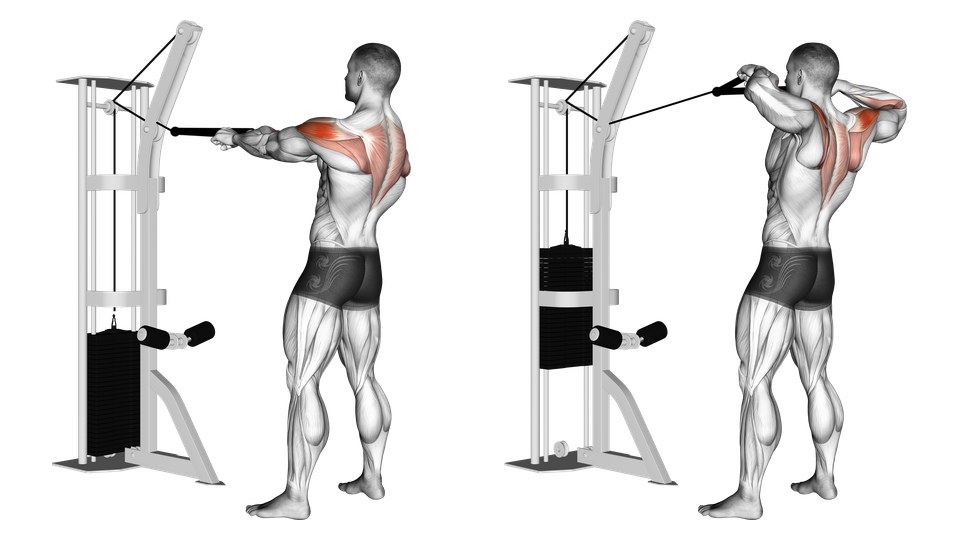
- Face pullsFace pulls move the upper arms as well as rotating the shoulders; they are a different pulling exercise.
Frequently asked questions
How much weight should I use?
Choose the lightest practical setting that lets you repeat the movement without turning your torso. Cable stacks differ, so there is no fixed starting weight.
How is this different from a face pull?
Here the upper arm stays beside your body while the forearm turns outward. A face pull moves the upper arms out and back as the rope approaches the face.
Sources
- Betts JG et al. Anatomy and Physiology 2e, 11.5 Muscles of the pectoral girdle and upper limbs. OpenStax, 2022. https://openstax.org/books/anatomy-and-physiology-2e/pages/11-5-muscles-of-the-pectoral-girdle-and-upper-limbs