
Band face pull
Also called banded face pull, resistance band face pull.
What is a band face pull?
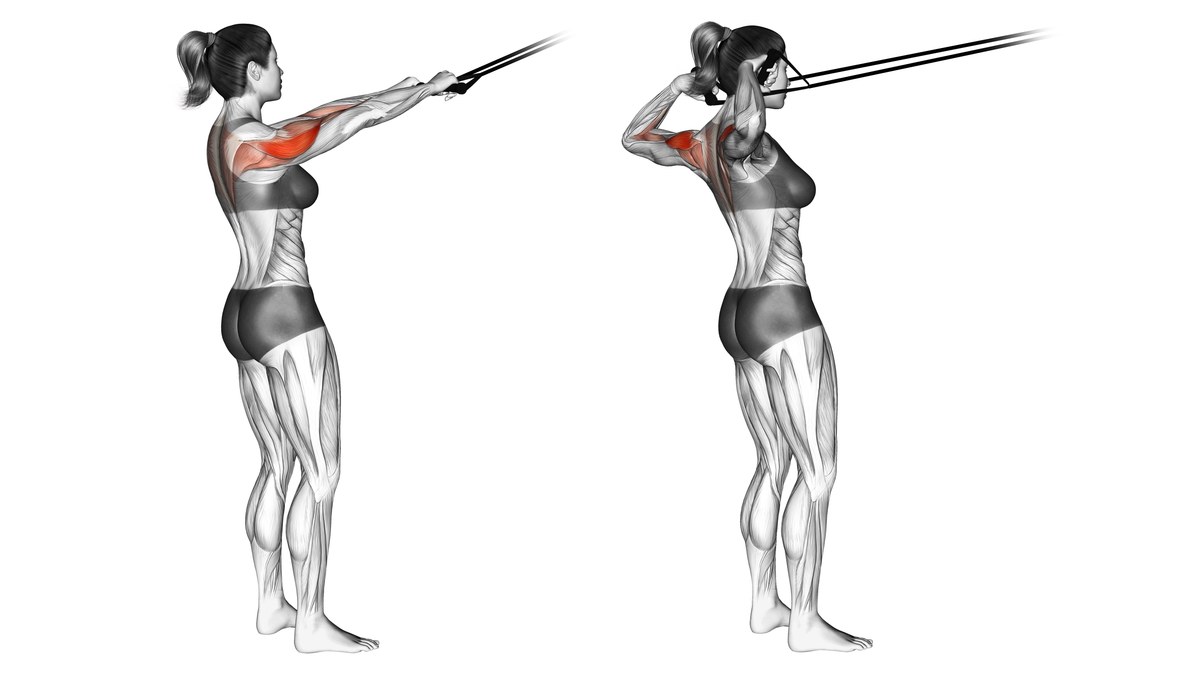
A band face pull is a standing pull toward the upper face using an anchored resistance band. Your elbows move outward as your hands separate beside your head. It trains the rear deltoids and the shoulder's outward rotators, with help from the muscles that bring the shoulder blades together.
How do you perform a band face pull?
Set up
- Check the band and attachment for damage. Secure a long band near eye height to a fixed support, using the anchor and method its maker permits; avoid sharp or rough contact surfaces.
- Face the anchor and hold one side of the band in each hand, palms down. Move back until your arms reach forward with light tension in the band.
- Plant your feet firmly with your knees soft. Stand upright and brace your midsection so the band does not pull you forward.
Execution
- Bend your elbows and pull toward your forehead, moving your elbows outward at about shoulder height. Keep your head still rather than reaching your face toward the band.
- Let your hands move apart beside your temples as your forearms turn upward. Finish with the shoulder blades drawn together and your torso upright, without forcing the hands behind your head.
- Reach forward slowly until your elbows are nearly straight again. Keep hold of the band and repeat without letting it snap you toward the anchor.
- After the last repetition, walk toward the anchor to take the stretch out of the band before releasing your grip.
Common mistakes
Moving farther back than you can control
A band that stops your hands short of the face is too demanding for this version. Move closer or use a lighter band within its maker's stretch limit.
Finishing at the chest
This becomes a lower pulling path. Keep the pull directed toward the upper face and make room for the hands on either side of the head.
Rocking the body between repetitions
Changing your body position changes the distance from the anchor. Keep that distance steady instead of using a backward lean to finish the pull.
Where it fits in a session
Use it as shoulder accessory work, for example after your main presses and rows.
Choose a band that lets you complete the separated-hands finish on every repetition. Keep the band and your starting distance consistent when comparing sets.
Muscles worked
Primary
Secondary
Schematic surface view. Some muscles are partly visible or not shown.
The rear shoulders move the upper arms back while the infraspinatus and teres minor rotate them outward. The middle trapezius and rhomboids help draw the shoulder blades together. Infraspinatus and teres minor are the rotator-cuff muscles named here for their outward-rotation action.
Variations
- Staggered-stance band face pull — Place one foot a little behind the other if that gives you a steadier standing base. The arm movement stays the same.
Frequently asked questions
What muscles does a band face pull work?
It works the rear deltoids and the outward rotators of the shoulder, particularly the infraspinatus and teres minor. The middle trapezius and rhomboids assist as the shoulder blades come together.
How high should I anchor the band?
Start around eye height for the forehead-directed version shown here. Use a stable support and an attachment intended for your band. An anchor far above you creates a different line of pull; do not compensate for it by leaning backward.
Can I use a door anchor for face pulls?
Yes, if the band and door-anchor maker allow that setup. Follow their instructions for the door, anchor position and attachment, close and secure the door, and check the connection before loading it. Do not copy a bare-band rack wrap onto tubing that requires a separate anchor.
Is a band face pull the same as a band pull-apart?
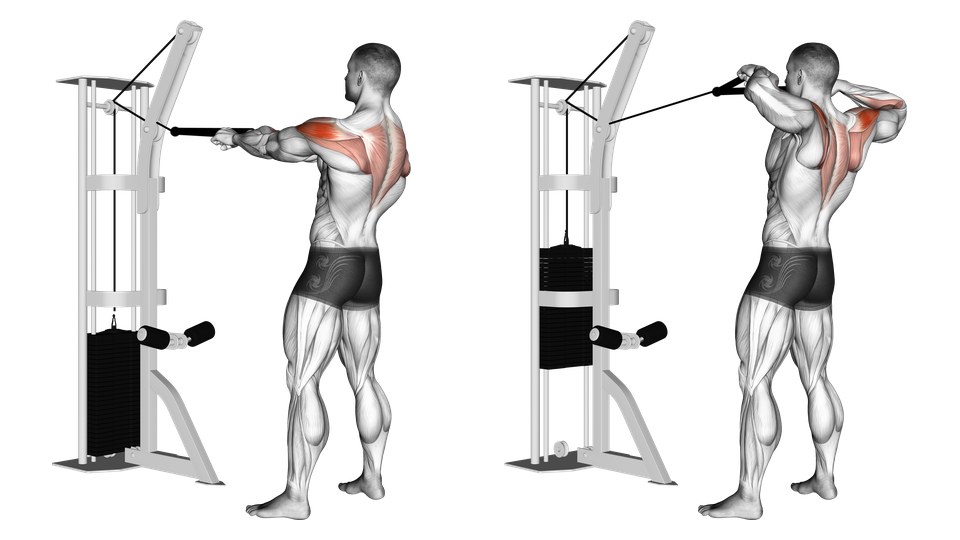
No. A face pull uses an anchor in front of you and bends the elbows as the hands come toward the head. In a pull-apart, you stretch a band between your hands without a separate anchor and keep the elbows much straighter.
How do I make band face pulls harder?
Use a more resistant band or move a little farther from the anchor, staying within the band's allowed stretch. The finish should still be reachable without rocking or shortening the repetition. A band colour or printed resistance is not a cable-stack weight.
Sources
- McCausland C, Sawyer E, Eovaldi BJ, Varacallo MA. Anatomy, Shoulder and Upper Limb, Shoulder Muscles. StatPearls, updated 2023. https://www.ncbi.nlm.nih.gov/books/NBK534836/
- Ourieff J, Scheckel B, Agarwal A. Anatomy, Back, Trapezius. StatPearls, updated 2023. https://www.ncbi.nlm.nih.gov/books/NBK518994/
- Betts JG, et al. Anatomy and Physiology 2e, section 11.5: Muscles of the Pectoral Girdle and Upper Limbs. OpenStax. https://openstax.org/books/anatomy-and-physiology-2e/pages/11-5-muscles-of-the-pectoral-girdle-and-upper-limbs