
Face pulls
Also called face pull, rope face pull, cable face pull.
What are face pulls?
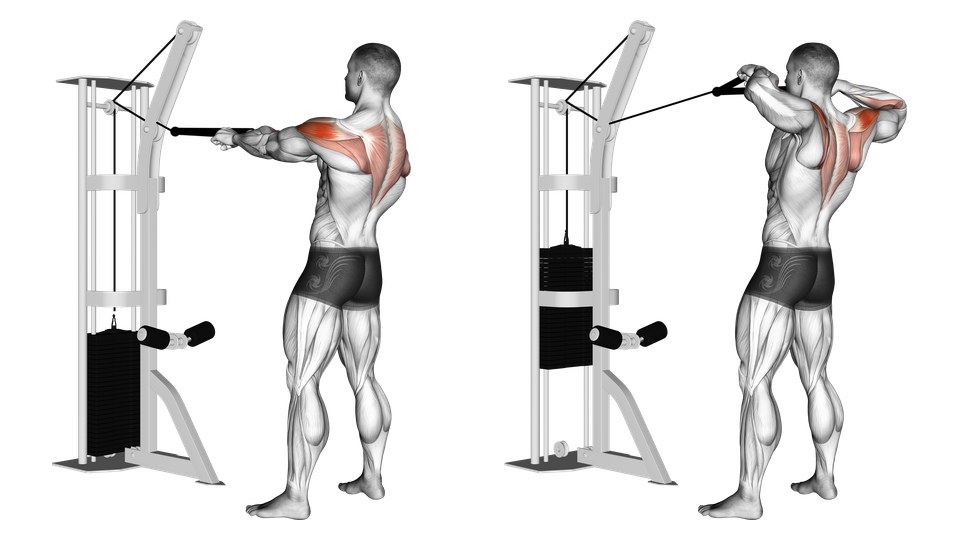
Face pulls are a cable exercise performed by pulling a rope toward the face with the elbows high, then rotating the hands apart. They train the rear deltoids and rotator cuff, with help from the lateral deltoids and muscles around the shoulder blades.
How do you perform face pulls?
Set up
- Attach a rope to a high pulley, hold one end in each hand and step back until the cable is taut.
- Stand steadily with your arms reaching forward, shoulders relaxed and elbows pointing outward.
Execution
- Pull the rope toward your forehead while driving your elbows out and back.
- Separate the rope ends beside your head so your forearms finish roughly upright.
- Return slowly until your arms reach forward again without letting the stack pull you off balance.
Common mistakes
Turning it into a low row
Pulling toward the ribs drops the elbows and removes the external-rotation finish that distinguishes a face pull.
Leaning back to move the load
Body movement shortens the working range and makes the cable weight difficult to compare between sets.
Letting the rope ends meet at the finish
The hands need room to separate so the shoulders can rotate as the rope reaches the face.
Where it fits in a session
Usually after heavier presses and rows, or with other shoulder accessory work.
Use a load that allows the rope to reach the face without torso movement or a shortened finish.
Muscles worked
Primary
Secondary
Schematic surface view. Some muscles are partly visible or not shown.
The rope face pull combines a rearward upper-arm movement with external rotation. The compact list reflects the muscles shared by the exact check-only references; it does not turn every stabiliser into a target.
Variations
- Band face pull — Anchors a resistance band above eye level instead of using a cable stack.
- Seated face pull — Uses a seated base so leaning backward is harder.
Frequently asked questions
What muscles do face pulls work?
Face pulls train the rear deltoids and rotator cuff, while the lateral deltoids, trapezius and rhomboids assist the pull and shoulder-blade movement.
Where should the rope go on a face pull?
Pull toward the forehead or upper face, then separate the rope ends beside the head. Pulling to the chest changes the movement into more of a row.
Should face pulls feel like a row?
They share a pulling action, but a face pull finishes higher and adds shoulder external rotation. Keep the elbows high rather than pulling the rope toward the waist.
Can you do face pulls with a resistance band?
Yes. Anchor the band securely above eye level and use the same high-elbow pull and separated-hands finish.
Sources
- Elzanie A, Varacallo MA. Anatomy, Shoulder and Upper Limb, Deltoid Muscle. StatPearls. https://www.ncbi.nlm.nih.gov/books/NBK537056/
- La Rose J, Madrazo-Ibarra A, Varacallo MA. Anatomy, Rotator Cuff. StatPearls. https://www.ncbi.nlm.nih.gov/books/NBK441844/
- Ourieff J, Scheckel B, Agarwal A. Anatomy, Back, Trapezius. StatPearls. https://www.ncbi.nlm.nih.gov/books/NBK518994/