
Band lat pulldown
What is a band lat pulldown?
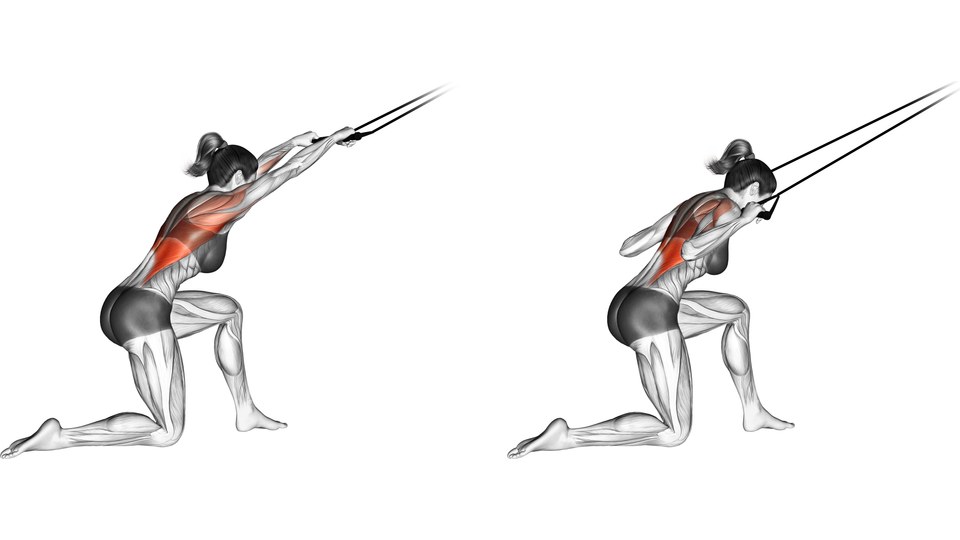
A band lat pulldown pulls handles down from a high anchor by bending the elbows and bringing the upper arms toward the torso. This guide uses a half-kneeling position facing the anchor, with the torso angled slightly forward.
How do you perform a band lat pulldown?
Set up
- Check the band and fasten it to a suitable high anchor. Test the attachment gently, then place one knee on a pad with the other foot in front.
- Face the anchor and hold one handle in each hand. Reach your arms upward toward it with a little band tension, leaning your whole torso slightly forward while keeping your back comfortable.
Execution
- Draw your elbows down toward your sides and bring the handles toward the front of your upper chest.
- Stop where you can finish the pull without bending your neck forward or rocking away from the anchor.
- Reach your arms back toward the high attachment under control, maintaining the same torso angle. Repeat, then release the band tension before standing.
Common mistakes
Rocking backward to finish
Move closer or choose a lighter band so you can complete the pull without using a changing torso angle.
Pulling behind the neck
Keep the handles in front of you and give your head room between the bands.
Using a low attachment
Set the band overhead so the starting reach and the pull match this guide.
Where it fits in a session
Include this where you plan the corresponding upper-body movement in your session.
Choose a band that lets you complete the planned repetitions with the described setup. Record the band and setup distance so you can reproduce the session.
Muscles worked
Primary
Secondary
Schematic surface view. Some muscles are partly visible or not shown.
Variations
Frequently asked questions
Should I kneel on both knees?
This guide shows one knee down and the other foot planted. Set up with enough padding and space to keep that position steady.
Is this a straight-arm pulldown?
No. Your elbows bend as you pull the handles down. A straight-arm pulldown keeps the elbows nearly straight throughout.
Sources
- J. Gordon Betts et al. Anatomy and Physiology 2e: Muscles of the Pectoral Girdle and Upper Limbs. 2022. https://openstax.org/books/anatomy-and-physiology-2e/pages/11-5-muscles-of-the-pectoral-girdle-and-upper-limbs