
Band overhead press
What is a band overhead press?
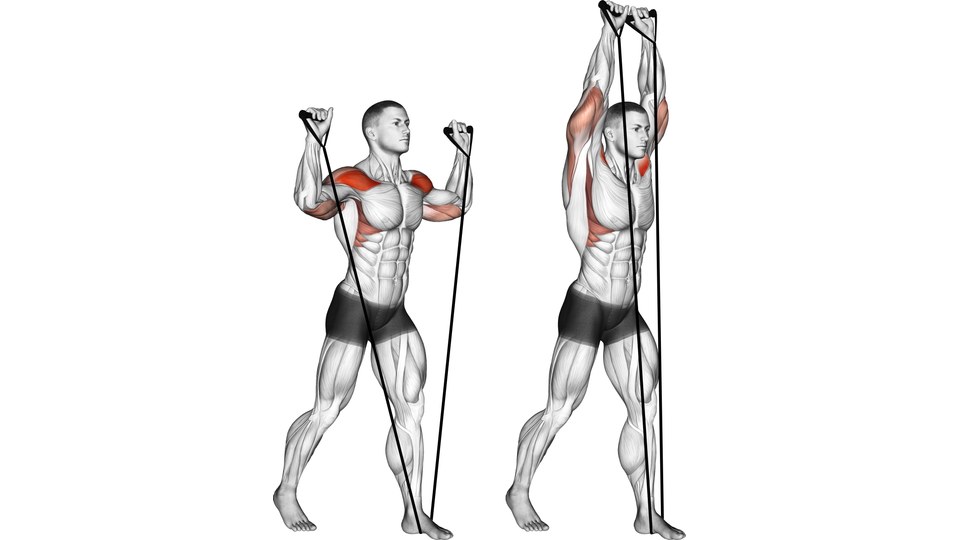
A band overhead press moves two handles from shoulder level to above your head while the band is held under your foot. This guide uses a standing split stance and a strict press, without a knee dip or leg drive.
How do you perform a band overhead press?
Set up
- Inspect the band and handles, then pin the middle of the band securely beneath your front foot with the other foot behind you. Wear suitable footwear and follow the band instructions for standing on it.
- Bring the handles beside your shoulders with your palms facing forward. Brace your torso and choose a band that allows the full press without leaning back.
Execution
- Press both handles upward, keeping your feet planted and your knees still. Let your shoulder blades move naturally as your arms rise.
- Finish with your arms extended overhead and your torso stacked over your hips. Do not force your head forward or arch your lower back to finish.
- Lower the handles back to shoulder level under control. Keep the band under your foot until the set is finished and its tension is released.
Common mistakes
Adding a knee dip
Reset your stance and use less resistance so the repetition remains a strict press.
Arching to get the handles overhead
Use a lighter band if you cannot finish with your ribs controlled.
Letting the band slip from under the foot
Check its position before starting and stop the set if the band shifts.
Where it fits in a session
Include this where you plan the corresponding upper-body movement in your session.
Choose a band that lets you complete the planned repetitions with the described setup. Record the band and foot placement so you can reproduce the same usable band length.
Muscles worked
Primary
Secondary
Schematic surface view. Some muscles are partly visible or not shown.
Variations
Frequently asked questions
Is this a push press?
No. The knees stay still in this guide. A push press uses a knee dip and leg drive before finishing with the arms.
Do I need an overhead anchor?
No. The band is held beneath the front foot. Make sure it stays secure and that you have enough space above you.
Sources
- J. Gordon Betts et al. Anatomy and Physiology 2e: Muscles of the Pectoral Girdle and Upper Limbs. 2022. https://openstax.org/books/anatomy-and-physiology-2e/pages/11-5-muscles-of-the-pectoral-girdle-and-upper-limbs