Dumbbell shoulder press
Also called dumbbell overhead press, seated dumbbell shoulder press, dumbbell military press, db shoulder press.
What is a dumbbell shoulder press?
The dumbbell shoulder press is an overhead press with a dumbbell in each hand, driven from shoulder height to straight arms above your head. The arm moves at the shoulder and the forearm at the elbow, with the deltoid and triceps as main movers: the deltoid raises the arm and the triceps brachii extends the elbow. Underneath that, the trapezius and serratus anterior turn the shoulder blade upward, which is what makes the overhead position reachable, and the rotator cuff keeps the ball of the joint sitting in the socket while it happens. Seated or standing, palms forward or palms facing each other: all four are ordinary ways to do it and none of them is the correct one.
How do you perform a dumbbell shoulder press?
Set up
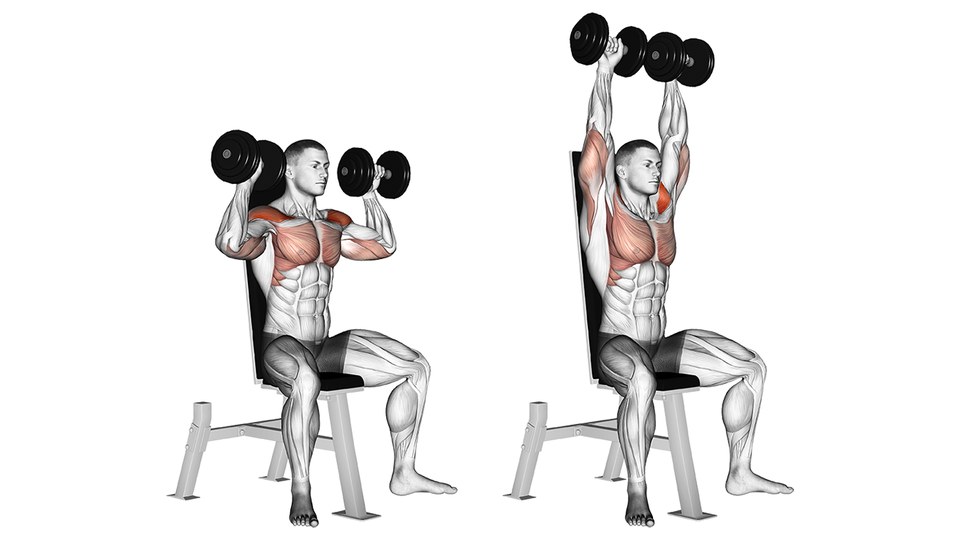
- Sit against an upright back pad with your feet firmly on the floor. Rest the dumbbells on your thighs, then use one knee at a time to guide them safely to your shoulders.
- Start with the dumbbells at about ear height, palms forward and wrists straight over your elbows. Keep your upper arms slightly in front of your body, or directly out to the sides if that feels better.
- Brace your abs, keep your ribs down and hold your back against the pad.
Execution
- Press both dumbbells up and slightly inward without leaning back.
- Let your shoulder blades rotate upward and straighten your elbows, finishing with the dumbbells over the middle of your head without banging them together.
- Lower under control until your upper arms are about parallel with the floor, or slightly lower if that feels comfortable.
- After the final rep, lower the dumbbells to your shoulders, then guide them one at a time back to your thighs before setting them down.
Common mistakes
Leaning back until it becomes an incline press
Recline the torso and the dumbbells travel out in front of you, so you are pressing at an incline rather than overhead. The lean itself is held by your lower back, which is not the thing being trained. Wanting the lean is the clearest signal the dumbbells are too heavy.
Letting the wrist bend back under the dumbbell
A dumbbell sitting behind the line of your forearm makes the wrist hold a bend for every rep, so your grip and forearms quit before your shoulders do. It also puts the load behind your elbow, which is why the top of the press feels like it is falling backwards.
Curling the dumbbells up to the start position
You can press far more than you can curl, so on a working set you spend your arms getting into position and have less than you should for the first rep. Kicking them up off the knees seated, or swinging them up from the hips standing, costs nothing and is the difference between the weight you can press and the weight you can get to your shoulders.
Shortening the bottom as the set goes on
The lockout is the easy part, so a press that gets shorter is a press that keeps the number on the dumbbell and quietly drops the work behind it. If the range is shrinking, the set is over; racking it and dropping the weight next set is the honest read.
Resting at the top with the arms locked
Holding two dumbbells overhead does not recover your shoulders. It keeps your trunk loaded and your grip working while you wait. Take the pause at the bottom with the dumbbells parked on your shoulders instead.
Where it fits in a session
Early in an upper-body or push session, after any barbell pressing but before lateral raises and triceps work.
It is a compound press over a fairly small amount of muscle, so it does not carry the loading of a bench press and does not need to be pushed to the same edge every week. The limiter is often something other than the deltoid: the wrists, the trunk if you are standing, or simply getting the dumbbells to your shoulders. Progression is awkward on purpose, because the next dumbbell up is a jump of 2 kg or 5 lb per hand, which is a lot when you are pressing 20s. Add a rep, then a set, and take the weight jump when the current one is comfortably clean.
Muscles worked
Primary
Secondary
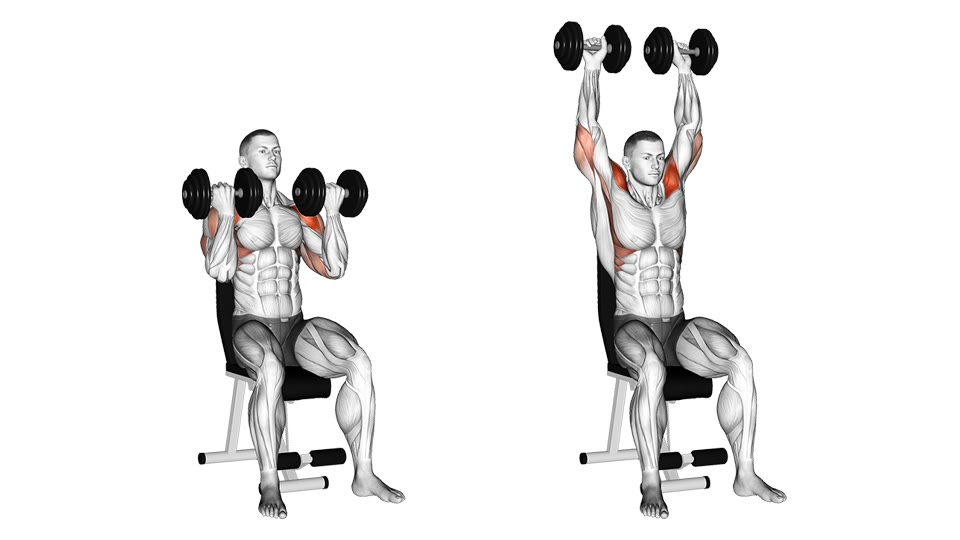
Schematic surface view. Some muscles are partly visible or not shown.
The deltoid raises the upper arm and the triceps extends the elbow. The trapezius and serratus anterior move the shoulder blade, while the rotator cuff helps control the shoulder joint. Pectoralis major activity has also been recorded during dumbbell shoulder pressing.
The deltoid is kept as a whole muscle in this list. Studies measured different responses in its front, side and rear regions when the setup changed, but those readings do not rank how much each region will grow. The primary and secondary lists describe roles rather than a complete measurement of contribution.
What lifters actually do
About five in eight regular RepCount users have a dumbbell shoulder press in their history, and it turns up in roughly one workout in twelve. The movements it sits beside are bench press, pushdowns, incline dumbbell press and triceps extensions, which is a push day, and the strongest single pairing is with the dumbbell lateral raise, present in 42.2% of the sessions that contain a press. When it appears it takes a little over three sets, in a session of about seven exercises.
Most often trained alongside
Share of dumbbell shoulder press sessions that also include each exercise.
- Bench press24.9%
- Pushdowns22.7%
- Triceps extensions16.8%
Figures come from workouts tracked in RepCount.
Scientific studies on dumbbell shoulder presses
Changing the support, implement or bench angle changes the pressing task. The studies below measured maximum load and muscle activity, rather than long-term shoulder growth.
Track seated, standing and barbell presses separately. Lower lifted weight can coexist with higher muscle activity, and neither measurement alone establishes a better exercise for growth.
Is standing better than sitting?
In 15 men, the maximum standing dumbbell press was lower than the seated dumbbell press. During separate muscle-activity tests at 80% of each version’s maximum, standing produced higher side- and rear-deltoid activity. The front-deltoid difference did not reach statistical significance.
That does not make standing the better growth exercise. Choose the setup that fits your training and keep it consistent when judging progress.
How do dumbbells compare with a barbell?
In the same study, front-deltoid activity was higher with dumbbells than with a barbell in both seated and standing presses. Standing barbell pressing allowed more maximum weight than standing dumbbell pressing, and produced more triceps activity during the submaximal test.
Those results do not isolate the trunk as the only limiting factor, or establish which implement grows the shoulders most.
What changes when the bench leans back?
A study of 24 women compared dumbbell pressing on a flat bench, a 45-degree incline and an almost-upright 85-degree backrest. Front-deltoid and upper-trapezius activity increased as the bench became more upright. Activity in the sternal chest region was lower in the shoulder press than in either chest press.
Everyone used the same 4.5 kg dumbbells, so effort was not matched to each exercise’s maximum. These were short tests, not a training program. They show that the angle changes the activity pattern, but do not establish a best angle for growth or mean that the chest is inactive overhead.
Sources
Variations
- Seated dumbbell shoulder press — The back pad supports the torso while both arms press overhead.
- Standing dumbbell shoulder press — Without a back pad, you hold the trunk position while pressing.
- Neutral grip dumbbell shoulder press — Palms face each other the whole way up rather than turning forward.
- Single arm dumbbell shoulder press — One side at a time, which adds resisting the sideways pull to the pressing.
- Half kneeling dumbbell shoulder press — One knee down, which takes the option of leaning back away from you.
Articles
Related tools
Frequently asked questions
What muscles does the dumbbell shoulder press work?
The deltoid raises the upper arm and the triceps straightens the elbow. The trapezius and serratus anterior turn the shoulder blade upward, while the rotator cuff helps control the joint. The chest also contributes: muscle activity has been measured in both sampled pectoralis regions, though that does not establish how much either grows from shoulder pressing.
Should I do the dumbbell shoulder press seated or standing?
Either can fit a training program. A back pad provides support; standing asks you to hold the position without it. In a small study, standing dumbbell pressing allowed less maximum weight but produced higher activity in some deltoid regions. That does not establish better growth or show that the trunk alone limits standing presses. Track the two versions separately.
Palms forward or palms facing each other?
Both are ordinary. Palms forward is the familiar version; palms facing each other, sometimes called a neutral grip, is what many people find more comfortable, and some lifters rotate from one to the other on the way up. The choice is yours rather than ours, and a picture of one grip is not an argument against the other.
Does the dumbbell shoulder press work your traps?
Yes, though not in the way the word usually suggests. The trapezius is not the muscle lifting the dumbbells. Its upper and lower fibres work with the serratus anterior to rotate the shoulder blade upward, and that rotation is what allows the arm to travel overhead at all. Anatomy references describe sustained upward rotation of the scapula as the specific thing that makes overhead lifting possible.
Does it work your chest?
Chest muscle activity has been recorded during dumbbell shoulder pressing. In the study reviewed here, activity in the sternal region was lower than in flat or incline dumbbell presses. The result does not support saying that only the upper chest is involved, and it does not measure chest growth from overhead pressing.
Is the dumbbell shoulder press better than the barbell overhead press?
Neither is established as universally better by the studies reviewed here. Dumbbells give each arm its own path; a bar connects the hands. A small comparison found different loads and muscle-activity patterns, but did not measure which implement builds more shoulder muscle. Choose a version you can set up and perform consistently, and track its progress separately.
Is the dumbbell shoulder press worth doing?
About five in eight regular RepCount users have it in their history, and it shows up in about one workout in twelve. What the logs say more clearly is where it lives: it sits beside bench press, pushdowns, incline dumbbell press and triceps extensions, and in 42.2% of the sessions containing it there is a dumbbell lateral raise too. It is a push-day staple rather than a specialist shoulder exercise.
How many sets should I do?
When RepCount users do this exercise they average a little over three sets of it, inside a session of about seven exercises. That is a description of what people do rather than a prescription. The number that matters more is whether you can start each set with the dumbbells already at your shoulders and finish it without leaning back.
Sources
- Elzanie A, Varacallo MA. Anatomy, Shoulder and Upper Limb, Deltoid Muscle. StatPearls. https://www.ncbi.nlm.nih.gov/books/NBK537056/
- Tiwana MS, Sinkler MA, Bordoni B. Anatomy, Shoulder and Upper Limb, Triceps Muscle. StatPearls. https://www.ncbi.nlm.nih.gov/books/NBK536996/
- Lung K, St Lucia K, Lui F. Anatomy, Thorax, Serratus Anterior Muscles. StatPearls. https://www.ncbi.nlm.nih.gov/books/NBK531457/
- Ourieff J, Scheckel B, Agarwal A. Anatomy, Back, Trapezius. StatPearls. https://www.ncbi.nlm.nih.gov/books/NBK518994/
- Solari F, Burns B. Anatomy, Thorax, Pectoralis Major. StatPearls. https://www.ncbi.nlm.nih.gov/books/NBK525991/
- Jeno SH, Munjal A, Schindler GS. Anatomy, Shoulder and Upper Limb, Arm Supraspinatus Muscle. StatPearls. https://www.ncbi.nlm.nih.gov/books/NBK537202/
- Saeterbakken AH, Fimland MS. Effects of body position and loading modality on muscle activity and strength in shoulder presses. 2013. https://pubmed.ncbi.nlm.nih.gov/23096062/
- Luczak J, Bosak A, Riemann BL. Shoulder Muscle Activation of Novice and Resistance Trained Women during Variations of Dumbbell Press Exercises. 2013. https://doi.org/10.1155/2013/612650