
Band pull-apart
What is a band pull-apart?
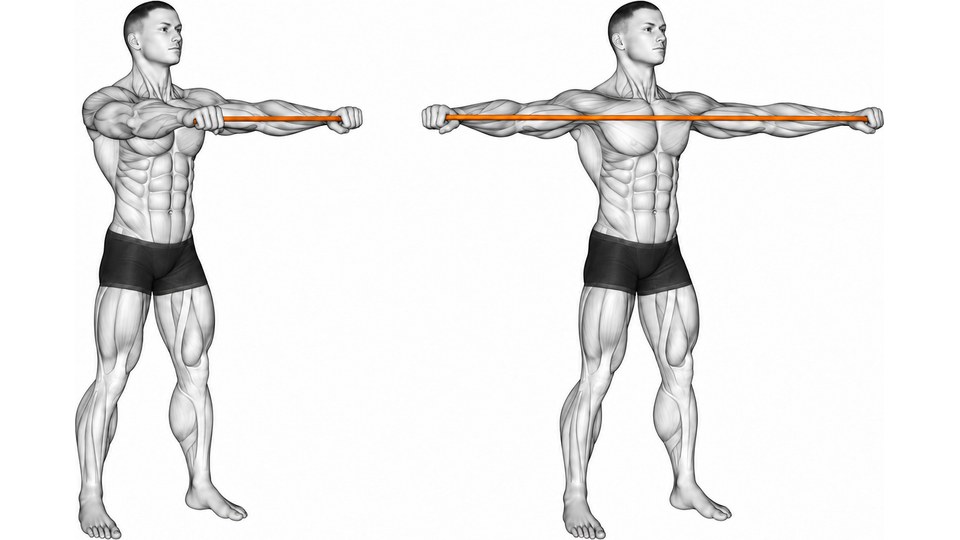
A band pull-apart stretches a band held between your hands by opening the arms out to the sides. This guide uses a standing position, palms down and arms held around shoulder height, with a small fixed bend in the elbows.
How do you perform a band pull-apart?
Set up
- Check the band for tears or worn areas. Hold it in front of your chest with your hands about shoulder-width apart and palms facing down.
- Stand comfortably tall with your feet apart and raise your arms to around shoulder height. Keep a small bend in the elbows and start with only light tension.
Execution
- Open your arms out to the sides, stretching the band across the space in front of your chest. Allow your shoulder blades to move together as you pull.
- Stop when your arms are roughly in line with your torso, without forcing them behind you or lifting your shoulders toward your ears.
- Bring your hands back in front under control, keeping the same elbow bend and arm height. Repeat without snapping the band inward.
Common mistakes
Bending the elbows more as you pull
Keep the elbow angle nearly unchanged so the movement comes from opening the upper arms.
Arching the back to reach farther
Use a lighter band or a wider grip instead of pushing your chest forward.
Starting with too much tension
Leave enough available band length to complete the opening without straining to reach the end.
Where it fits in a session
Include this where you plan the corresponding upper-body movement in your session.
Choose a band that lets you complete the opening without changing your elbow angle. Record the band and grip spacing so you can reproduce the setup.
Muscles worked
Primary
Secondary
Schematic surface view. Some muscles are partly visible or not shown.
Frequently asked questions
Do I need an anchor?
No. Hold the band between both hands. Keep a firm grip and use a band you can control through the return.
Should the band touch my chest?
It may touch lightly near the end, depending on your hand spacing and arm position. Do not force extra range just to make contact.
Sources
- J. Gordon Betts et al. Anatomy and Physiology 2e: Muscles of the Pectoral Girdle and Upper Limbs. 2022. https://openstax.org/books/anatomy-and-physiology-2e/pages/11-5-muscles-of-the-pectoral-girdle-and-upper-limbs