
Band triceps pushdown
Also called band tricep pushdown, resistance band triceps pushdown, banded triceps pushdown.
What is a band triceps pushdown?
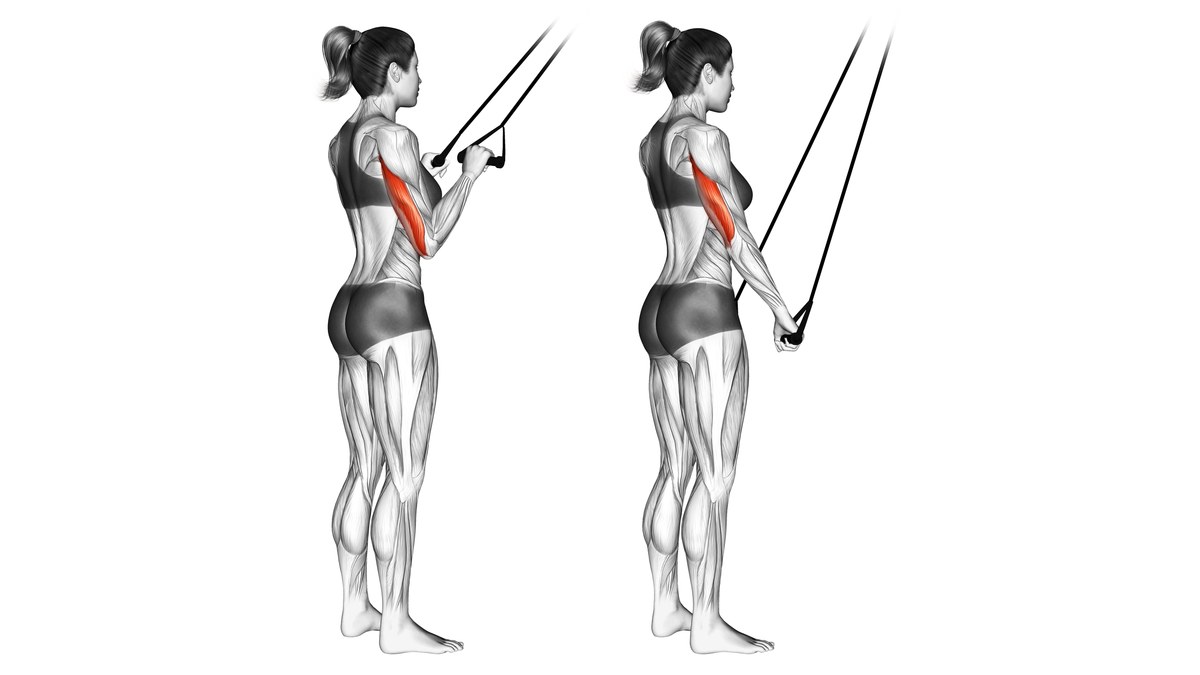
A band triceps pushdown trains the triceps by straightening your elbows against a band attached above your head. With your upper arms beside your torso, press the handles from chest height toward your thighs, then let them rise under control. This guide uses two handles and an overhand grip.
How do you perform a band triceps pushdown?
Set up
- Check the band, handles and anchor for damage. Connect the handles and secure the band above head height using compatible equipment and the manufacturer's attachment instructions.
- Take a handle in each hand with your palms facing down. Face the anchor with your feet about hip-width apart, and test the attachment with a gentle pull.
- Step back until the band has light tension. Bend your elbows so the handles sit near your lower chest, with your upper arms beside your ribs. Soften your knees and lean forward slightly.
Execution
- Straighten both elbows to bring the handles down in front of your thighs. Keep your upper arms in place and your torso still.
- Bend your elbows to bring the handles back toward your lower chest slowly, stopping before the band pulls your upper arms forward.
- Repeat from that position. After the last rep, move toward the anchor to ease the tension before putting the handles down.
Common mistakes
Dropping your torso to finish the pushdown
Hold your starting posture instead of adding a dip on each rep. If you need to lean farther forward to reach the bottom, use a lighter band.
Letting the band pull your arms upward
Guide the handles back with your elbows still beside you. Stop the return before your shoulders and upper arms start following the band.
Choosing more tension than you can finish against
Use a lighter band if each rep stops with your elbows still noticeably bent. Keep the same setup while checking whether you can finish the movement cleanly.
Where it fits in a session
As direct triceps work after your main presses, or in an arm session.
Choose tension that lets you repeat the full movement without changing your posture. Keep track of the band, anchor height and where you stand so you can reproduce the setup next time.
Muscles worked
Primary
Secondary
- None listed in this guide
Schematic surface view. Some muscles are partly visible or not shown.
The triceps at the back of the upper arm straighten the elbow. The muscle has three heads: long, lateral and medial.
Variations
Frequently asked questions
What muscles does a band triceps pushdown work?
It trains the triceps brachii, the three-headed muscle on the back of the upper arm. Its main action is straightening the elbow. The target list refers to the whole muscle, without ranking its heads.
Is a band pushdown the same as a cable pushdown?
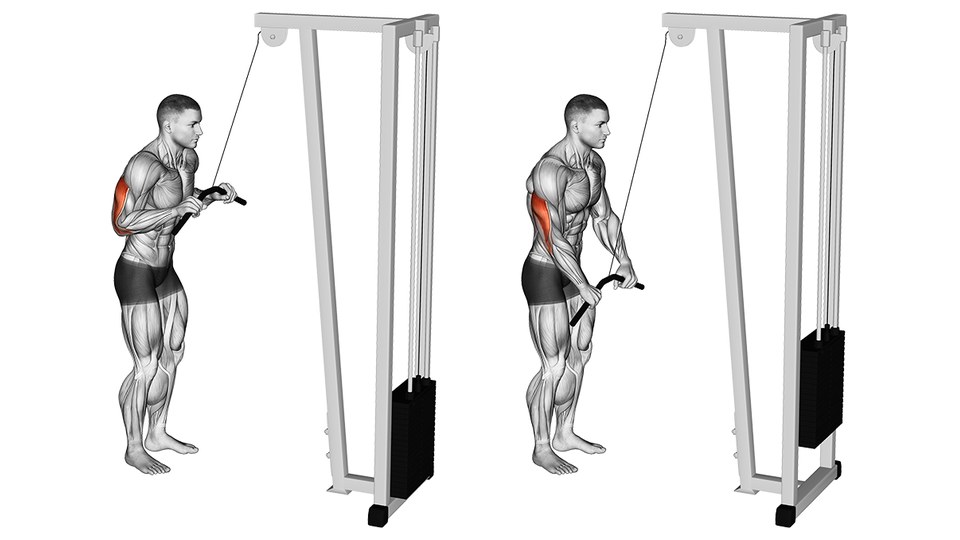
Both use elbow extension with the upper arms beside the torso. A band pushdown uses an elastic band and a fixed high anchor; the cable version uses a pulley and weight stack. Track the band version with its own setup so you can repeat it consistently.
How is this different from a band overhead triceps extension?
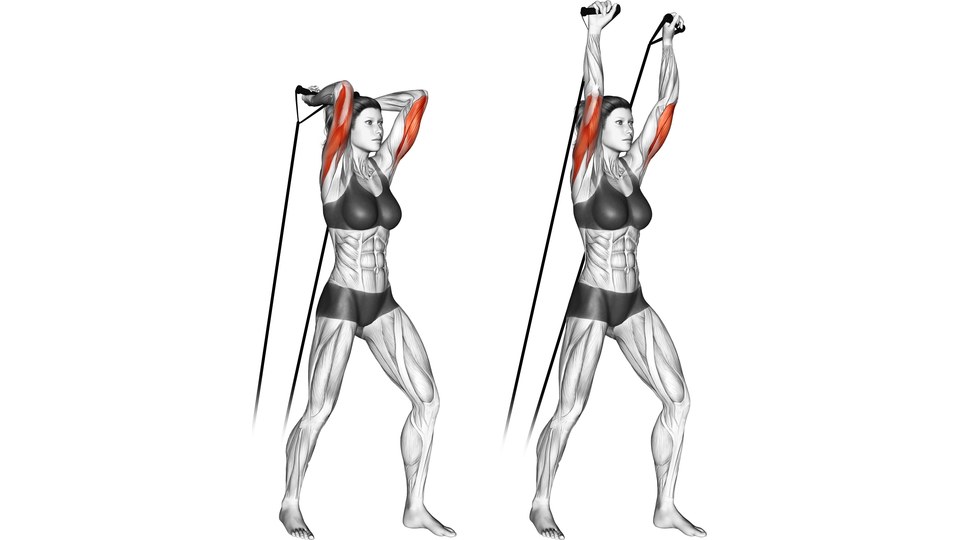
In this pushdown, the anchor is high and your upper arms stay down beside you. The overhead guide uses a low attachment behind you and keeps your upper arms raised as you straighten your elbows.
What band should I start with?
Begin with a light band and check that you can straighten your elbows while keeping your torso still. Follow that band's stretch limit and attachment instructions. Add tension only when you can control both directions through the same range.
Can I attach the band directly to a bar or door?
Use the attachment method specified for your band. Some systems need a separate anchor or protective strap, so do not assume the elastic itself can be wrapped around an object. For a door setup, follow the anchor's instructions for door position, closure and securing it.
Sources
- Tiwana MS, Sinkler MA, Bordoni B. Anatomy, Shoulder and Upper Limb, Triceps Muscle. StatPearls. Updated August 28, 2023. https://www.ncbi.nlm.nih.gov/books/NBK536996/