Triceps pushdown
Also called tricep pushdown, cable pushdown, triceps pressdown, tricep pressdown.
What is a triceps pushdown?
A triceps pushdown is a cable exercise performed at a high pulley. Hold the upper arms at your sides and straighten the elbows against resistance, then return under control. The triceps brachii extends the elbow with help from the anconeus. A rope, bar or single handle changes the grip and movement options; none isolates one triceps head.
How do you perform a triceps pushdown?
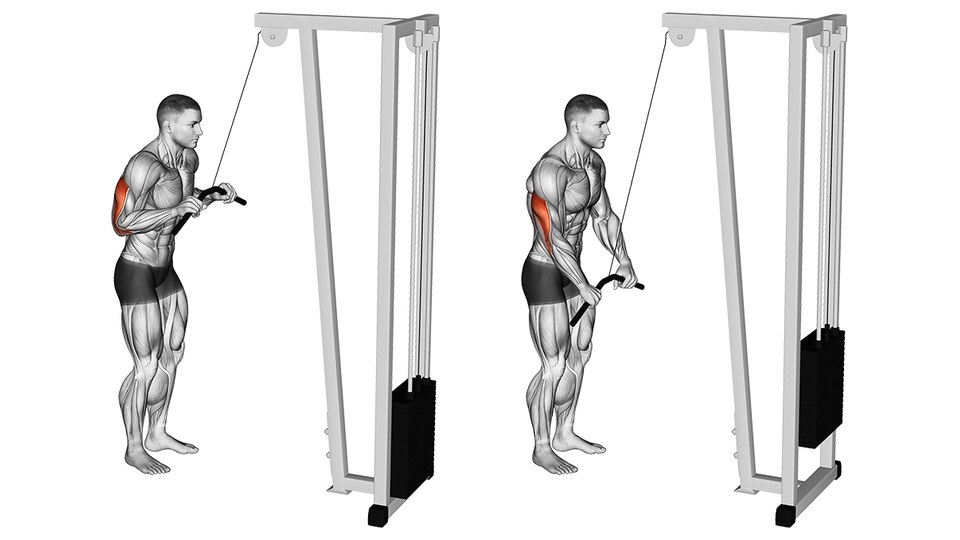
Set up
- Set the pulley at the top, attach a rope or bar, and choose a weight you can control.
- Hold the rope near the ends with your palms facing in. On a bar, use an overhand grip slightly inside shoulder width.
- Stand a half step from the stack with your feet hip-width apart or slightly staggered. Lean forward a little, brace, and pin your elbows to your sides.
Execution
- Start with the attachment at chest height and your elbows bent a little past 90 degrees.
- Press the attachment down by straightening your elbows. Keep your upper arms and torso still.
- Finish with your elbows straight. With a rope, separate the ends and turn your palms down beside your thighs. Pause briefly.
- Return the attachment under control without letting the stack rest. Keep your elbows pinned and do not lean back.
Common mistakes
Letting the upper arm swing forward and back with the rep
Once the humerus starts moving at the shoulder, the lats and the chest are helping push the weight down and the movement becomes a short press. The attachment travels the same distance, so the reps still look like reps, but the triceps is doing less of the work than the number on the stack suggests.
Leaning further forward as the set gets hard
An increasing lean puts your bodyweight over the attachment and pushes it down for you. The last reps get finished by your torso dropping rather than your elbow straightening, and your log now says you did a weight you did not really do.
Standing in the wrong place
Directly under the pulley, the cable runs straight up your torso and the attachment jams into your chest before your elbows reach the bent end of the range. Too far back and the cable pulls forward instead of up, so the bent end goes light and the top half of every rep does nothing. Half a step back keeps the cable close to vertical with the whole range in front of your body.
Finishing the rep with the wrist instead of the elbow
Bending the wrist can push an attachment the last couple of inches while the elbow is still slightly bent, which turns a full rep into a three-quarter rep you will not notice you are doing. It also loads the forearms enough that they, not the triceps, become the reason you stop the set.
Comparing the stack across attachments
A straight bar and a rope are not the same load: the bar is rigid and splits the weight evenly between two hands that cannot move apart, while a rope asks each hand to control its own end as it splits apart, as well as push it down. If your log jumps the week you switched attachments, the exercise changed, not your triceps. Log them as separate entries.
Where it fits in a session
Push day, after the pressing. It is accessory work and it should not be the reason a bench set goes badly.
Two practical notes. Cable stacks move in fixed steps, and those steps are large relative to what an isolation exercise for one muscle can add, so progression on a pushdown usually shows up as reps first and as a plate much later. And because a pushdown holds the upper arm at your side, it leaves the long head at a shorter length than an overhead position would — which is the reasoning behind pairing it with an overhead extension rather than doing two versions of the same arm position. That is an argument from where the muscle attaches, not a finding from a training study.
Muscles worked
Primary
Secondary
Schematic surface view. Some muscles are partly visible or not shown.
The triceps brachii extends the elbow, with a smaller contribution from the anconeus. All three triceps heads contribute; only the long head also crosses the shoulder. Grip can change measured activity in a particular protocol, but the studies here do not establish an attachment that isolates one head or produces the most growth. The latissimus dorsi and teres major help hold the upper arm in position.
What lifters actually do
Close to three in five regular RepCount users have logged a triceps pushdown at some point, and it appears in about one workout in eleven. Where it sits in the week is clear in the data: of the five exercises it most often shares a session with, three are presses — bench, incline dumbbell press and dumbbell shoulder press — one is lateral raises and one is another triceps movement. No back or biceps movement is among them. This is a push-day accessory, and lifters log it as one: around three sets, in a session of roughly seven exercises.
Most often trained alongside
Share of triceps pushdown sessions that also include each exercise.
- Bench press29.5%
- Triceps extensions14.5%
Figures come from workouts tracked in RepCount.
Scientific studies on triceps pushdowns
Training studies have compared pushdowns with overhead extensions. Grip studies ask a different question: how muscle activity and repetition performance change within a session.
Pushdowns produced triceps growth in the training studies discussed here, although a twelve-week trial favored overhead cable extensions. Grip can change measured activity and how many repetitions you complete; that does not establish a best attachment for growth.
How do pushdowns compare with overhead extensions for growth?
In a twelve-week study, twenty-one adults trained one arm with overhead cable extensions and the other with pushdowns. Both arms gained triceps volume on MRI, including the long head. Growth was greater overhead, despite lower weights being used in that position. Both exercises were performed one arm at a time with an underhand grip.
An earlier six-week trial in nine novice women found increased long-head thickness with both exercises and no clear difference between them. That smaller study used different partial elbow ranges and ultrasound measurements. Neither trial establishes the best choice for every lifter or proves that both exercises must be combined.
Does turning the palm change muscle activity?
Twenty-two adults performed single-arm pushdowns with an overhand or underhand handle grip, and with a strap attached at the wrist. With the same weight, the underhand handle condition produced higher long-head activity but fewer repetitions than the other conditions. The lateral head did not show a clear difference between the two handle grips.
The conditions therefore differed in performance as well as hand position. This was an acute muscle-activity study, not a growth trial, and it did not compare a rope with a straight bar. It supports tracking grip and attachment consistently rather than treating a higher activity reading as a promise of more growth.
Sources
Variations
- Rope pushdown — Rope attachment. The hands split apart and the palms turn down at the bottom, so the arms finish out to the sides.
- Straight bar pushdown — Fixed hand spacing and a rigid bar, so both arms are locked into the same path.
- V-bar pushdown — Angled bar. The hands sit turned slightly in rather than flat, so the bar and the forearms line up differently.
- Reverse grip pushdown — Underhand grip, on a straight bar or one arm at a time with a handle.
- Single arm cable pushdownOne side at a time with a handle, which makes it obvious when one arm is leading.
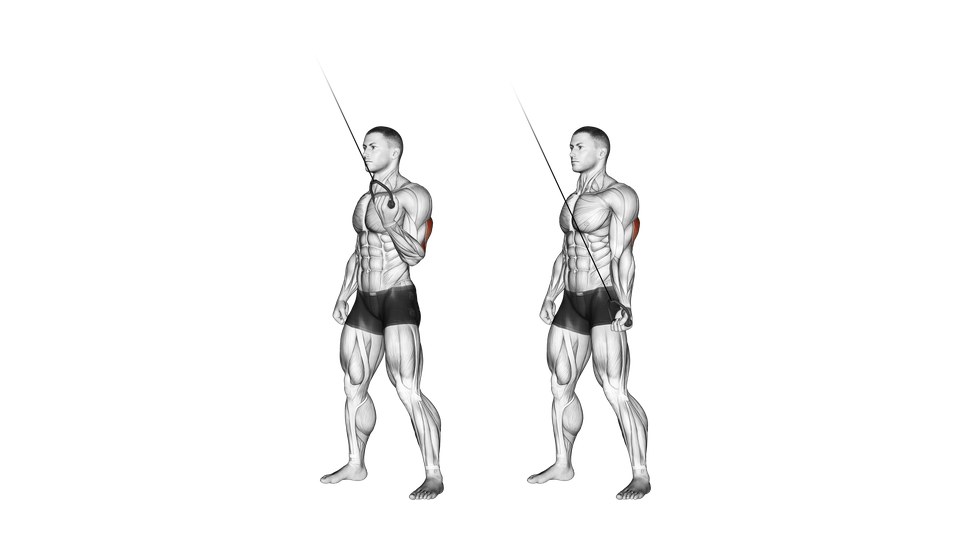
- Band pushdown — Same movement with a band anchored above head height, so resistance rises as the elbow straightens.
Articles
Related tools
Frequently asked questions
What muscles do triceps pushdowns work?
The triceps brachii, with a minor contribution from the anconeus, a small muscle at the outside of the elbow. Elbow extension is what a pushdown is, and the triceps is what extends the elbow. The latissimus dorsi and teres major work too, but only to hold your upper arm at your side against a cable trying to pull it up — they hold position rather than move the weight.
Should I use a rope or a bar for pushdowns?
Either. It is mostly a preference about grip and hand position, and it does not change which muscle does the work. A straight bar fixes your hands at one spacing and one angle; an angled bar turns them in a little; a rope lets your hands split apart and turn palms down at the bottom so your arms finish out to the sides. Any picture of a pushdown has to show one attachment or another, so read whichever you see as an example rather than as the instruction. Two things do follow from the choice. The grip: a bar is taken overhand, a rope with the palms facing each other, which is what the stoppers on the ends are for. And the load: the weight is not comparable between attachments, so log them separately rather than wondering why the number dropped.
Do pushdowns work the long head of the triceps?
Yes. In a twelve-week cable training study, the long head grew with both pushdowns and overhead extensions, with a larger increase overhead. Participants used one arm at a time with an underhand grip. This result does not mean pushdowns miss the long head, or establish how every attachment compares.
What is the difference between a pushdown and a triceps extension?
A pushdown keeps the upper arm at your side; an overhead extension raises it beside your head, while lying extensions use another arm position. Only the long head crosses the shoulder, but a cable training trial found greater growth overhead in both the long head and the lateral and medial heads measured together. Anatomy alone cannot predict all of those training results.
Can you do pushdowns without a cable machine?
Yes, with a band anchored above head height — a door anchor, a rack pin, anything solid. The movement is identical. The feel is not: a band gets harder as it stretches, so the hardest part is the straight-arm end, whereas a cable holds roughly the same load all the way through.
Why do my forearms get tired before my triceps on pushdowns?
Usually one of two things. Either you are finishing reps by bending the wrist instead of straightening the elbow, which hands the last inches of each rep to the forearm, or you are gripping a rope hard enough to hold the ends together all the way down that the grip fails first. Keep the knuckles in line with the forearm, and on a rope let your hands split apart and turn palms down at the bottom rather than holding the ends together.
Are triceps pushdowns worth doing?
Judging by what RepCount users actually log, they are one of the standard accessories: close to three in five regular users have logged one, and a pushdown turns up in about one workout in eleven. The company it keeps is the more interesting part — the exercises it most often shares a session with are the bench press, dumbbell lateral raises, the incline dumbbell press and the dumbbell shoulder press — four of the five, the fifth being another triceps movement. It is push-day work, and lifters treat it that way.
How many sets and reps should I do?
A pushdown is isolation work for one muscle, so it does not need to be heavy to be worth doing, and heavy is where the form goes first — the upper arm starts swinging and the torso starts leaning. The straight-arm pause is the test: it is the only point in a pushdown where the triceps is as short as this exercise takes it, and it is the first thing to disappear when the weight is too heavy. Whatever weight lets you straighten the elbow fully, hold it for a beat and keep the same lean on the last rep as on the first is the right one. For reference, RepCount users who log a pushdown average around three sets of it in a session of roughly seven exercises.
Sources
- Tiwana MS, Sinkler MA, Bordoni B. Anatomy, Shoulder and Upper Limb, Triceps Muscle. StatPearls. https://www.ncbi.nlm.nih.gov/books/NBK536996/
- Card RK, Lowe JB, Launico MV. Anatomy, Shoulder and Upper Limb, Elbow Joint. StatPearls. https://www.ncbi.nlm.nih.gov/books/NBK532948/
- Mitchell B, Whited L. Anatomy, Shoulder and Upper Limb, Forearm Muscles. StatPearls. https://www.ncbi.nlm.nih.gov/books/NBK536975/
- Jeno SH, Varacallo MA. Anatomy, Back, Latissimus Dorsi. StatPearls. https://www.ncbi.nlm.nih.gov/books/NBK448120/
- Syros A, Rizzo MG. Anatomy, Shoulder and Upper Limb, Teres Major Muscle. StatPearls. https://www.ncbi.nlm.nih.gov/books/NBK580487/
- Maeo S, Wu Y, Huang M, Sakurai H, Kusagawa Y, Sugiyama T, Kanehisa H, Isaka T. Triceps brachii hypertrophy is substantially greater after elbow extension training performed in the overhead versus neutral arm position. 2023. https://pubmed.ncbi.nlm.nih.gov/35819335/
- Stasinaki AN, Zaras N, Methenitis S, Tsitkanou S, Krase A, Kavvoura A, Terzis G. Triceps Brachii Muscle Strength and Architectural Adaptations with Resistance Training Exercises at Short or Long Fascicle Length. 2018. https://www.mdpi.com/2411-5142/3/2/28
- Villalba MM, Fujita RA, Iossi Junior C, Gomes MM. Forearm Position Influences Triceps Brachii Activation During Triceps Push-Down Exercise. 2024. https://journal.iusca.org/index.php/Journal/article/view/250