
Barbell rear delt row
Also called bent-over barbell rear delt row.
What is a barbell rear delt row?
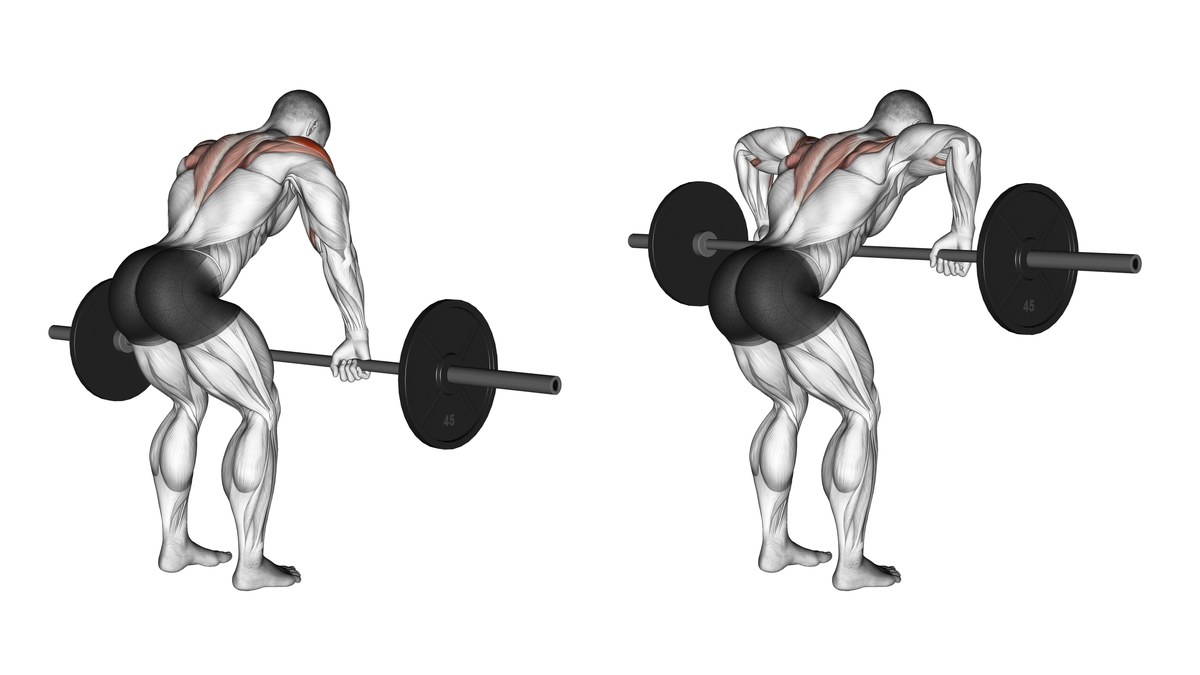
A barbell rear delt row is a bent-over row with a wide, palms-down grip and elbows moving out to the sides. You hold the hip hinge without a bench while rowing the bar toward the chest. It trains the rear shoulders and upper back with both hands on the same bar.
How do you perform a barbell rear delt row?
Set up
- Put a light bar on secure rack hooks just below your hands when standing, with room behind you to bend over. Secure any plates with collars.
- Bend your knees to take a palms-down grip wider than your shoulders, with thumbs around the bar. Stand to lift it from the hooks, then step clear into a stable stance.
- Soften your knees and push your hips back until your chest faces the floor. Let your arms hang below your shoulders, brace your middle and hold your back steady.
Execution
- Bend your elbows outward as you lift the bar toward your chest. Keep your torso at the same angle and both feet planted.
- Finish with your upper arms roughly in line with your torso. Keep your wrists straight and stop before a shrug or upward heave is needed.
- Lower the bar smoothly until your arms hang beneath your shoulders again, then repeat.
- After the last repetition, stand up with the bar under control and return it to the hooks.
Common mistakes
Rowing toward the hips with tucked elbows
This changes the movement into the closer-elbow barbell row. Reduce the load and let the elbows travel out rather than brushing your ribs.
Standing up to finish the pull
If the chest rises with the bar, reset the hinge and use less weight. End the set when you cannot hold the bent-over position.
Forcing the bar to touch the chest
Do not curl the wrists or shrug to create contact. Use the upper-arm position to judge the finish instead.
Where it fits in a session
Use as rear-shoulder accessory work in an upper-body session.
Start with a light enough bar to keep the elbow path and torso position consistent. Add load only when you can repeat the same controlled movement throughout the set.
Muscles worked
Primary
Secondary
Schematic surface view. Some muscles are partly visible or not shown.
The posterior deltoid at the back of the shoulder moves the upper arm outward and back. The middle fibers of the trapezius help draw the shoulder blades toward the spine.
Variations
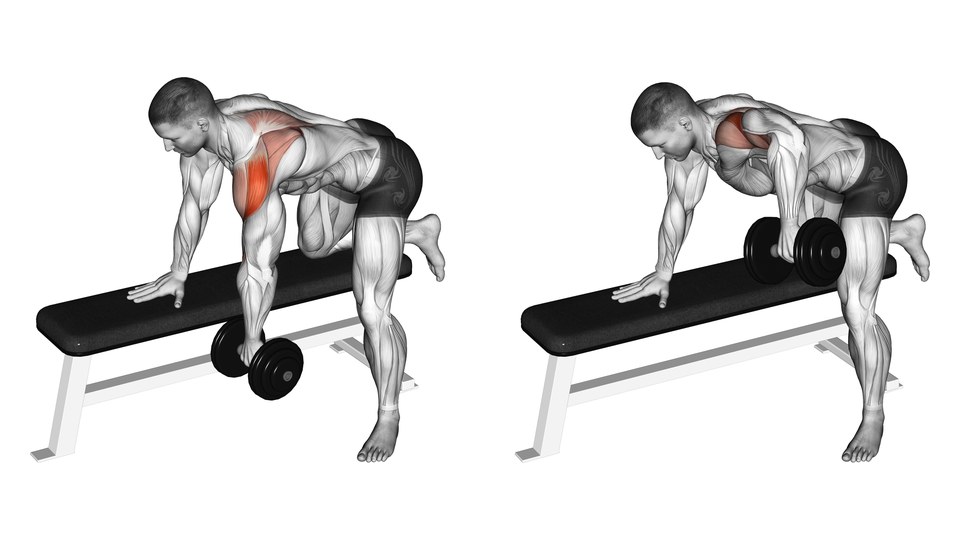
- One-arm dumbbell rear delt rowUses one dumbbell with the other hand and knee braced on a flat bench.
- Chest-supported rear delt row — Supports the chest on an incline bench while rowing dumbbells with the elbows wide.
Frequently asked questions
What muscles does a barbell rear delt row work?
It trains the posterior deltoids at the back of the shoulders and the trapezius in the upper back. The wide upper-arm movement and the shoulder-blade movement involve both; this is not a rear-shoulder isolation exercise.
How is this different from a standard barbell row?
The elbows travel out to the sides and the bar rises toward the chest. A closer-elbow barbell row brings the elbows back alongside the body and the bar toward the lower torso. Keep the wide elbow path when following this guide.
How wide should my grip be?
Start wider than shoulder width and adjust with a light bar so your elbows can spread comfortably while your wrists stay straight. The exact hand spacing is a setup choice; you do not need to copy another lifter's grip marks.
Does the bar have to touch my chest?
No. Stop with the upper arms roughly in line with the torso. If contact requires a shrug, bent wrists or lifting the chest, finish the repetition before that happens.
What if I cannot hold the bent-over position?
End the set and reduce the load. You can also choose the one-arm bench-braced or chest-supported rear delt row, which uses a different support setup. Treat that as a change of exercise rather than standing more upright halfway through this one.
Sources
- Lippincott Williams & Wilkins. The shoulder. Chapter 6, page 255, Tables 6-2 and 6-3, publisher-hosted textbook sample. https://downloads.lww.com/wolterskluwer_vitalstream_com/sample-content/9780781795746_Hendrickson/samples/Chapter06.pdf
- Ourieff J, Scheckel B, Agarwal A. Anatomy, Back, Trapezius. StatPearls. Updated March 11, 2023. https://www.ncbi.nlm.nih.gov/sites/books/NBK518994/