
Bear crawl
Also called bear crawls, forward bear crawl.
What is a bear crawl?
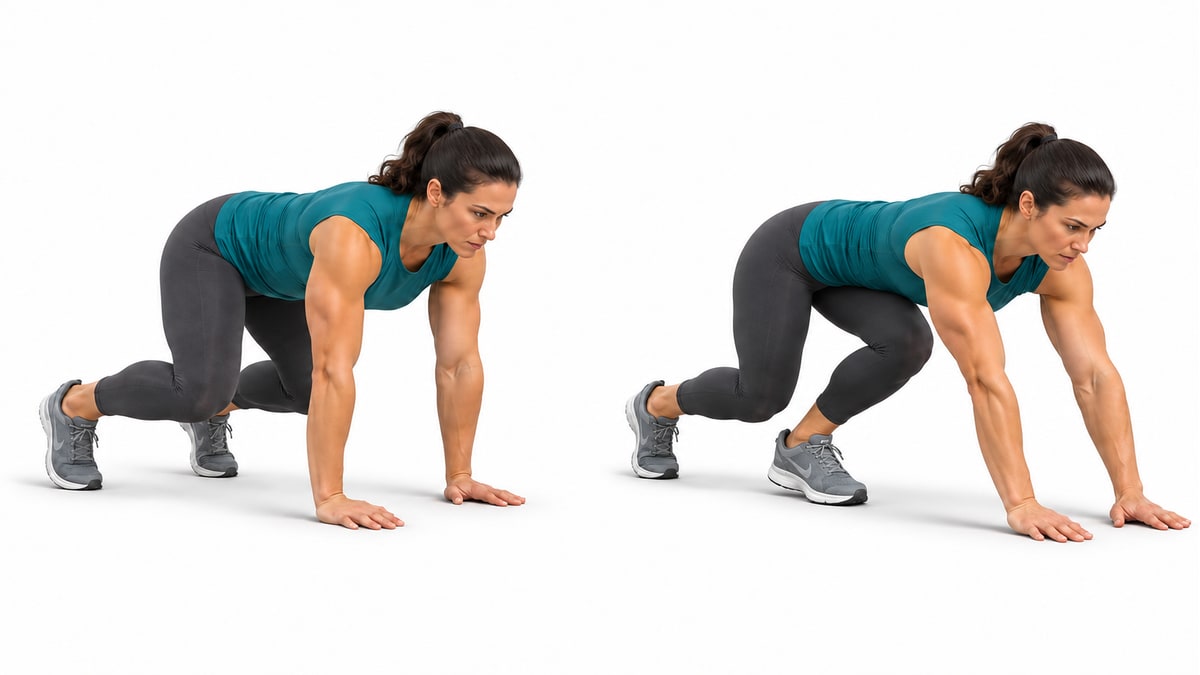
A bear crawl is a bodyweight exercise that moves you across the floor on your hands and toes. Keep your knees bent and lifted a little, then advance one hand with the opposite foot before changing pairs. Your trunk stays steady while your limbs take small steps. This guide covers the low forward crawl, rather than a stationary bear plank or a high-hip bear walk.
How do you do a bear crawl?
Set up
- Choose a clear, firm, non-slip stretch of floor. Lower onto all fours, with your palms beneath your shoulders and your knees beneath your hips, about hip width apart.
- Tuck your toes, keep your arms straight and firm your abdomen. Press into your hands and toes to lift both knees just clear of the floor; keep your hips low and look down slightly ahead.
Execution
- Take a small forward step with your right hand and left foot together, leaving the other hand and foot on the floor. Place both moving support points down before changing pairs.
- Advance your left hand and right foot the same way. Keep your knees bent, your back steady and your breathing continuous as you alternate.
- Continue along the clear path without reaching for long strides. To finish, stop with both hands and both feet planted, then lower your knees gently.
- Rest on your knees, then bring one foot forward into a half-kneeling position. Stand when balanced, using your hands on your front thigh for support if needed.
Common mistakes
Letting the hips climb as you travel
Shorten the steps and keep the knees near the floor. If you cannot maintain the low position, lower your knees and reset instead of finishing as a high-hip walk.
Taking a long reach and dragging the feet
Move a hand and the opposite foot as a pair. A short, deliberate step makes it easier to keep the support points under control than reaching far ahead with the hands.
Moving one side of the body together
Pair the right hand with the left foot, then the left hand with the right foot. Slow down or reset on your knees if you lose that sequence.
Where it fits in a session
Use it as a moving bodyweight or trunk-control exercise in the session you have planned. Leave enough unobstructed floor for the full pass.
Choose time, distance or the step-cycle convention below before starting, and keep that convention consistent. End the pass when you need to raise the hips, drag a foot or rush the steps to continue.
Muscles worked
Primary
Secondary
- None listed in this guide
Schematic surface view. Some muscles are partly visible or not shown.
Your abdominal muscles help keep the trunk steady as the support points change. Your arms and legs also support and move your body. This list describes the main trunk-control focus, not every working muscle or a measured activation ranking.
Variations
- Bear plankHold the bent-knee hover in one place without stepping. It is a stationary sibling, rather than another name for this moving crawl.
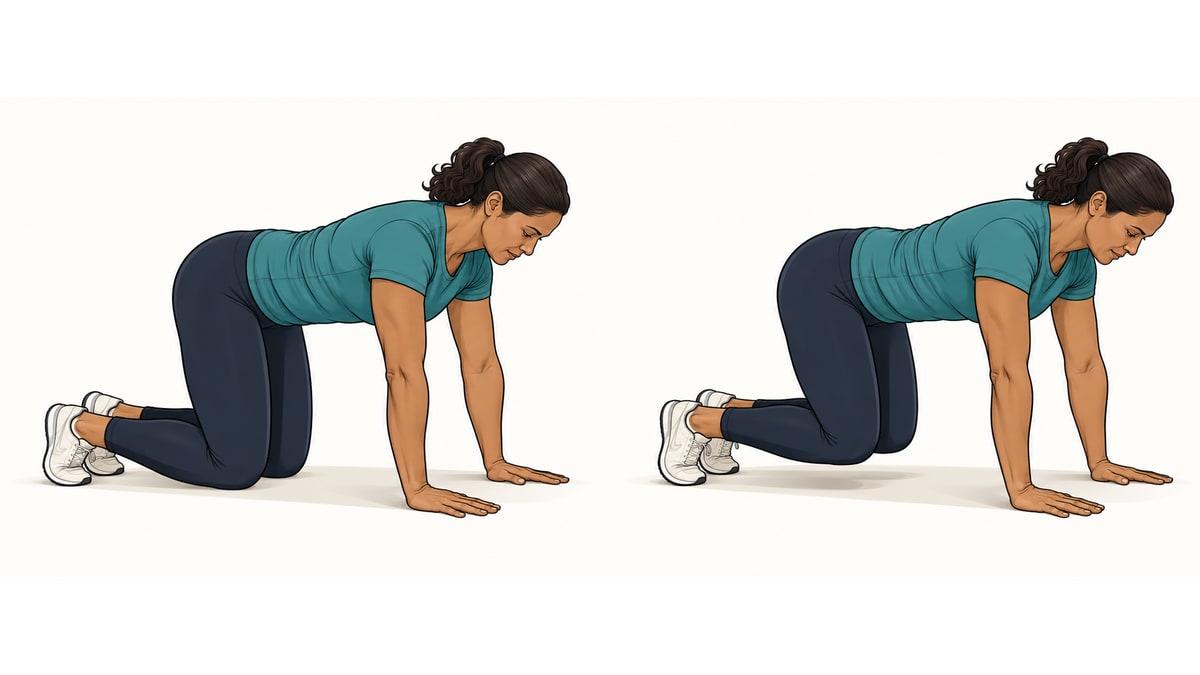
- Short forward passes with resets — Take a few controlled steps, lower the knees and reset before another pass. Keep the same low posture and opposite-limb sequence.
Frequently asked questions
Is a bear crawl the same as a bear plank?
A bear plank holds the hands-and-toes position without traveling. A bear crawl moves those support points to cross the floor. Both can use a low bent-knee position, but the hold and the moving steps are different exercises.
Which hand and foot move together?
Move a hand with the opposite foot: right hand with left foot, then left hand with right foot. Place each pair down before lifting the next. Crawling on your knees or moving the same-side hand and foot together changes the pattern described here.
How high should your knees be?
Leave a small gap so the knees do not take your weight. There is no exact height to measure. Keep the knees bent and the hips low; straightening the legs and lifting the hips makes a different, higher crawl.
How do you count bear crawls?
For a repeatable count, treat one right-hand/left-foot step plus one left-hand/right-foot step as one cycle. That is the counting convention used here, rather than a universal rule. You can instead measure the clear distance traveled or the time set for your session.
What muscles does a bear crawl work?
The rectus abdominis, obliques and deeper transversus abdominis contribute to trunk control while the hands and feet move. The arms and legs support and propel you too. The crawl is a coordinated whole-body task; this target list does not show which muscle works hardest or promise a particular training result.
Sources
- Flynn W, Vickerton P. Anatomy, Abdomen and Pelvis: Abdominal Wall. StatPearls, updated 2023. https://www.ncbi.nlm.nih.gov/books/NBK551649/