Broad jump
Also called standing long jump, standing broad jump, broad jumps.
What is a broad jump?
A broad jump is a forward jump from a stationary, two-foot stance. You use an arm swing and a quick bend of the hips and knees to leave the ground, then land on both feet and regain your balance. It is also called a standing long jump; the version here resets between jumps.
How do you perform a broad jump?
Set up
- Clear a level, nonslip takeoff and landing area, with room ahead and to either side. Start with a distance you can land without stumbling.
- Face forward with a comfortable gap between your feet, roughly hip width. Let your arms hang and keep both feet still before you begin.
Execution
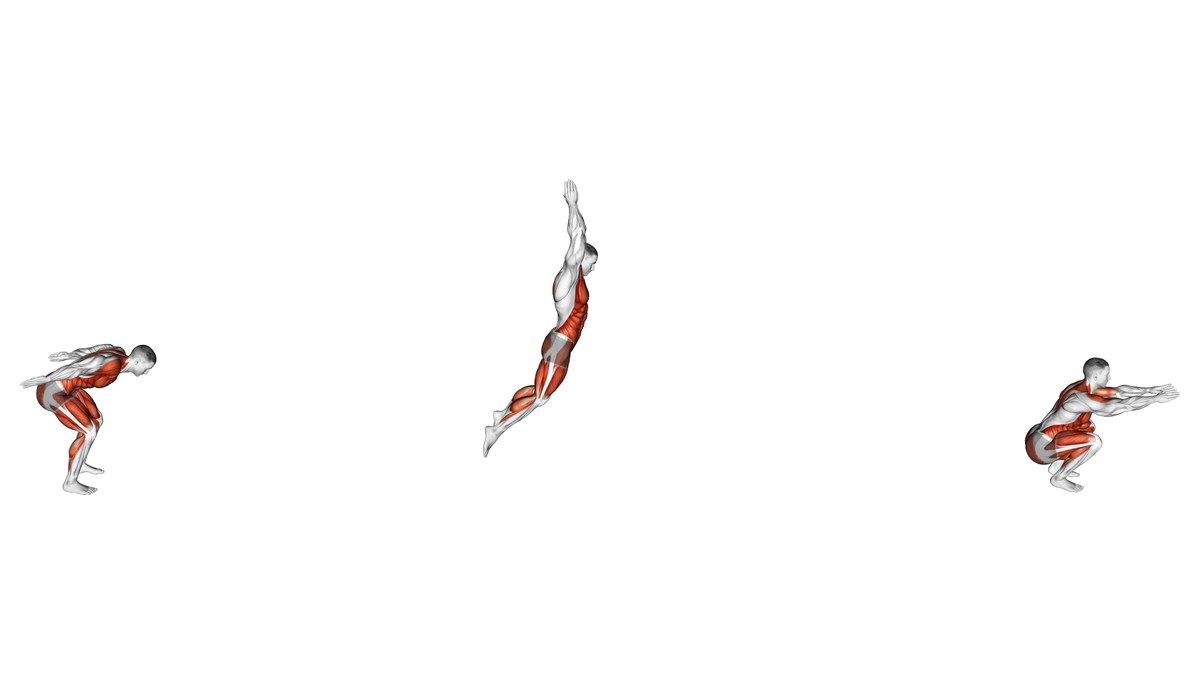
- Bend your knees and send your hips back as your arms sweep behind you. Look toward the place you intend to land.
- Push off with both feet, straightening your legs as your arms swing forward and up. Travel forward through the air with your feet alongside each other.
- Bring your feet forward for the landing and touch down on both together. Let your hips and knees bend, keep your knees following your toes, and settle onto your whole feet.
- Hold your balance, then stand up. Reset in clear space for the next jump; when you finish, walk out of the landing area.
Common mistakes
Taking a step into the jump
A run-up or staggered push changes the standing, two-foot version. Settle both feet before starting your arm swing.
Reaching for distance with stiff legs
Arriving with locked knees leaves little room to bend as you land. Shorten the jump until you can land with both legs bending and keep your balance.
Jumping again before the landing settles
Quick rebounds are a different way to organize the exercise. For the reset version, finish the landing and stand before preparing another takeoff.
Where it fits in a session
Use the standing version when your session calls for forward jumps.
Reset between attempts, and finish the set if you can no longer settle the landing without extra steps.
Muscles worked
Primary
Secondary
Schematic surface view. Some muscles are partly visible or not shown.
The quadriceps straighten the knees and the gluteus maximus extends the hips during takeoff. The calves help push through the ankles, while the hamstrings assist at the hips and knees. The legs also control the landing. These are functional roles, not an activation ranking.
Variations
- Repeated broad jumps — Links forward jumps without the standing reset taught here; it changes the rhythm rather than the direction or implement.
Frequently asked questions
What muscles does a broad jump work?
The quadriceps and gluteus maximus drive knee and hip extension. The gastrocnemius and soleus in the calves contribute at the ankles, and the hamstrings assist hip and knee control. The legs then control the landing. This describes their jobs in the movement, not measured activation percentages or a muscle-growth comparison.
Is a broad jump the same as a standing long jump?
Yes. Both names describe a forward jump without a run-up, taking off and landing on two feet. A running long jump is a different movement.
How far should I jump?
Begin with a short jump that lets you land on both feet and stay balanced. A longer distance is not a useful target if you have to stumble, put your hands down or fall backward to finish it. This guide teaches the movement rather than a scored distance test.
Do I have to land as deep as the illustration?
No. Let the hips and knees bend enough to finish a controlled landing; the drawing shows one squat depth, not a depth you must copy. Keep the jump short enough that you can settle on your feet without falling forward or backward.
Should I jump again as soon as I land?
Reset first for the version taught here. Finish the landing, regain balance and stand before the next attempt. Repeated broad jumps link the landings and takeoffs and are listed as a separate coaching variation.
Sources
- Betts JG, et al. Anatomy and Physiology 2e. 11.6 Appendicular Muscles of the Pelvic Girdle and Lower Limbs. OpenStax. 2022. https://openstax.org/books/anatomy-and-physiology-2e/pages/11-6-appendicular-muscles-of-the-pelvic-girdle-and-lower-limbs