
Box jumps
Also called box jump, jump to box, plyometric box jump.
What are box jumps?
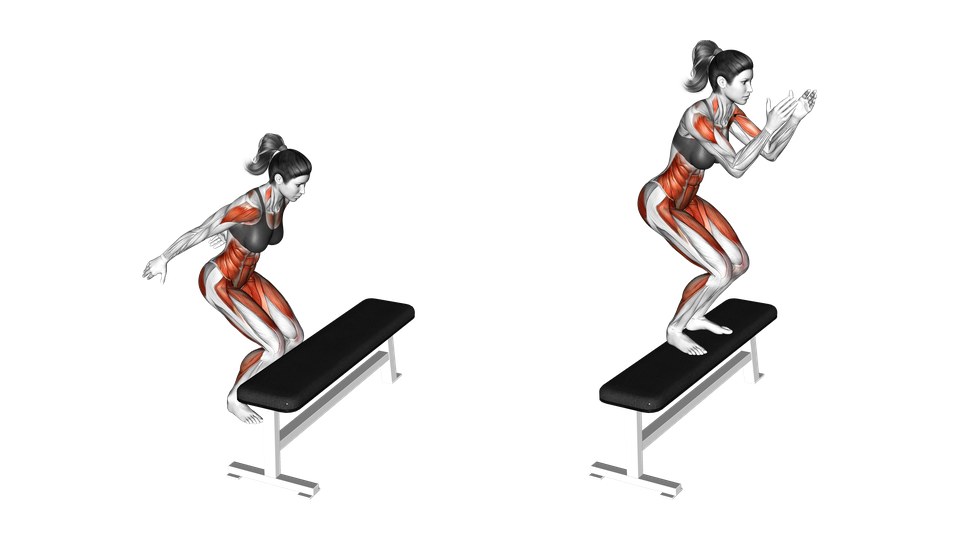
Box jumps are a two-foot plyometric exercise in which you jump from the floor and land on a stable raised box. The hips, knees and ankles extend to create the jump, while a soft bent-knee landing absorbs it.
How do you perform box jumps?
Set up
- Choose a stable box low enough that you can land with both feet fully on top and only a modest knee bend.
- Stand a short step in front of it with your feet around hip to shoulder width and clear the space behind you for stepping down.
Execution
- Dip into a shallow squat and swing your arms back, then drive through both feet and swing the arms forward to jump.
- Land quietly with both feet fully on the box and your knees following your toes.
- Stand tall to finish the repetition, then step down carefully one foot at a time.
Common mistakes
Choosing a box that is too high
Pulling the knees sharply toward the chest can hide a small jump and leaves less room for a stable landing. Lower the box until both feet land fully and quietly.
Landing on the edge
Partial foot contact can slip. Move the box or starting position so the whole feet reach the top.
Jumping back down
Repeated drop landings add an impact that is not needed for the upward-jump practice taught here. Step down under control.
Where it fits in a session
Use it early in a session while takeoffs and landings are crisp, with enough rest to repeat the same jump quality.
Progress by improving takeoff and landing quality before raising the box.
Muscles worked
Primary
Secondary
Schematic surface view. Some muscles are partly visible or not shown.
The hips, knees and ankles extend to create the jump, and the same lower-body muscle groups help absorb the landing.
Variations
- Seated box jump — Starts seated before the jump, removing the usual countermovement.
- Lateral box jump — Jumps sideways onto the box instead of straight ahead.
- Depth jump — Starts by dropping from a box before rebounding; it adds a distinct landing and is not the exercise taught here.
Frequently asked questions
What muscles do box jumps work?
They use the quadriceps, glutes, hamstrings, adductors and calves to extend the lower body and absorb the landing.
How high should the box be?
Use a height you can reach without tucking the knees sharply, landing on the edge or collapsing into a deep squat.
Should you jump or step down?
Step down carefully. Jumping down adds a drop landing that is not necessary for the standard box jump taught here.
Should you land with straight legs?
No. Land softly with a modest bend at the hips and knees, then stand tall after you are stable.
Sources
- Bordoni B, Varacallo MA. Anatomy, Bony Pelvis and Lower Limb: Thigh Quadriceps Muscle. StatPearls. https://www.ncbi.nlm.nih.gov/books/NBK513334/
- Elzanie A, Borger J. Anatomy, Bony Pelvis and Lower Limb, Gluteus Maximus Muscle. StatPearls. https://www.ncbi.nlm.nih.gov/books/NBK538193/
- Bordoni B, Varacallo MA. Anatomy, Bony Pelvis and Lower Limb: Gastrocnemius Muscle. StatPearls. https://www.ncbi.nlm.nih.gov/books/NBK532946/