
Cable crunch
Also called cable crunches, cable ab crunch, cable rope crunch.
What is a cable crunch?
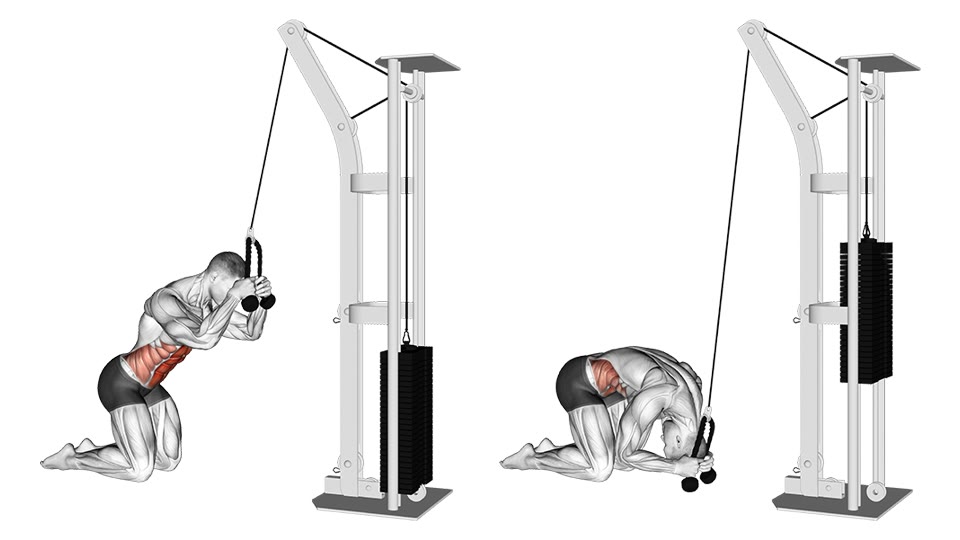
The cable crunch is a kneeling abdominal exercise performed by curling the rib cage toward the pelvis against a high cable. It mainly trains the rectus abdominis, with the internal and external obliques assisting.
How do you perform a cable crunch?
Set up
- Attach a rope to a high pulley, kneel facing the stack and hold the rope ends beside your head.
- Set your hips back and keep them in that position while the cable becomes taut.
Execution
- Curl your rib cage toward your pelvis, allowing the upper and middle back to round.
- Keep the rope by your head and the hips mostly still instead of pulling with the arms.
- Return under control until the abdominal muscles lengthen, then repeat without letting the stack settle.
Common mistakes
Turning it into a hip hinge
Rocking the hips forward and back moves the torso without producing the spinal flexion that defines the crunch.
Pulling the rope with the arms
Moving the hands away from the head lets the arms contribute instead of keeping the load on the trunk movement.
Stopping the return too early
A very short top position removes much of the controlled range available from the high cable.
Where it fits in a session
Usually placed with other trunk work after the main lifts.
Set the stack light enough that the spine curls without the arms or hips taking over.
Muscles worked
Primary
Secondary
Schematic surface view. Some muscles are partly visible or not shown.
The abdominal wall flexes the spine while the hips stay in roughly the same position.
Variations
- Standing cable crunch — Uses the same high cable while standing.
- Twisting cable crunch — Adds rotation toward one knee.
Frequently asked questions
What muscles do cable crunches work?
They mainly train the rectus abdominis. The internal and external obliques assist the spinal flexion.
Should your back round during a cable crunch?
Yes. Controlled spinal flexion is the movement: bring the rib cage toward the pelvis rather than keeping the torso rigid and only bending at the hips.
Where should the rope be held?
Keep the rope beside the head or upper shoulders. The hands hold it in place rather than pulling it down with the arms.
Should the hips move?
Keep them mostly in one position. A small natural adjustment is fine, but rocking through a large hip hinge changes the exercise.