Crunch
Also called abdominal crunch, ab crunch, floor crunch.
What is a crunch?
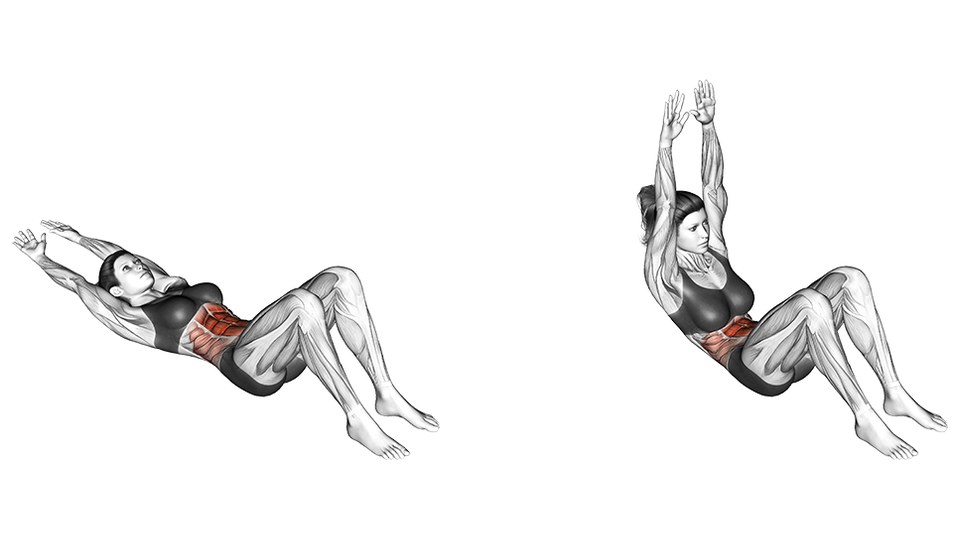
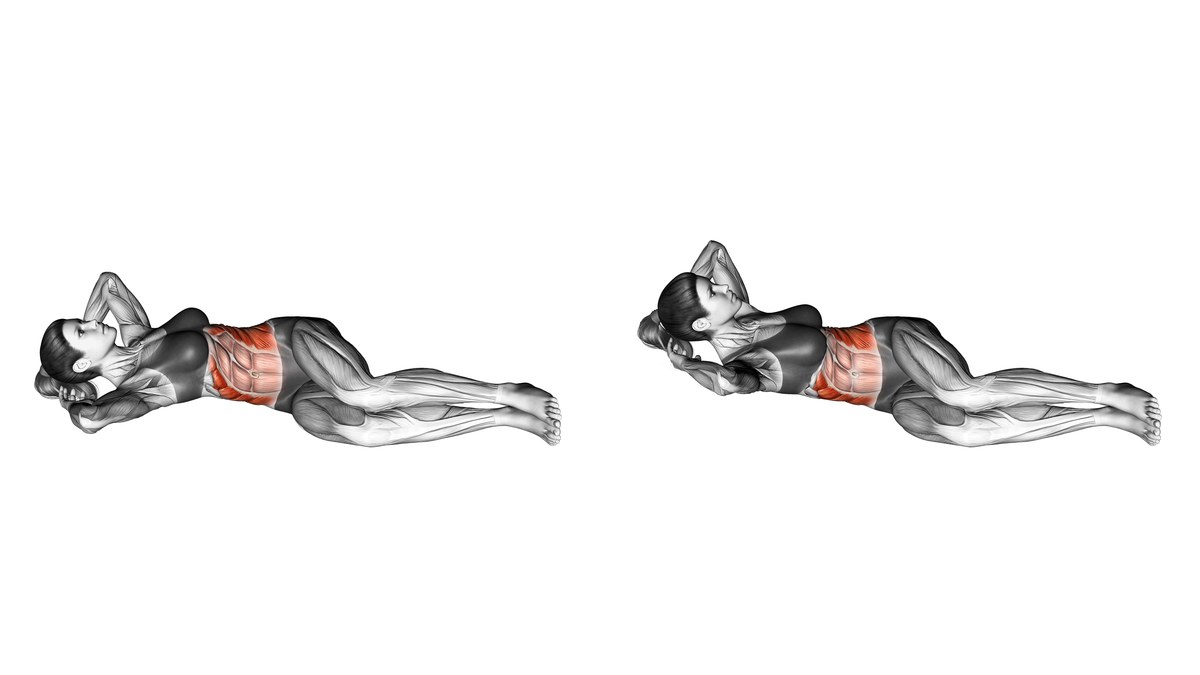
A crunch is a bodyweight abdominal exercise done lying on your back with your knees bent: you curl your head and shoulder blades off the floor, pause, and lower under control. It trains the rectus abdominis — the six-pack muscle, and a powerful flexor of the spine — with the external and internal obliques assisting. The lower back never leaves the floor, and that is what separates a crunch from a sit-up. Stopping at the shoulder blades keeps the movement focused on curling the trunk. Continuing into a sit-up adds more hip-flexor involvement while the abs remain active.
How do you perform a crunch?
Set up
- Lie on your back with your knees bent and your feet flat, about hip-width apart.
- Rest your fingertips lightly behind your ears and keep your elbows open.
Execution
- Exhale as you curl your ribs toward your hips until your shoulder blades lift, keeping your lower back down.
- Pause briefly without pulling on your head or tucking your chin.
- Lower under control until your shoulder blades touch, then start the next rep without bouncing.
Common mistakes
Pulling your head forward with your hands
Your arms bend your neck, which is not something your abs did. The rep looks finished while the spine barely flexed, and the neck soreness that follows tends to end ab training long before the abs were the limit.
Coming all the way up into a sit-up
Once your lower back leaves the floor the joint that is moving changes. The rest of the travel is flexion at the hip, driven by the hip flexors, while the abs mostly hold the position they already reached. A sit-up is a fine exercise; it is just not the one you started.
Lifting only the head and neck
If the shoulder blades never clear the floor, the spine hardly flexes and the rectus abdominis hardly shortens. The set is easy because almost no work is being done, which is why the rep count keeps climbing.
Hooking your feet under something heavy
Anchoring the feet can increase hip-flexor involvement even in a curl-up. If you use the anchor to pull yourself all the way up, you turn the rep into a sit-up.
Bouncing off the floor between reps
The rebound covers the start of the next rep, and the start is the hardest part: your torso is closest to horizontal there, so your abs are fighting the longest lever. Bouncing removes exactly the range you came for.
Where it fits in a session
At the end of a session. A crunch needs no equipment and blocks nobody, so it sits after the work that needs a rack, a bench or a machine.
Two to four sets is plenty. Crunches get easier fast, because bodyweight does not go up — when a set runs past about twenty reps without much effort, add resistance or slow the tempo rather than adding reps. A plate on the chest or a cable crunch both do the job.
Muscles worked
Primary
Secondary
Schematic surface view. Some muscles are partly visible or not shown.
Ranked, unlike some records, because the anatomy references support a ranking here. The rectus abdominis is described as a powerful flexor of the vertebral column, and a straight crunch is spinal flexion and nothing else. The obliques' named actions are rotation and lateral flexion, which a symmetrical crunch never asks for; they contribute to trunk flexion as part of the flat-muscle group, which is what puts them second rather than off the list. Transversus abdominis is deliberately excluded — its described action is compressing the abdominal contents, not moving the spine. The hip flexors are not listed as targets: keeping the movement to trunk flexion limits their involvement compared with a full sit-up, without implying that their activity is zero.
What lifters actually do
Crunches are an add-on, and the logs are unambiguous about it. A bit over a third of regular RepCount users have logged them at some point, but they appear in only about one workout in twenty-eight, and when they do it is as roughly three sets inside a full session of seven or eight exercises. What that session is usually about is legs: leg extensions, leg curls, the leg press and squats all sit near the top of what crunches share a workout with. The one movement in that group that is not leg work is another ab exercise — leg raises, alongside crunches in nearly one crunch session in five — so abs tend to arrive in pairs, bolted onto the end of leg day rather than given a day of their own.
Most often trained alongside
Share of crunch sessions that also include each exercise.
- Leg extensions22.6%
- Leg raises18.1%
- Leg curls17.9%
- Leg press15.8%
- Squat15.4%
Figures come from workouts tracked in RepCount.
Scientific studies on crunches
Crunch research helps separate three things that often get bundled together: abdominal muscle activity, improved exercise performance and changes in body fat.
A crunch can train the abs while keeping hip-flexor involvement lower than a full sit-up. Abdominal training can improve endurance, but a few sets of floor crunches are not an established way to selectively reduce belly fat.
Do sit-ups stop working the abs?
No. In a small study of six men, both trunk-flexion and hip-flexion sit-ups produced substantial abdominal muscle activity. Hip flexors were most active when the movement included lifting the whole torso or the legs. Adding hip movement did not switch the abs off.
Foot restraint also matters. In 23 British Army personnel, sit-ups and curl-ups with restrained feet produced more rectus femoris activity than curl-ups with free feet. Rectus femoris helps flex the hip. These were electrical muscle-activity measurements during exercise; they do not establish which version builds more muscle or causes fewer injuries.
Will more crunches reduce belly fat?
Do not count on it. In a six-week trial, 24 sedentary adults were assigned to an abdominal-exercise program or a control group. Training improved curl-up performance, but did not clearly reduce abdominal fat, waist circumference or body-fat percentage.
A later trial found greater trunk-fat loss with abdominal machine exercise plus treadmill training than with treadmill training alone. However, it involved only 16 men and 84-minute sessions, four times per week for ten weeks. The measurement included fat across the abdomen, chest and back. That result cannot be transferred to a few sets of floor crunches.
Why these results need different interpretations
The six-week trial used seven abdominal exercises, so it did not isolate the floor crunch. The later trial combined machine crunches, torso rotation and treadmill exercise, with energy expenditure matched using separate pilot samples. Its trunk-fat measure did not isolate the layer of fat over the abs, and waist reduction did not clearly differ between groups. Neither study demonstrates that the floor crunch alone selectively removes belly fat.
Variations
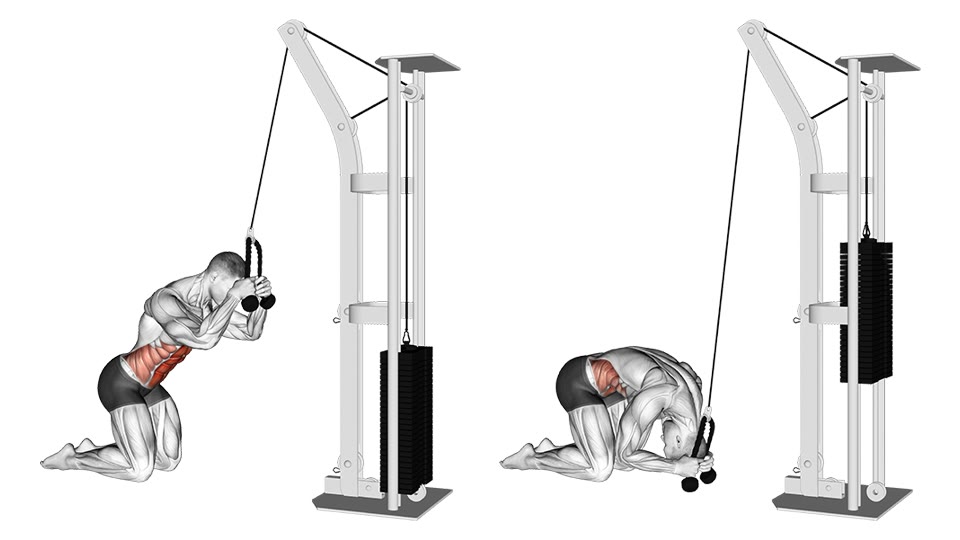
- Cable crunchKneeling under a high pulley, holding a rope. The stack makes the movement loadable, which bodyweight reps never become.
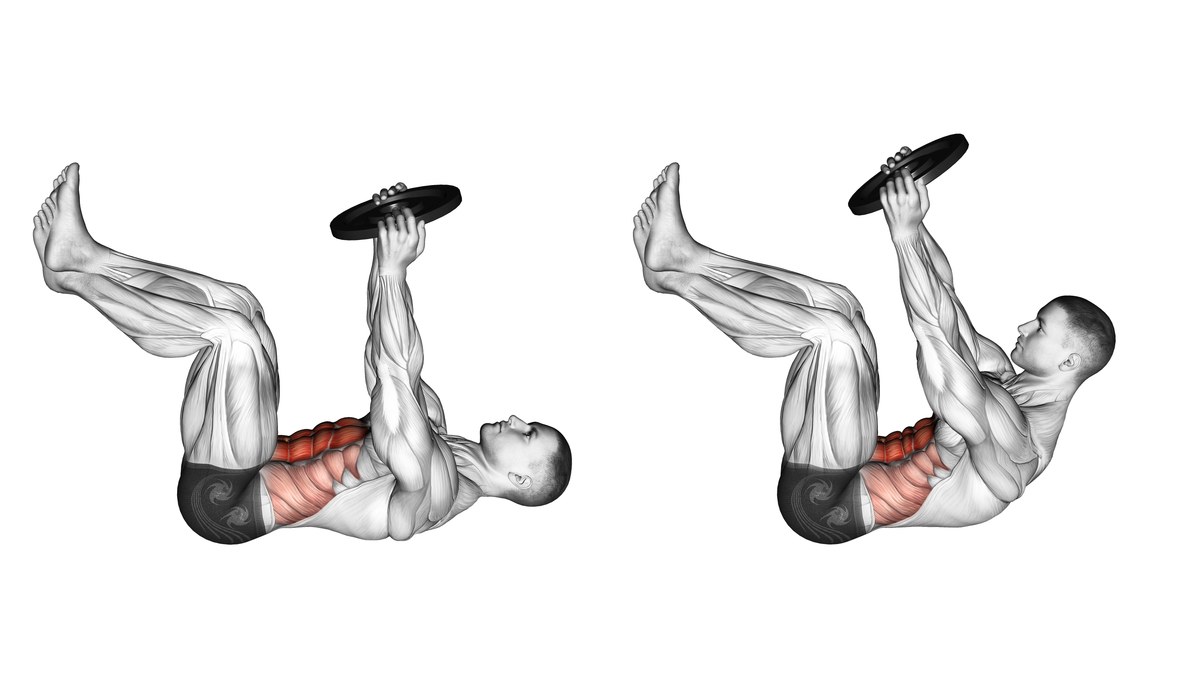
- Weighted crunchHold a plate above the chest for a short floor crunch, with the pelvis and lower back staying on the mat.
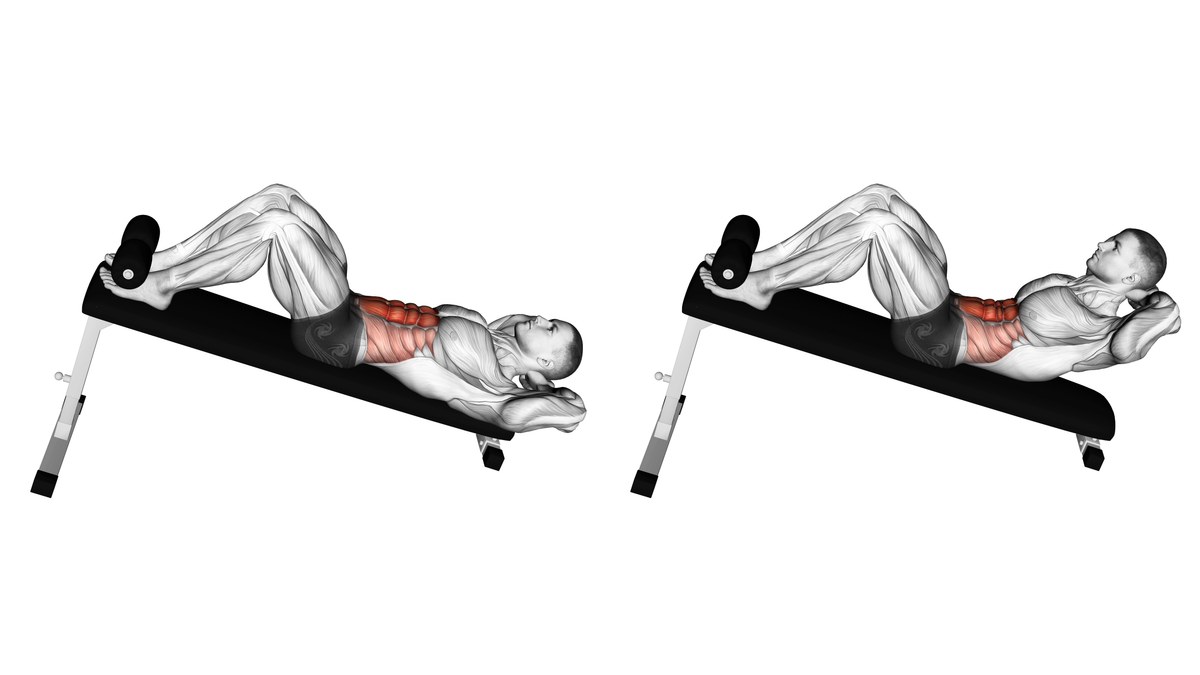
- Decline crunchOn a decline bench with the feet secured. The angle keeps tension on further into the curl.
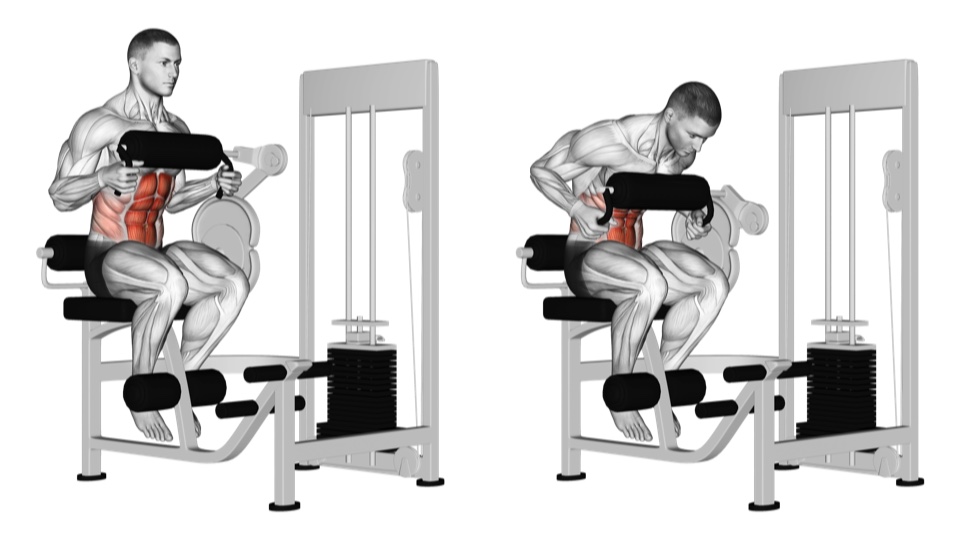
- Machine crunchSeated ab machine. Fixes the path and puts the load on a pin, so progression is a matter of moving it.
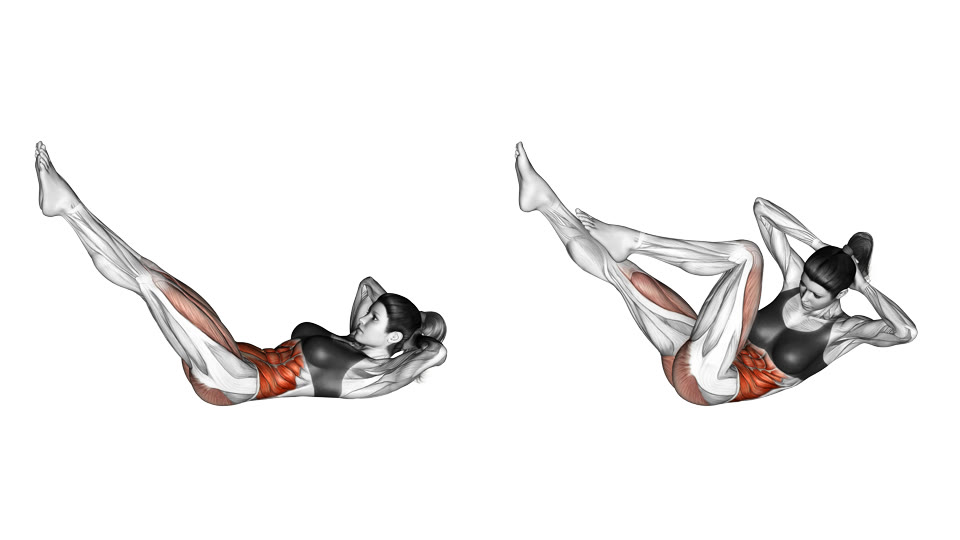
- Bicycle crunchAdds rotation toward the opposite knee, which brings the obliques in rather than leaving them assisting.
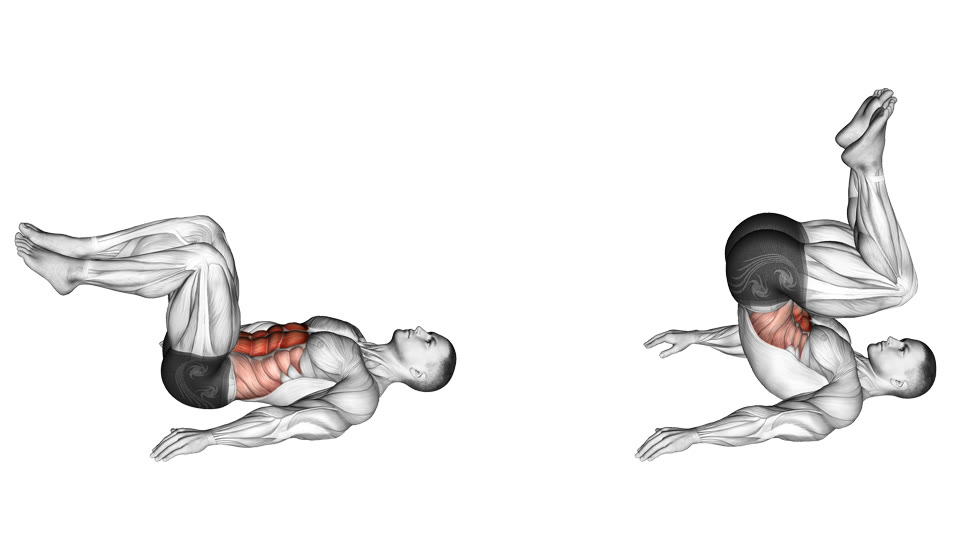
- Reverse crunchThe other end moves: the hips and knees curl toward the chest while the upper back stays down.
Articles
Related tools
Frequently asked questions
What muscles do crunches work?
Mainly the rectus abdominis — the long paired muscle running from the pubic bone up to the fifth through seventh costal cartilages, divided by tendinous intersections into the segments people call a six-pack. Anatomy references describe it as a powerful flexor of the vertebral column, and flexing the spine is all a crunch does. The external and internal obliques assist: they help flex the trunk as part of the abdominal wall, though their own leading actions are rotation and lateral flexion, which a straight crunch never asks for. The deepest abdominal muscle, the transversus abdominis, compresses the abdominal contents rather than moving the spine.
What is the difference between a crunch and a sit-up?
A crunch ends with the shoulder blades lifted and the lower back still on the floor. A sit-up continues farther and includes more movement at the hips. Both involve the abs; the sit-up also asks more of the hip flexors. Studies of curl-up variations show that restraining the feet can increase hip-flexor activity even without completing a full sit-up.
Should my hands go behind my head or across my chest?
Either. It is a preference rather than a technique point, and an illustration can only ever show one of them. Fingertips behind the ears supports the head on long sets; folded across the chest removes the temptation to pull. What matters is the same either way — the hands never drag the head forward.
Do crunches burn belly fat?
Crunches train the abdominal muscles, but a few sets are not an established way to selectively reduce belly fat. A six-week abdominal-training trial improved curl-up endurance without clearly reducing abdominal fat. A later trial reported greater trunk-fat loss from long machine-and-treadmill sessions, which is a different program from ordinary floor crunches.
How many crunches should I do?
Two to four hard sets beats one long set of easy reps, and that is close to what lifters actually do: in workouts tracked in RepCount, a session containing crunches averages about three sets of them. Because bodyweight never increases, sets creep longer over time — when one runs past roughly twenty reps without much effort, the useful change is load or tempo, not a higher count.
Are crunches worth doing?
They are worth a few sets as an add-on, which is exactly how they get used. In workouts tracked in RepCount, crunches turn up in roughly one workout in twenty-eight, almost always inside a full session of seven or eight exercises built around something else. As direct, equipment-free work for the rectus abdominis they earn their place at the end of a session; they are not what a session gets built around.
Sources
- Flynn W, Vickerton P. Anatomy, Abdomen and Pelvis: Abdominal Wall. StatPearls. https://www.ncbi.nlm.nih.gov/books/NBK551649/
- Varacallo MA, Scharbach S, Al-Dhahir MA. Anatomy, Anterolateral Abdominal Wall Muscles. StatPearls. https://www.ncbi.nlm.nih.gov/books/NBK470334/
- Bordoni B, Varacallo MA. Anatomy, Bony Pelvis and Lower Limb: Iliopsoas Muscle. StatPearls. https://www.ncbi.nlm.nih.gov/books/NBK531508/
- Andersson EA, Nilsson J, Ma Z, Thorstensson A. Abdominal and hip flexor muscle activation during various training exercises. 1997. https://pubmed.ncbi.nlm.nih.gov/9118976/
- Burden AM, Redmond CG. Abdominal and hip flexor muscle activity during 2 minutes of sit-ups and curl-ups. 2013. https://pubmed.ncbi.nlm.nih.gov/23207881/
- Vispute SS, Smith JD, LeCheminant JD, Hurley KS. The effect of abdominal exercise on abdominal fat. 2011. https://pubmed.ncbi.nlm.nih.gov/21804427/
- Brobakken MF, Krogsæter I, Helgerud J, Wang E, Hoff J. Abdominal aerobic endurance exercise reveals spot reduction exists: A randomized controlled trial. 2023. https://pmc.ncbi.nlm.nih.gov/articles/PMC10680576/