
Cable front raise
Also called cable front raises, two-arm cable front raise, cable bar front raise.
What is a cable front raise?
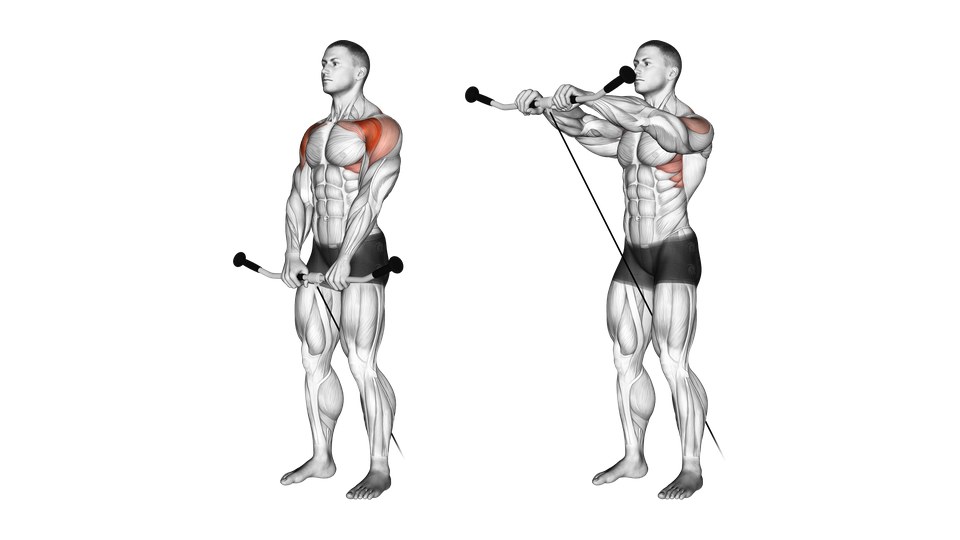
The cable front raise is a shoulder isolation exercise in which you raise a bar forward against a low pulley. It mainly trains the anterior deltoid at the front of the shoulder.
How do you perform a cable front raise?
Set up
- Attach a short bar to the low pulley, face away from the stack and take an overhand grip around shoulder width.
- Stand tall with the bar in front of your thighs, your arms almost straight and enough distance from the stack to keep the cable taut.
Execution
- Raise the bar forward by moving at the shoulders while keeping the elbow angle and torso still.
- Stop around shoulder height, before you need to lean back or shrug to lift farther.
- Lower the bar under control to the front of your thighs and repeat from the same stance.
Common mistakes
Leaning back
Torso movement helps the bar rise without asking the shoulders to produce the same movement. Use less load and keep your ribs over your pelvis.
Turning it into an upright row
Bending the elbows sharply changes the exercise. Keep only a small, fixed bend while the upper arms travel forward.
Losing cable tension at the bottom
Standing too close can let the stack settle between reps. Step far enough away that the cable stays taut at your thighs.
Where it fits in a session
Usually used after compound pressing as direct work for the front of the shoulders.
Keep the attachment, stance and endpoint consistent when comparing loads between sessions.
Muscles worked
Primary
Secondary
- None listed in this guide
Schematic surface view. Some muscles are partly visible or not shown.
The anterior deltoid raises the upper arm forward. Other shoulder and shoulder-blade muscles assist, but the compact target list does not present them as equal targets.
Variations
- Single-arm cable front raise — Uses one handle and trains one shoulder at a time.
- Rope cable front raise — Uses a rope so the hands can rotate instead of staying fixed on a bar.
Frequently asked questions
What muscles do cable front raises work?
They mainly train the anterior deltoid at the front of the shoulder.
How high should you raise the cable bar?
Shoulder height is a clear, repeatable endpoint. Stop earlier if going higher causes discomfort, a shrug or a backward lean.
Should your elbows be straight?
Keep them straight or slightly bent, then hold that angle through the repetition instead of bending more as the bar rises.
Can you do cable front raises one arm at a time?
Yes. Use a single handle and keep the same forward arm path on each side.
Sources
- Elzanie A, Varacallo MA. Anatomy, Shoulder and Upper Limb, Deltoid Muscle. StatPearls. https://www.ncbi.nlm.nih.gov/books/NBK537056/
- McCausland C, Sawyer E, Eovaldi BJ, Varacallo MA. Anatomy, Shoulder and Upper Limb, Shoulder Muscles. StatPearls. https://www.ncbi.nlm.nih.gov/books/NBK534836/