Front raise
Also called front raises, dumbbell front raise, front delt raise.
What is a front raise?
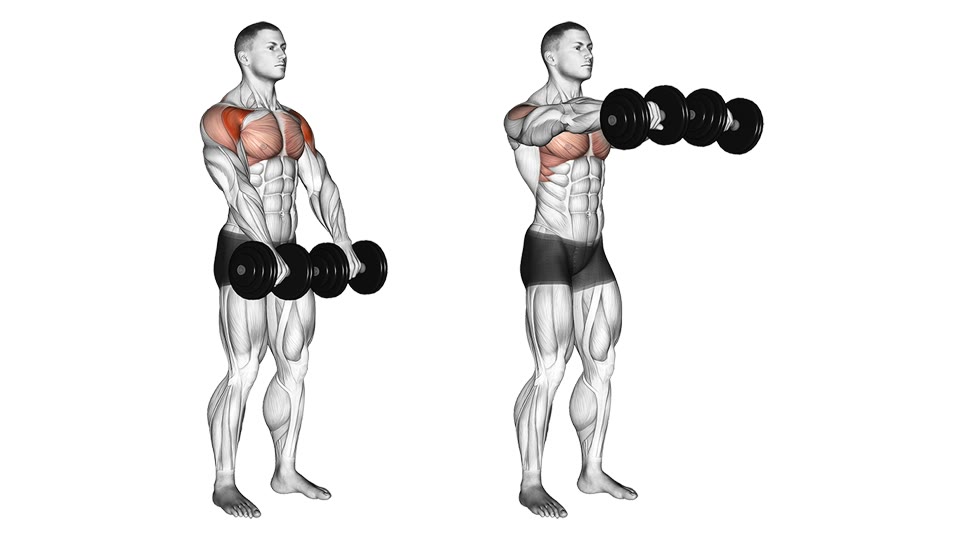
The front raise is a shoulder exercise performed by lifting dumbbells forward from the thighs to about shoulder height. It mainly trains the front deltoids, with the lateral deltoids assisting.
How do you perform a front raise?
Set up
- Stand steadily with a dumbbell in each hand resting in front of your thighs.
- Keep a small bend in the elbows and brace your torso so the arms can move without leaning back.
Execution
- Raise both dumbbells forward until your arms are around shoulder height.
- Keep the same elbow bend and stop before the shoulders or torso have to move for extra height.
- Lower the dumbbells under control to the thighs.
Common mistakes
Leaning back to start the raise
Torso movement supplies momentum instead of keeping the resistance on the shoulder movement.
Changing the elbow bend
Bending and straightening the arms changes the lever and makes the path inconsistent.
Forcing the dumbbells above a comfortable range
Extra height is not useful if it requires shrugging, arching or shoulder discomfort.
Where it fits in a session
Usually after heavier shoulder presses or with other shoulder accessory work.
Choose dumbbells that can reach shoulder height without a torso swing.
Muscles worked
Primary
Secondary
Schematic surface view. Some muscles are partly visible or not shown.
The front deltoids raise the arms forward, with the lateral deltoids assisting.
Variations
- Alternating front raise — Raises one dumbbell at a time.
- Cable front raise — Uses a low cable for the same forward arm path.
- Plate front raise — Holds one plate with both hands.
Frequently asked questions
What muscles do front raises work?
They mainly train the front deltoids, with the lateral deltoids assisting.
How high should a front raise go?
About shoulder height is a clear stopping point. Use a lower comfortable range if going higher makes you shrug, lean or feel shoulder discomfort.
Should the arms be straight?
Keep the elbows straight or slightly bent, then hold that angle through the repetition rather than bending to move the weight.
Can you alternate arms?
Yes. Alternating lets one arm rest briefly, while raising both together makes torso movement easier to notice.