
Cable lateral raise
Also called cable side raise, single-arm cable lateral raise, cable lat raise.
What is a cable lateral raise?
The cable lateral raise is a shoulder isolation exercise in which one arm lifts out to the side against a low pulley. It mainly trains the lateral deltoid, with the anterior deltoid assisting.
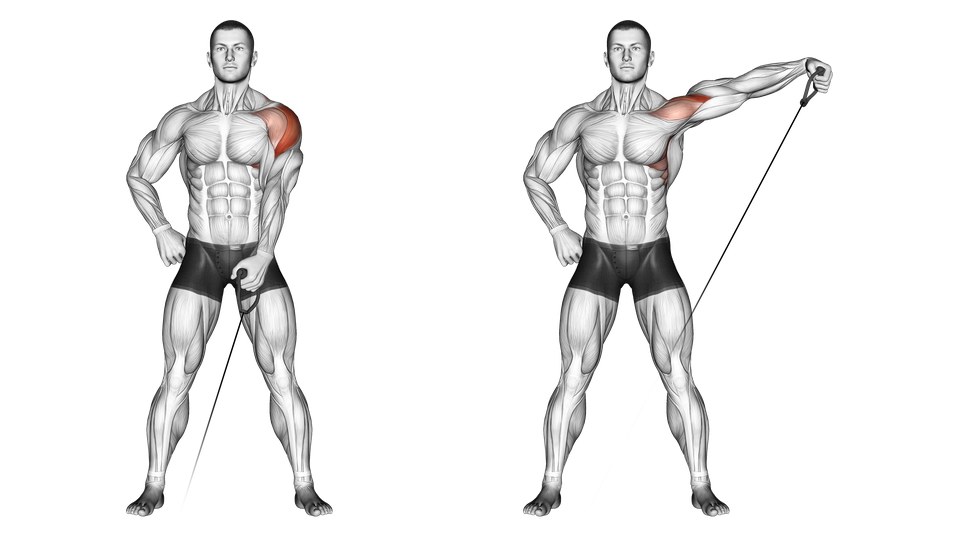
How do you perform a cable lateral raise?
Set up
- Set a single handle on the low pulley and stand side-on with the working arm away from the machine.
- Hold the handle in front of your body, brace with the free hand if needed, and keep a small bend in the working elbow.
Execution
- Raise the arm out to the side, keeping the elbow angle steady.
- Stop around shoulder height without leaning or shrugging to gain extra range.
- Lower the handle under control, finish the set, then change sides.
Common mistakes
Bending and straightening the elbow
Changing the elbow angle turns one shoulder movement into a mixed arm movement and makes reps inconsistent.
Leaning away to lift more weight
Torso movement changes the cable angle and shortens the useful comparison between reps.
Shrugging the shoulder upward
Choose a load that lets the arm rise without the shoulder being pulled toward the ear.
Where it fits in a session
Usually after compound shoulder pressing, alongside other shoulder isolation work.
Use a load that keeps the torso and elbow angle still through the chosen range.
Muscles worked
Primary
Secondary
Schematic surface view. Some muscles are partly visible or not shown.
The lateral deltoid is the main target. The anterior deltoid assists; smaller stabilisers are not promoted into the compact target list.
Variations
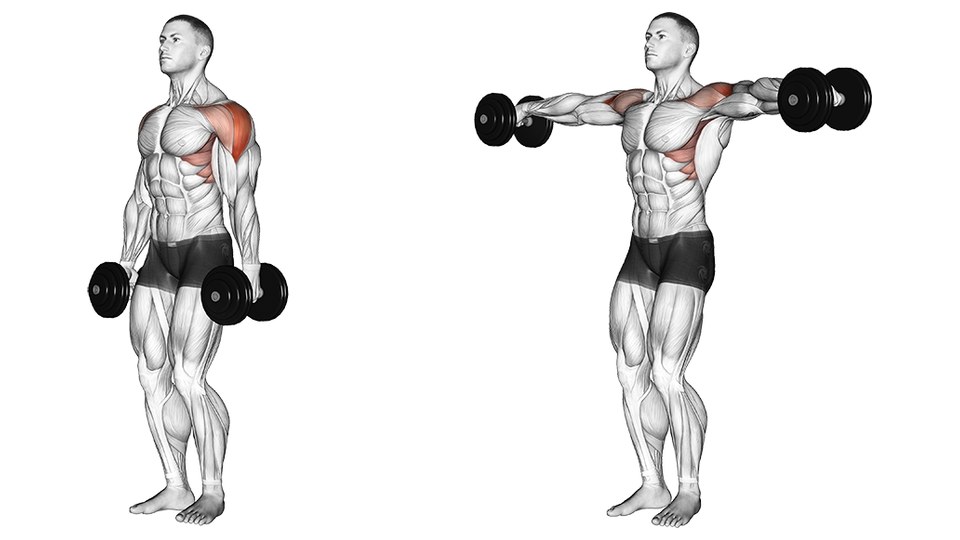
- Dumbbell lateral raiseUses free weights, so resistance is lightest near the bottom rather than coming from the pulley.
- Cuffed cable lateral raise — Attaches the cable above the wrist so grip is removed from the setup.
- Behind-the-back cable lateral raise — Starts with the cable running behind the hips instead of in front.
Frequently asked questions
What muscles do cable lateral raises work?
They mainly train the lateral deltoid. The anterior deltoid assists the arm as it rises.
How high should you raise the cable?
Shoulder height is a clear, repeatable endpoint. Going higher is optional, but it should not require a shrug or torso lean.
Should the cable run in front of or behind you?
The standard version shown here starts in front of the body. A behind-the-back start is a valid variation, but log it consistently if its range feels different.
Can you use a cuff instead of a handle?
Yes. A wrist cuff removes grip from the exercise while keeping the same one-arm shoulder movement.
Sources
- Elzanie A, Varacallo MA. Anatomy, Shoulder and Upper Limb, Deltoid Muscle. StatPearls. https://www.ncbi.nlm.nih.gov/books/NBK537056/
- Larsen S, Wolf M, Schoenfeld BJ, et al. Dumbbell versus cable lateral raises for lateral deltoid hypertrophy: an experimental study. 2025. https://doi.org/10.3389/fphys.2025.1611468