
Dumbbell lateral raise
Also called lateral raise, side lateral raise, dumbbell side raise, shoulder lateral raise.
What is a dumbbell lateral raise?
A dumbbell lateral raise is shoulder abduction with a dumbbell: arms at your sides, you lift them out sideways to about shoulder height. It trains the lateral head of the deltoid, the part of the shoulder muscle that raises the arm out to the side, with help from the rotator cuff and the muscles that steady the shoulder blade. Several things about it are preference rather than technique: both arms together or one at a time, seated or standing, and how far you rotate the hand.
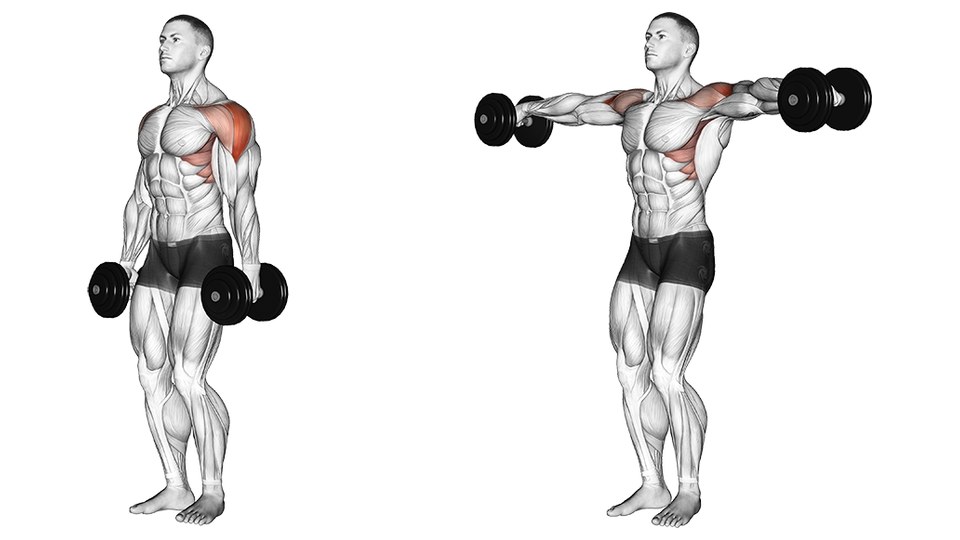
How do you perform a dumbbell lateral raise?
Set up
- Stand with a light dumbbell in each hand, feet about hip-width apart and knees soft. Brace your torso and lean forward slightly from the hips.
- Let the dumbbells hang just clear of your thighs, palms facing in. Keep a slight bend in your elbows for the whole set.
Execution
- Raise your arms out and slightly forward, leading with your elbows. Keep your torso still and do not swing the weights.
- Stop at shoulder height with your elbows level with or slightly above your hands, and keep your shoulders down.
- Lower the dumbbells under control to the start, keeping them just off your thighs, then repeat.
Common mistakes
Loading it heavy enough that the torso has to help
The top of the rep, arm out and horizontal, is the longest lever this movement puts on the shoulder, and it is the position the exercise exists for. Swinging the torso throws the weight through exactly the range you added the weight for, so you end up with a heavier dumbbell and a lighter set. The slight lean you set at the start is not the problem; it stays where you put it. If your hips are moving, the number in your log is measuring your hips.
Shrugging as the dumbbells come up
The upper trapezius elevates and upwardly rotates the shoulder blade, so a shrug genuinely does raise the arm — just not by abducting the shoulder. The dumbbell reaches the same height with the lateral deltoid doing less of the work, which is the opposite of the trade you wanted.
Letting the elbows bend further as the set gets hard
Bending the elbow shortens the distance between the shoulder and the weight, which makes the same dumbbell easier to lift. The reps look identical from the outside and the set is quietly getting lighter as it goes, so the log records progress that did not happen.
Drifting the upper arms forward as fatigue sets in
Raising in front of the body turns it into a front raise, and the anterior deltoid is a shoulder flexor that pressing already works. In our own data the movements that most often share a session with a lateral raise are presses and triceps work, so a drifting plane sends the work to the part of the shoulder that has had the most of it already.
Chasing extra height above the shoulder for a bigger squeeze
Use the same shoulder-height endpoint from rep to rep so that you can compare your sets. Raising higher changes the range being trained; it is not evidence that the deltoid has stopped contributing.
Where it fits in a session
After the pressing on an upper-body or push day, alongside the other shoulder and triceps accessory work.
This is isolation work for a small muscle with light absolute loads, so it is cheap to recover from and can be repeated more than once a week without much cost. Higher reps suit it — somewhere in the 10 to 20 range — partly because form holds up better there and partly because the smallest dumbbell jump available is a large percentage step on a weight this light. Progress it by adding reps and cleaning up the descent for several sessions before you touch the next dumbbell up. Keep it light and strict: the load should stay low enough that the shoulders lift it, not a swing.
Muscles worked
Primary
Secondary
Schematic surface view. Some muscles are partly visible or not shown.
The lateral deltoid is the main target of this guide. The rotator cuff and other deltoid portions help control the upper arm, while the trapezius and serratus anterior move and steady the shoulder blade.
These muscles work together. The supraspinatus does not start the movement alone, and the deltoid does not wait for a fixed angle before contributing. Muscle activity also changes with arm position; the target list is not a complete ranking of measured activity or expected growth.
What lifters actually do
Roughly seven in ten regular RepCount users have logged a dumbbell lateral raise at some point, so few lifters go without trying it. What it sits beside says more than that number. The five movements that share a session with it most often are the dumbbell shoulder press, bench press, pushdowns, incline dumbbell press and triceps extensions: every one of them a press or a triceps movement, with nothing from a back or leg day on the list. Lateral raises are a push-day fixture rather than a shoulder-day one. Sessions holding it run to about seven exercises and about three sets of the raise itself, which is accessory-work behaviour and not the profile of something anyone builds a workout around.
Most often trained alongside
Share of dumbbell lateral raise sessions that also include each exercise.
- Bench press25%
- Pushdowns22%
- Triceps extensions16.7%
Figures come from workouts tracked in RepCount.
Scientific studies on lateral raises
One direct training study compared dumbbells with cables. Other experiments examined muscle activity and shoulder function; those answer different questions from muscle growth.
Dumbbells and cables both produced side-deltoid growth in the tested program. Rotation changes muscle activity, but that does not establish a best grip for growth. The shoulder muscles work together rather than taking turns at fixed angles.
Do cables build more side deltoid than dumbbells?
An eight-week study assigned one arm of each of 24 trained men and women to cables and the other to dumbbells. Both versions increased lateral-deltoid thickness, with the analysis supporting similar changes under the tested conditions.
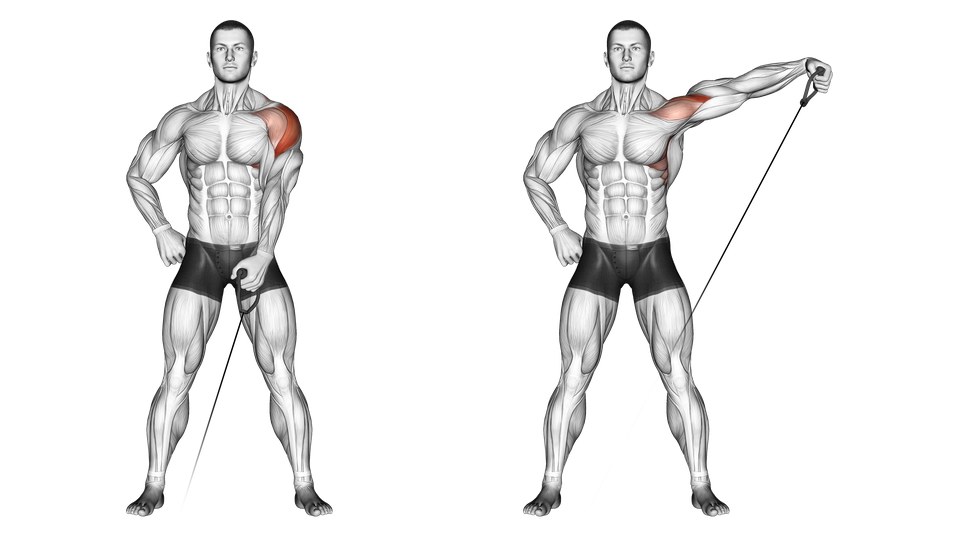
Both arms trained twice weekly through the same range, from the arm beside the body to shoulder height. The cable pulley was approximately hand-height at the bottom. That result does not cover every pulley position or a cable raise starting across the body.
You do not need to replace dumbbells on the assumption that cables always build more muscle. This was one short study measuring thickness at two sites, not a guarantee that every variation gives identical results.
Sources
Should you turn your thumbs down?
A study of ten male bodybuilders compared seated raises with the upper arm rotated inward, outward or held neutral. Neutral rotation produced more side-deltoid activity than outward rotation while lifting; inward rotation produced more while lowering than either. Inward rotation also increased rear-deltoid and upper-trapezius activity.
There was no single rotation that simply increased all shoulder activity in the same way. The experiment measured electrical activity, not growth, pain or injury. It does not establish that thumbs-down raises are necessary or safer. Use a comfortable arm position that you can repeat.
Sources
Does the deltoid only work between fixed angles?
The research does not support such a neat handover. In 14 volunteers, the deltoid and several other shoulder muscles activated before the arm began to rise. The supraspinatus did not activate significantly earlier than those muscles.
In another experiment, temporarily blocking the nerve supply to the deltoid reduced shoulder-abduction strength both with the arm at the side and above shoulder height. That experiment examined overall shoulder function, not growth of an individual deltoid head.
Shoulder height remains this guide’s practical endpoint. It is not a switch where the side deltoid stops working, and these experiments do not establish an optimal training range.
Variations
- Cable lateral raiseThe pulley position and line of pull change where the movement is hardest; the cable does not automatically provide constant shoulder resistance.
- Seated dumbbell lateral raise — Removes the option to drive the weight up with the hips and knees.
- Leaning single-arm lateral raise — Holding a rack and leaning away sideways puts load on the shoulder earlier in the range than the standing version does.
- Lying side lateral raise — Done on your side on a bench or incline; the hardest point of the rep moves lower in the range.
- Behind-the-back cable lateral raise — Cable runs behind the body, which keeps tension on at the bottom, where a dumbbell has almost none.
Articles
Related tools
Frequently asked questions
What muscles does the dumbbell lateral raise work?
Mainly the lateral deltoid, with help from the rotator cuff, other deltoid portions and muscles that move and steady the shoulder blade. The deltoid and supraspinatus work together from the start rather than handing the movement over at a fixed angle.
How high should you raise the dumbbells?
This guide uses about shoulder height as a clear, repeatable endpoint. That is a coaching choice, not proof that the side deltoid stops working above it. The studies reviewed here do not establish which upper endpoint produces the most growth.
Why do I feel lateral raises in my traps?
Usually because the shoulder is riding up toward your ear as the arm goes out. The upper trapezius elevates and upwardly rotates the shoulder blade, so shrugging is a genuine way to get the dumbbell to shoulder height — just not by abducting the shoulder. Keep the shoulder down, and if it will not stay down, the dumbbell is too heavy. Some trapezius involvement is normal regardless, because the shoulder blade has to be controlled for the shoulder joint to move properly.
Should you point your thumbs down at the top?
There is no need to force that position. Upper-arm rotation changes measured muscle activity, but the study reviewed here did not establish a best rotation for growth or shoulder safety. Use the position your shoulder is comfortable in through the range, and keep it consistent.
Should you raise both arms at once or one at a time?
Either. It is a preference, not a technique point. One arm at a time lets you hold onto something for balance and actually watch the working side, which makes it easier to catch a shoulder creeping upward; both arms at once gets the set done in half the time. Seated or standing is the same kind of choice, though seated removes the option of driving the weight up with your legs.
How heavy should lateral raises be?
Lighter than you would guess. The honest test is positional rather than numerical: can you reach shoulder height with the shoulders down, the elbow angle unchanged and the torso still, and have you added reps at that weight over the past few weeks. A dumbbell you can only move by swinging the torso is not measuring your shoulders.
Are lateral raises worth doing?
By what people actually do, yes. Roughly seven in ten regular RepCount users have logged a dumbbell lateral raise at some point, so few lifters go without trying it. It behaves like accessory work throughout: about three sets, in a session holding about seven exercises, usually alongside pressing.
Can you do lateral raises with a cable or a machine instead?
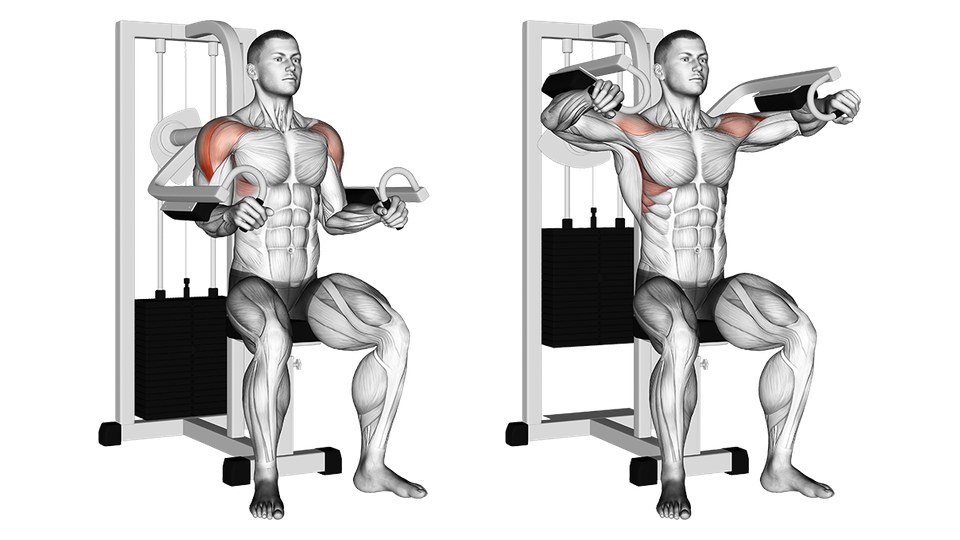
Yes. The resistance changes through the movement differently: a dumbbell creates little turning force at the shoulder when it hangs below it, and more as the arm approaches horizontal. A cable’s resistance profile depends on its line of pull and pulley position; it is not automatically constant. A machine guides the arm path. One eight-week comparison found similar side-deltoid thickness changes with the tested dumbbell and cable versions.
Sources
- Elzanie A, Varacallo MA. Anatomy, Shoulder and Upper Limb, Deltoid Muscle. StatPearls. https://www.ncbi.nlm.nih.gov/books/NBK537056/
- La Rose J, Madrazo-Ibarra A, Varacallo MA. Anatomy, Rotator Cuff. StatPearls. https://www.ncbi.nlm.nih.gov/books/NBK441844/
- Ourieff J, Scheckel B, Agarwal A. Anatomy, Back, Trapezius. StatPearls. https://www.ncbi.nlm.nih.gov/books/NBK518994/
- Lung K, St Lucia K, Lui F. Anatomy, Thorax, Serratus Anterior Muscles. StatPearls. https://www.ncbi.nlm.nih.gov/books/NBK531457/
- McCausland C, Sawyer E, Eovaldi BJ, Varacallo MA. Anatomy, Shoulder and Upper Limb, Shoulder Muscles. StatPearls. https://www.ncbi.nlm.nih.gov/books/NBK534836/
- Larsen S, Wolf M, Schoenfeld BJ, Sandberg NØ, Fredriksen AB, Kristiansen BS, van den Tillaar R, Swinton PA, Falch HN. Dumbbell versus cable lateral raises for lateral deltoid hypertrophy: an experimental study. 2025. https://doi.org/10.3389/fphys.2025.1611468
- Coratella G, Tornatore G, Longo S, Esposito F, Cè E. An Electromyographic Analysis of Lateral Raise Variations and Frontal Raise in Competitive Bodybuilders. 2020. https://doi.org/10.3390/ijerph17176015
- Reed D, Cathers I, Halaki M, Ginn K. Does supraspinatus initiate shoulder abduction?. 2013. https://pubmed.ncbi.nlm.nih.gov/23265661/
- Hecker A, Aguirre J, Eichenberger U, Rosner J, Schubert M, Sutter R, Wieser K, Bouaicha S. Deltoid muscle contribution to shoulder flexion and abduction strength: an experimental approach. 2021. https://pubmed.ncbi.nlm.nih.gov/32540315/