Cable rear delt fly
Also called rear delt cable fly, cable reverse fly, reverse cable fly.
What is a cable rear delt fly?
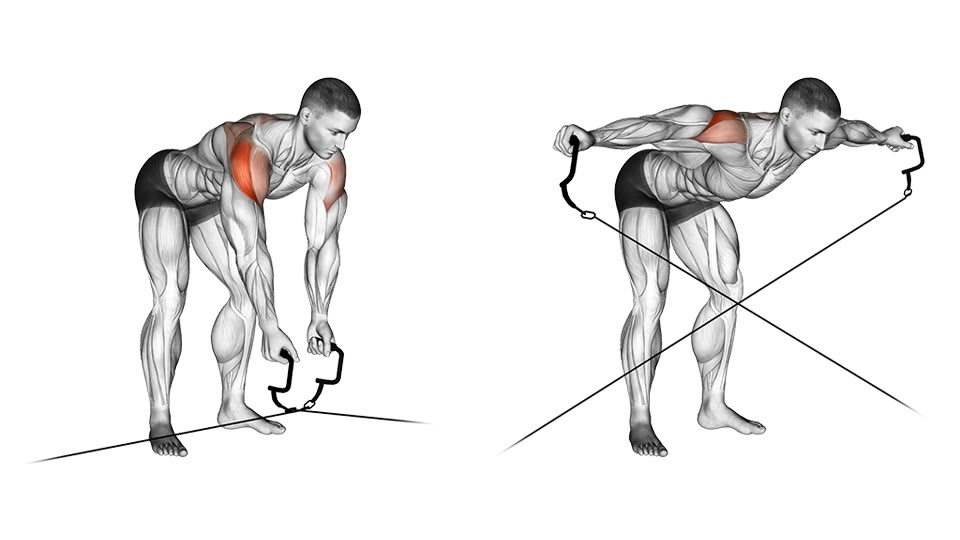
The cable rear delt fly is a wide-arm pulling exercise performed here in a hip hinge with crossed low cables. It trains the rear deltoids and rotator cuff, with the middle and lower trapezius and rhomboids assisting.
How do you perform a cable rear delt fly?
Set up
- Set both pulleys low, take the opposite handle in each hand so the cables cross, and step into the centre.
- Hinge forward with a steady torso, arms hanging below the shoulders and elbows slightly bent.
Execution
- Open both arms out and slightly back in a wide arc while keeping the elbow angle fixed.
- Stop around torso height before the shoulders shrug or the elbows turn into a row.
- Bring the handles back together under control without standing up.
Common mistakes
Rowing the handles
Bending the elbows and pulling toward the hips changes the movement from a fly into a row.
Standing up during the pull
Torso movement supplies momentum and changes the cable angle from rep to rep.
Shrugging for extra range
The arms do not need to travel above the torso if the neck and shoulders must rise to get there.
Where it fits in a session
Usually after heavier presses and rows, with other rear-shoulder accessory work.
Use a load that lets the arms move wide without bending into a row or lifting the torso.
Muscles worked
Primary
Secondary
Schematic surface view. Some muscles are partly visible or not shown.
The rear shoulders and rotator-cuff muscles move the arms wide while the middle back assists the shoulder-blade movement.
Variations
- Standing high-pulley reverse fly — Uses shoulder-height pulleys and an upright stance.
- Single-arm cable rear delt fly — Works one side at a time from the same cable path.
Frequently asked questions
What muscles does a cable rear delt fly work?
It mainly trains the rear deltoids and rotator cuff. The middle and lower trapezius and rhomboids assist.
Should the cables cross?
They cross in the low-pulley version shown here so each hand can start beneath the opposite shoulder. Upright versions can use different pulley positions.
How high should the arms go?
Open until the upper arms are around torso height. Stop sooner if going higher requires a shrug or changes the elbow bend.
Is this the same as a cable row?
No. A rear delt fly keeps a small, nearly fixed elbow bend and moves the arms wide; a row bends the elbows and pulls them closer to the torso.