Rear delt fly
Also called reverse dumbbell fly, dumbbell reverse fly, rear delt raise.
What is a rear delt fly?
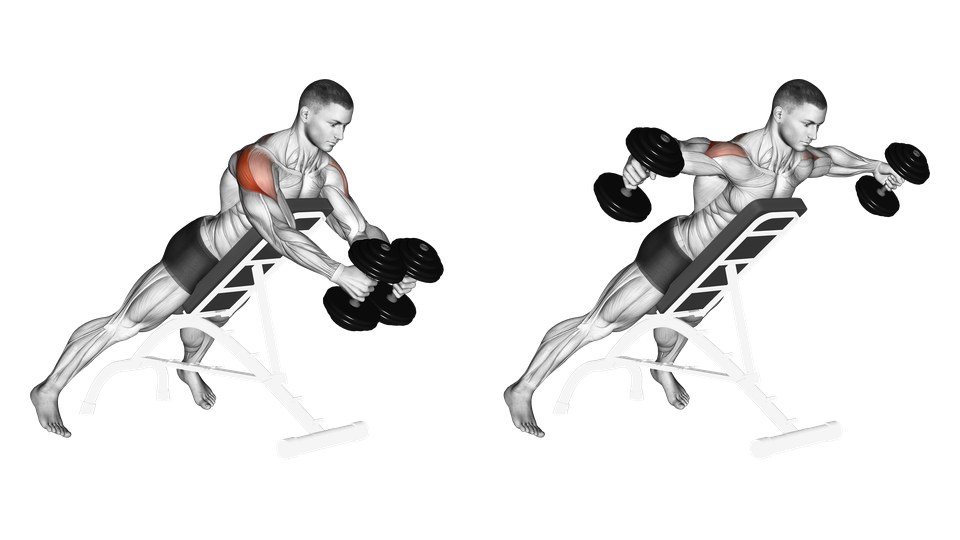
The rear delt fly is a wide-arm pulling exercise for the back of the shoulders. This version is performed chest-down on an incline bench with dumbbells, training the rear deltoids and rotator cuff while the trapezius and rhomboids assist.
How do you perform a rear delt fly?
Set up
- Set a bench to a low incline and lie chest-down with a dumbbell in each hand.
- Let the arms hang beneath the shoulders with the palms facing inward and a small, fixed bend in the elbows.
Execution
- Raise both upper arms out to the sides in a wide arc.
- Stop around shoulder height without shrugging or turning the movement into a row.
- Lower the dumbbells under control until they hang beneath the shoulders again.
Common mistakes
Rowing the dumbbells toward the hips
Pulling the elbows close to the torso changes the path toward a row and involves the lats more.
Changing the elbow bend during the rep
Bending the arms to finish makes the path shorter and turns the movement into a mixed fly and row.
Shrugging for extra height
Stop around shoulder height while the neck stays relaxed instead of forcing the dumbbells higher.
Where it fits in a session
Usually after heavier rows and presses, with other rear-shoulder accessory work.
Choose dumbbells that let the arms travel wide while the chest stays supported and the elbows keep the same bend.
Muscles worked
Primary
Secondary
Schematic surface view. Some muscles are partly visible or not shown.
The chest-supported dumbbell version uses the rear deltoids and rotator-cuff muscles for the wide arm movement while upper-back muscles assist.
Variations
- Standing rear delt fly — Uses a hip hinge instead of chest support from a bench.
- Cable reverse fly — Uses two cable handles crossing in front of the body.
- Reverse pec deck — Uses a seated machine with pads or handles guiding the arm path.
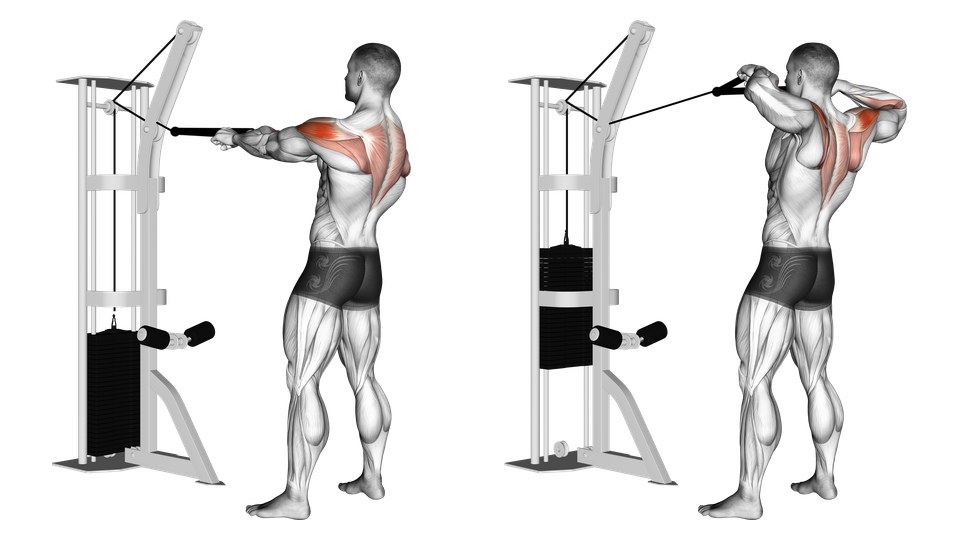
- Face pullsAdd a rope-to-face pull and external-rotation finish rather than using the fly's wide fixed-elbow arc.
Frequently asked questions
What muscles do rear delt flyes work?
They mainly train the rear deltoids and rotator cuff. The trapezius and rhomboids assist as the arms move wide and the shoulder blades move.
Should your elbows be straight in a rear delt fly?
Keep a small comfortable bend and hold that angle through the rep. The important point is not repeatedly bending the elbows to move the dumbbells.
How high should you lift the dumbbells?
Stop around shoulder height or level with the torso. Going higher should not require a shrug or the chest lifting away from the bench.
Is a rear delt fly the same as a face pull?
No. Both train the back of the shoulders, but a face pull uses a rope, bends the elbows more and finishes with external rotation beside the head.
Sources
- Elzanie A, Varacallo MA. Anatomy, Shoulder and Upper Limb, Deltoid Muscle. StatPearls. https://www.ncbi.nlm.nih.gov/books/NBK537056/
- La Rose J, Madrazo-Ibarra A, Varacallo MA. Anatomy, Rotator Cuff. StatPearls. https://www.ncbi.nlm.nih.gov/books/NBK441844/
- Ourieff J, Scheckel B, Agarwal A. Anatomy, Back, Trapezius. StatPearls. https://www.ncbi.nlm.nih.gov/books/NBK518994/