Cable wood chop
Also called cable woodchopper, cable woodchop, cable wood chops, high-to-low cable wood chop.
What is a cable wood chop?
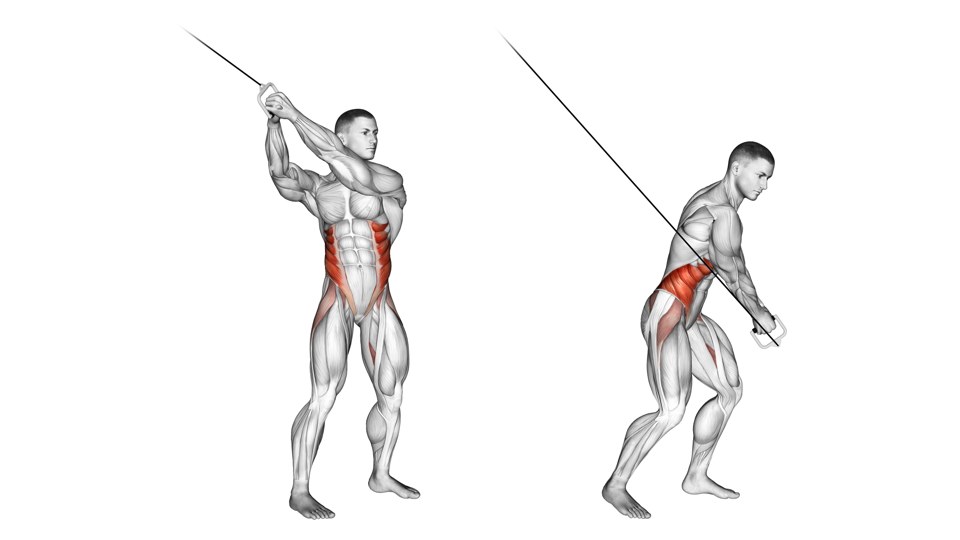
A cable wood chop moves a handle diagonally across the body while standing beside a cable machine. This guide covers the high-to-low version: both hands share one handle, which travels from above one shoulder toward the opposite hip.
How do you perform a cable wood chop?
Set up
- Attach a single handle to a pulley above shoulder height. Stand side-on to the pulley and hold the handle in both hands.
- Space your feet about shoulder-width apart, soften your knees and turn toward the high handle. Keep a slight bend in your elbows.
- Step away until the cable is taut, then brace your trunk before starting.
Execution
- Turn away from the pulley while guiding the handle down across your body toward the opposite hip. Let your hips and feet turn with your torso, allowing the rear heel to lift.
- Finish the diagonal with both hands near the far hip. Allow a small bend through the hips and knees, without collapsing your chest or tugging the handle with bent elbows.
- Follow the same diagonal back to the high position under control. Complete your repetitions, then turn around to train the other direction.
Common mistakes
Pulling mainly with the arms
Repeatedly bending and straightening the elbows turns the diagonal into an arm pull. Keep their angle nearly constant while turning.
Keeping the feet fixed while forcing a large turn
Allow the feet to pivot with the hips. Do not force the knees to follow a twisting torso while the feet stay planted.
Letting the stack yank you back
Use a load you can return smoothly without losing your balance or rushing the high position.
Where it fits in a session
Use it where your planned session calls for rotational trunk work.
Start with a load that permits a smooth diagonal in both directions. Keep the pulley height and standing distance consistent when recording your sets.
Muscles worked
Primary
Secondary
Schematic surface view. Some muscles are partly visible or not shown.
The obliques are the intended target, with the rectus abdominis also involved in the diagonal movement.
Variations
Frequently asked questions
Should your hips turn during a cable wood chop?
In the standing version taught here, the hips and feet turn with the torso. Avoid forcing the whole turn through the waist while the lower body stays locked.
Is a cable wood chop the same as a Pallof press?
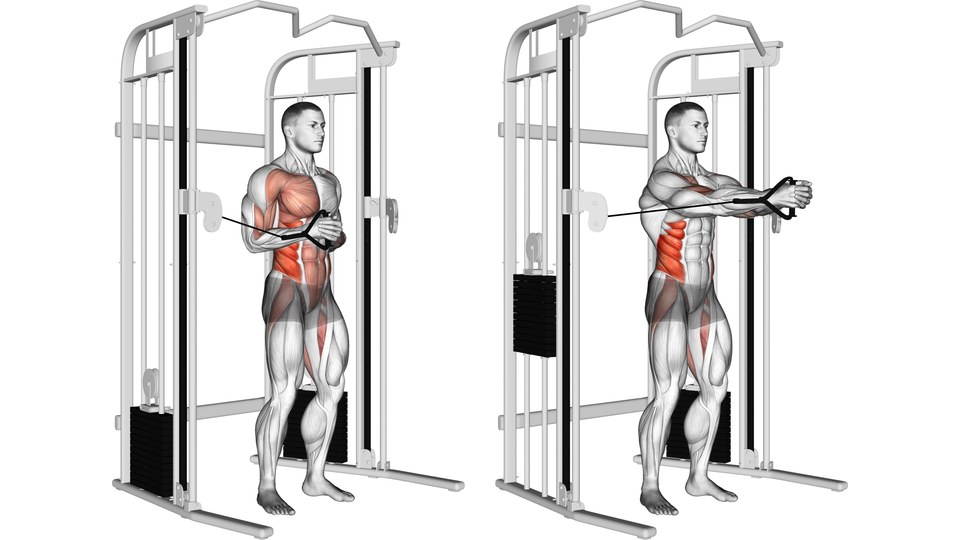
No. A wood chop includes a deliberate turn and a diagonal hand path. A Pallof press keeps the torso facing forward while the hands move out from the chest.