Clamshell
Also called clam exercise, side-lying clam.
What is a clamshell?
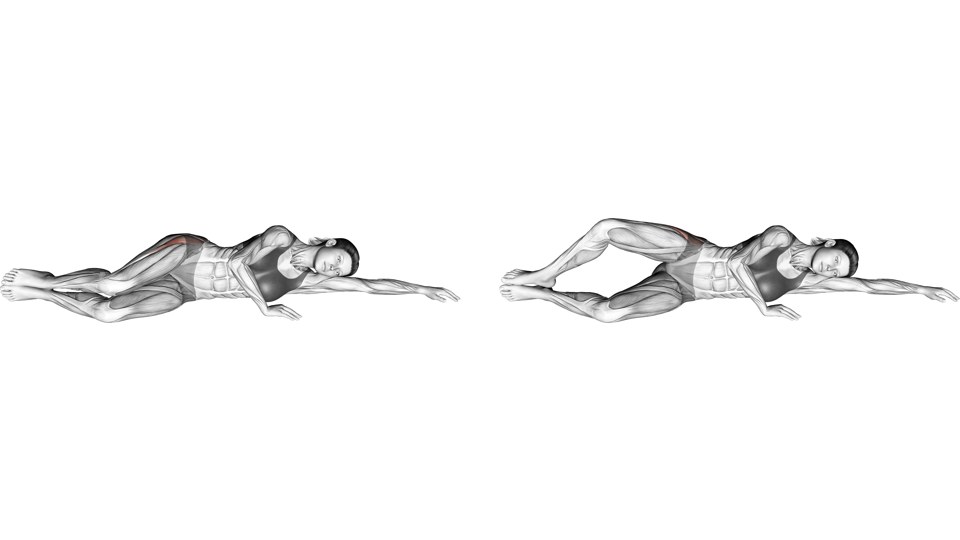
A clamshell is a side-lying exercise in which you open and close the upper knee while keeping your feet together. This guide covers the bodyweight version with both knees bent and the pelvis held still.
How do you perform a clamshell?
Set up
- Lie on your side on a mat with your hips and knees bent, your legs stacked and your feet together. Support your head with your lower arm.
- Keep your shoulders and pelvis stacked. Place your upper hand on the floor in front of your chest for support.
Execution
- Keep your feet touching and lift the upper knee away from the lower knee.
- Stop opening the knee before your pelvis rolls backward.
- Lower the upper knee gently to meet the other knee. Finish your repetitions before changing sides.
Common mistakes
Rolling backward to lift the knee farther
Reduce the opening until your upper hip stays above your lower hip.
Separating the feet
Keep the feet in contact while the upper knee moves.
Where it fits in a session
Include this movement where it fits your planned lower-body or home session.
Record repetitions for each side and keep the range consistent between sessions.
Muscles worked
Primary
Secondary
- None listed in this guide
Schematic surface view. Some muscles are partly visible or not shown.
The gluteus medius is involved in the movement.
Frequently asked questions
Do I need a resistance band?
No. The version here uses bodyweight. A band placed above the knees adds external resistance and should be logged as a separate variation.
Should I try to open the knee as far as possible?
Stop where you can keep the pelvis still. A larger opening obtained by rolling backward is not the motion taught here.
Sources
- Sidorkewicz et al. Clinical Biomechanics, 2014. https://pubmed.ncbi.nlm.nih.gov/25246373/
- McBeth et al. Journal of Athletic Training, 2012. https://pubmed.ncbi.nlm.nih.gov/22488226/