
Hollow body hold
Also called hollow hold.
What is a hollow body hold?
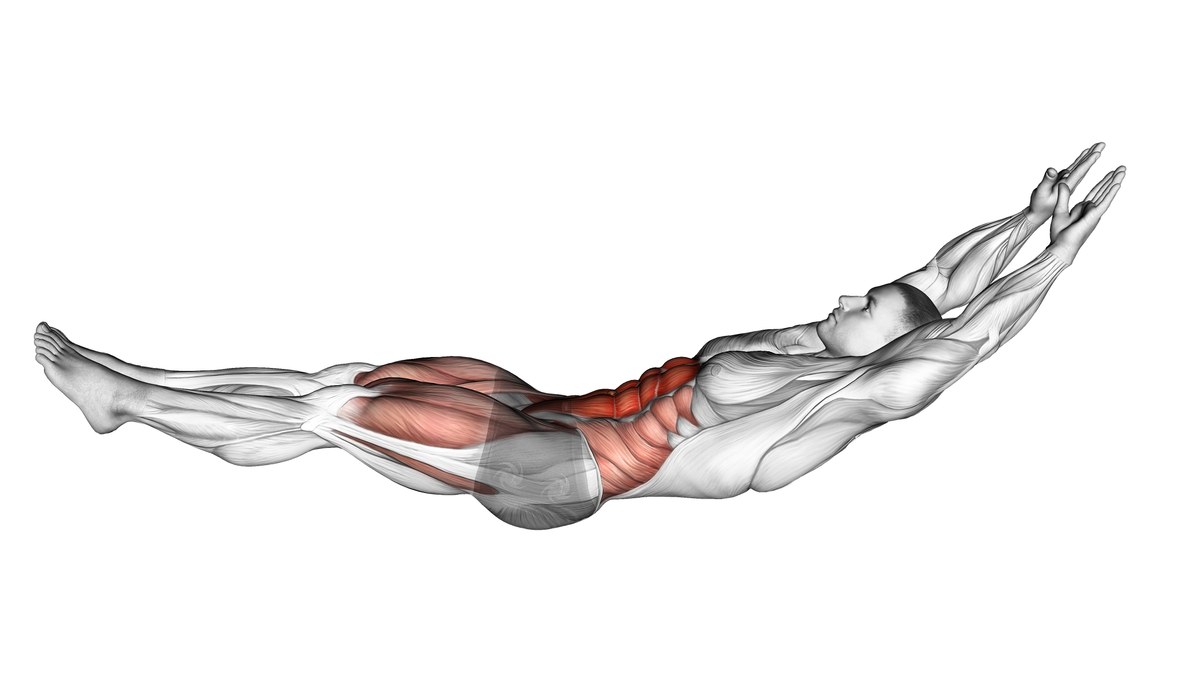
A hollow body hold is a floor exercise in which you hold your shoulders and legs off the ground while keeping your lower back in contact with the floor. Your arms reach overhead in the straight-leg version. The abdominal muscles and hip flexors work while you hold the position.
How do you perform a hollow body hold?
Set up
- Lie on your back with your knees bent toward your chest and your arms reaching toward your thighs. Gently settle your lower back against the floor.
- Lift your head and shoulder blades a little, keeping your chin comfortably away from your chest.
Execution
- Extend your legs and reach your arms overhead while keeping your lower back down. Stop extending or lowering your legs before your back starts to lift.
- Hold the position and take small, regular breaths. Keep your heels clear of the floor.
- Bend your knees and return your arms toward your sides before lowering your head and feet to finish.
Common mistakes
Lowering the legs until the back arches
Raise the legs, bend the knees or bring your arms forward to find a position you can hold.
Pulling the chin into the chest
Keep your neck in line with your upper back instead of trying to look at your toes.
Where it fits in a session
Place it with other abdominal exercises or in a gymnastics warm-up.
Time a position you can hold while breathing. End the hold when your lower back begins to lift, and use a shorter lever for the next set if needed.
Muscles worked
Primary
Secondary
Schematic surface view. Some muscles are partly visible or not shown.
The abdominal muscles hold the curled trunk position while the hip flexors support the raised legs.
Variations
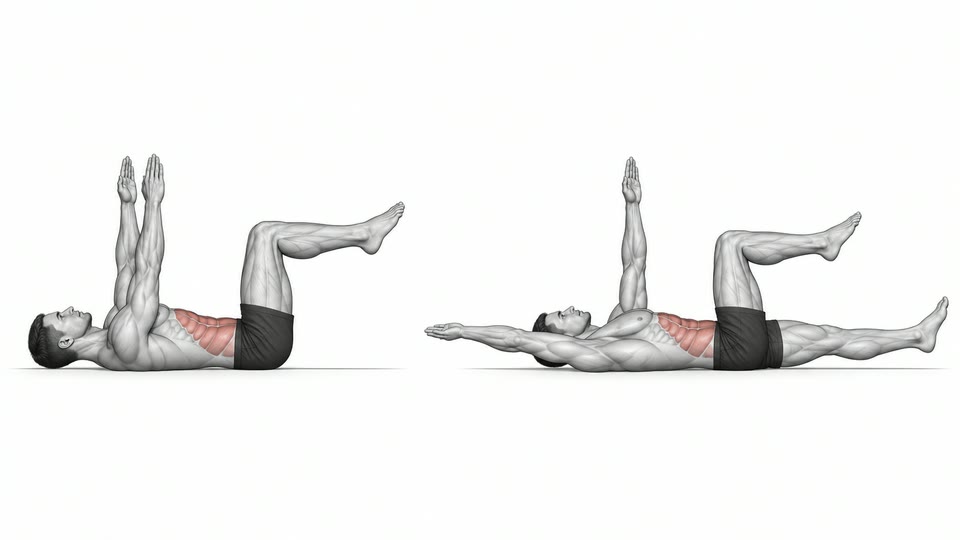
- Tuck hollow hold — Hold the knees bent toward the torso and keep the arms reaching forward.
- Arms-forward hollow hold — Keep the legs extended but reach your hands toward your thighs instead of overhead.
Frequently asked questions
Does my lower back need to stay on the floor?
Yes, for the version described here. Keep gentle contact rather than pushing down as hard as you can. Raise your legs or tuck your knees if contact is lost.
How do I progress from a tuck?
Try extending one leg, then both, while keeping your hands forward. Reach your arms overhead only when you can keep the same back position.
Is a hollow hold the same as a V-up?
No. A hollow hold keeps a position still. A V-up lifts the trunk and legs toward each other and lowers them again.
Sources
- J. Gordon Betts and colleagues, OpenStax. Anatomy and Physiology 2e, section 11.4: Axial muscles of the abdominal wall and thorax. 2022. https://openstax.org/books/anatomy-and-physiology-2e/pages/11-4-axial-muscles-of-the-abdominal-wall-and-thorax
- OpenStax. Anatomy and Physiology 2e, section 11.6: Appendicular muscles of the pelvic girdle and lower limbs. 2022. https://openstax.org/books/anatomy-and-physiology-2e/pages/11-6-appendicular-muscles-of-the-pelvic-girdle-and-lower-limbs