
Deficit reverse lunge
Also called dumbbell deficit reverse lunge, reverse lunge from a deficit.
What is a deficit reverse lunge?
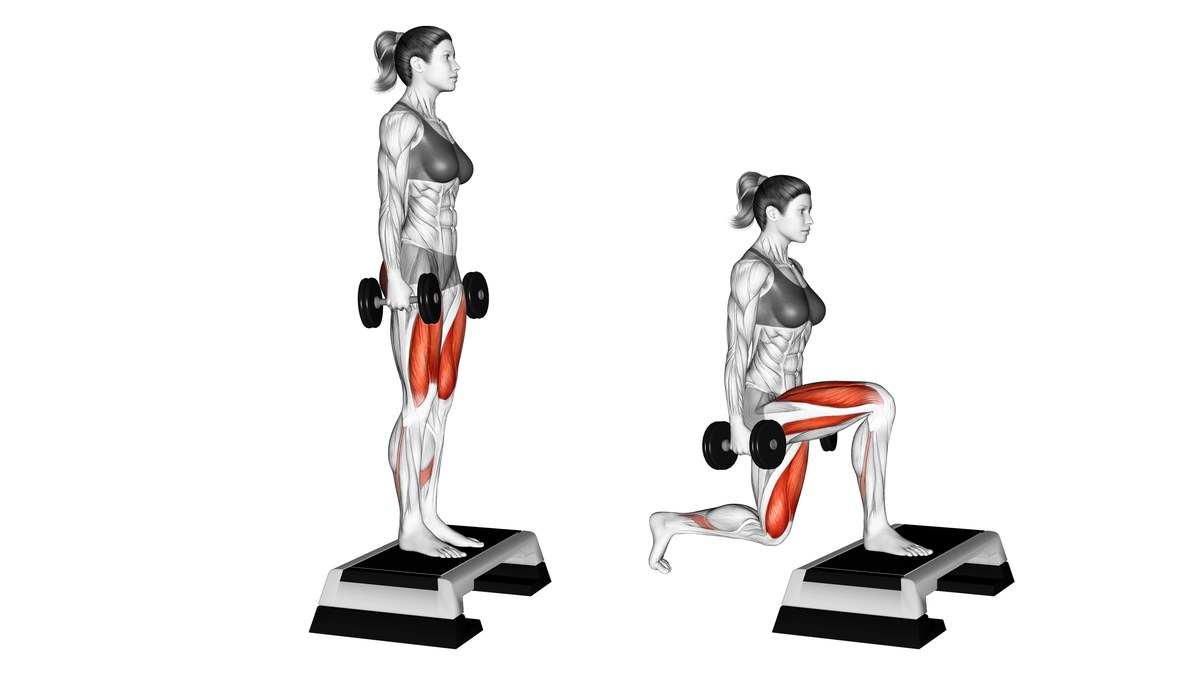
A deficit reverse lunge is a backward-stepping lunge performed from a low platform. The front foot stays on the platform while the rear foot lands on the floor, leaving room for a deeper descent than a floor lunge. This guide uses a dumbbell in each hand.
How do you perform a deficit reverse lunge?
Set up
- Place a low, stable step on a nonslip surface with clear floor space behind it.
- Hold a dumbbell at each side and stand with both feet about hip width apart on the step, with the whole soles supported.
Execution
- Reach one foot backward off the step and land on the ball of that foot, leaving the front foot planted on top.
- Bend both knees and lower smoothly to a depth you can control, keeping the front heel down and knee following the toes.
- Press through the raised foot to stand and bring the rear foot back onto the step; complete your reps, then change sides.
Common mistakes
Choosing a step that is too high
Start low. Reduce the height if reaching the bottom makes you twist, lift the front heel or lose balance.
Dropping the back knee onto the floor
Lower slowly enough to reverse without hitting your knee. The step gives you extra room; you do not have to use all of it.
Springing up from the rear foot
Keep most of the pressure through the front foot and stand smoothly before bringing both feet together on the step.
Where it fits in a session
Use as a single-leg exercise in a lower-body session, either on its own or after heavier lifts.
Rehearse the step without dumbbells first. Keep the step height and controlled depth consistent while you build repetitions or add weight.
Muscles worked
Primary
Secondary
- None listed in this guide
Schematic surface view. Some muscles are partly visible or not shown.
The quadriceps straighten the front knee, and the gluteus maximus helps extend the front hip as you stand.
Variations
- Reverse lungesUses the floor throughout, without a raised front foot.
Frequently asked questions
What muscles does the deficit reverse lunge work?
The quadriceps and gluteus maximus work as you straighten the front knee and hip to stand.
How high should the step be?
Start with a low aerobic step that fits both feet securely. Choose a height that lets you lower smoothly with the front foot flat; extra height is optional.
Does the back knee have to touch the floor?
No. Stop before the knee hits the floor, or earlier if you cannot keep control. Aim to repeat the same depth rather than forcing a deeper rep.
Can you alternate legs?
Yes. This guide keeps one front leg in place until its reps are finished, but you can alternate if each backward step stays controlled.
Sources
- Bordoni B, Varacallo MA. Anatomy, Bony Pelvis and Lower Limb: Thigh Quadriceps Muscle. StatPearls, updated May 8, 2023. https://www.ncbi.nlm.nih.gov/sites/books/NBK513334/
- Elzanie A, Borger J. Anatomy, Bony Pelvis and Lower Limb, Gluteus Maximus Muscle. StatPearls, updated April 1, 2023. https://www.ncbi.nlm.nih.gov/sites/books/NBK538193/