Reverse lunges
Also called backward lunges, rear lunges, bodyweight reverse lunges, step-back lunges.
What are reverse lunges?
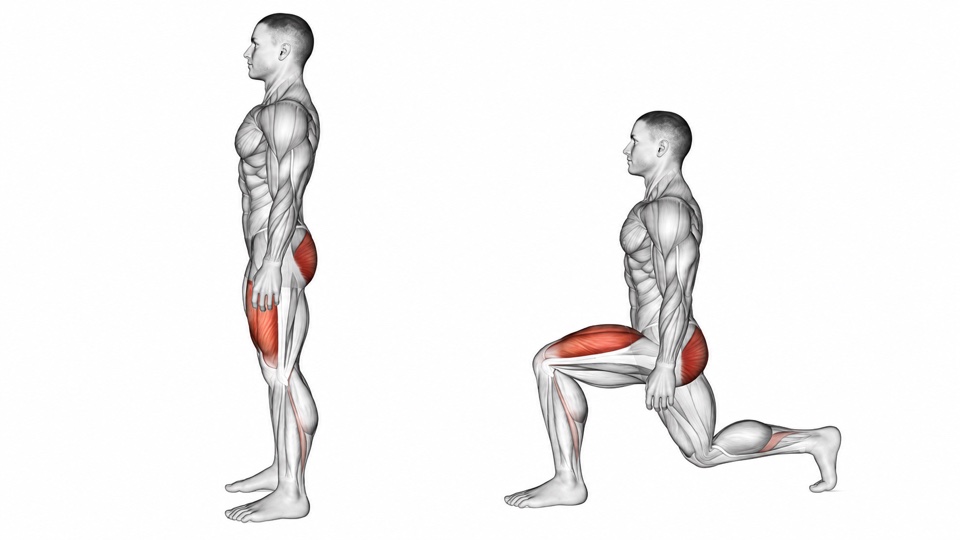
Reverse lunges are split-stance leg exercises in which you step one foot backward, lower both knees, then push through the front foot to return to standing. Stepping backward lets the front leg stay planted while the moving foot finds the lunge position.
How do you perform reverse lunges?
Set up
- Stand tall with your feet around hip width, whole feet planted and enough clear space behind you for a long step.
- Brace your trunk and choose one leg to step back first.
Execution
- Step that foot backward and land on the ball of the foot, keeping the front foot flat.
- Bend both knees and lower until the front leg reaches a depth you can control without the front knee collapsing inward.
- Push through the front foot and bring the back foot forward to stand, then repeat on the same side or alternate legs.
Common mistakes
Stepping directly behind the front foot
A tightrope stance narrows the base and makes balance unnecessarily difficult. Step back with some side-to-side space between the feet.
Pushing mostly from the back foot
The rear leg should help with balance, not turn the return into a toe push. Keep pressure through the whole front foot as you stand.
Letting the front knee fall inward
An inward collapse makes the rep less stable. Keep the knee following the direction of the front toes and shorten the range if needed.
Where it fits in a session
Use them as the main single-leg movement in a bodyweight session or after squats and deadlifts for additional leg work.
Start with alternating reps if balance or local fatigue makes one full side difficult. Add external load only after each step lands in a repeatable stance.
Muscles worked
Primary
Secondary
Schematic surface view. Some muscles are partly visible or not shown.
The front-leg quadriceps and gluteus maximus drive the return to standing. The adductors and soleus help control the split stance.
Variations
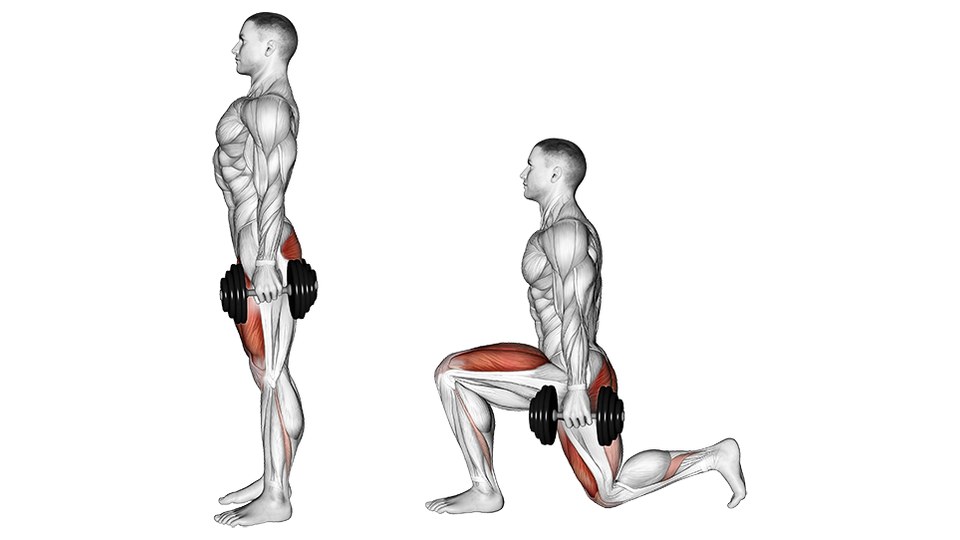
- Barbell reverse lunge — Places a bar across the upper back while using the same step-back pattern.
- Walking lunge — Travels forward from rep to rep instead of returning to the starting spot.
Frequently asked questions
What muscles do reverse lunges work?
They train the quadriceps and gluteus maximus of the front leg, while the adductors and soleus help control the stance.
Should you alternate legs on reverse lunges?
Either alternating or completing one side at a time works. Use the version that lets you keep the same step length and control.
How far back should you step?
Step far enough that both knees can bend comfortably while the front foot stays flat and the stance remains wide enough to balance.
Sources
- Anatomy, Bony Pelvis and Lower Limb: Thigh Quadriceps Muscle. StatPearls. https://www.ncbi.nlm.nih.gov/books/NBK513334/
- Anatomy, Bony Pelvis and Lower Limb, Gluteus Maximus Muscle. StatPearls. https://www.ncbi.nlm.nih.gov/books/NBK538193/
- Anatomy, Bony Pelvis and Lower Limb: Thigh Adductor Magnus Muscle. StatPearls. https://www.ncbi.nlm.nih.gov/books/NBK534842/