
Depth jump
Also called depth jumps, box depth jump.
What is a depth jump?
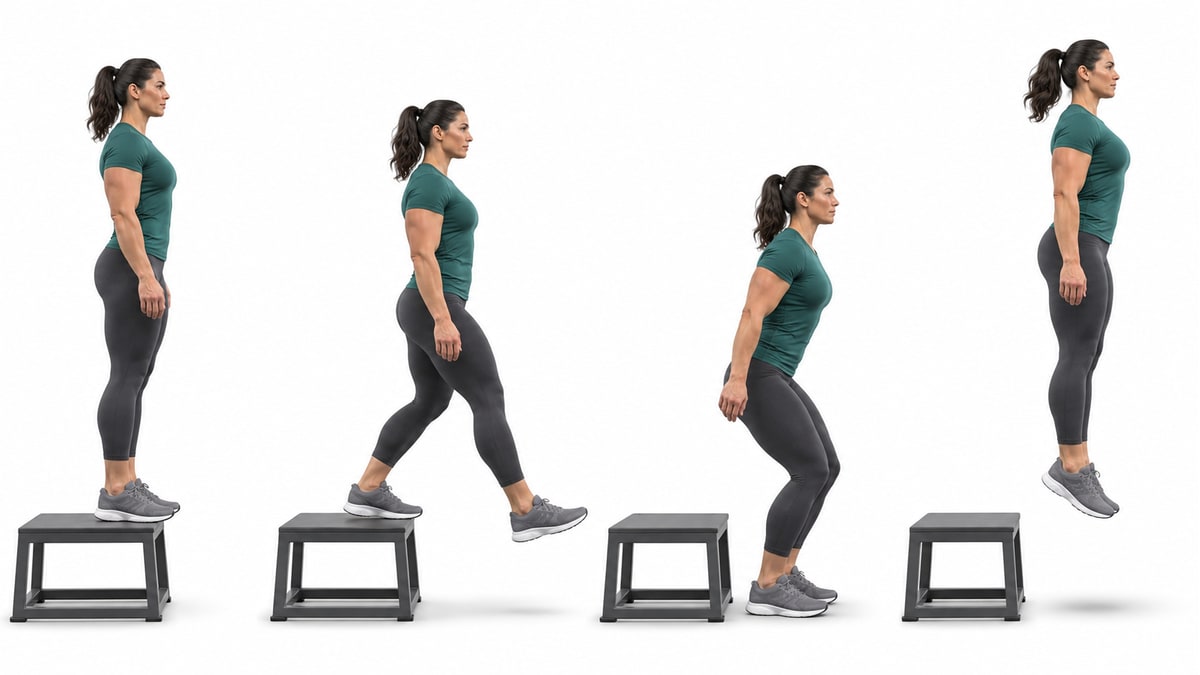
A depth jump starts on a platform. You step off, meet the floor with both feet and turn that first landing into an upward jump. After the rebound, you land on the floor again and settle before resetting. The step-off and immediate rebound distinguish it from jumping onto a box.
How do you perform a depth jump?
Set up
- Use a low, solid platform that cannot rock or slide. Leave a clear landing area in front of it and enough space above you for the jump.
- Step onto the platform and stand near its front edge, with your feet roughly the width of your hips. Start with a height from which you can control a two-foot landing.
Execution
- Reach one foot beyond the edge and let your body drop off. Bring the other foot forward to meet it; do not push upward or launch far away from the platform.
- Touch down on both feet together, letting the ankles, knees and hips bend. Keep the knees moving in the direction your toes point.
- Turn that contact into a vertical jump, extending your legs to leave the floor again. Rebound promptly without rushing a landing you cannot control or sitting into a deep squat.
- Absorb the second landing with bent knees and hips, then hold your balance. Stand up, walk back and step onto the platform for a separate repetition.
Common mistakes
Jumping off the platform
An upward push adds another jump before the drop. Reach beyond the edge and let yourself descend instead of springing from the top.
Picking height before landing control
Lower the platform or use the drop-and-hold option if you stumble, buckle inward or cannot turn the first landing into the intended upward jump.
Rushing both landings
Only the first contact leads straight into a rebound. After the upward jump, absorb the landing and settle instead of bouncing into extra hops.
Where it fits in a session
Place it where controlled rebound jumps fit your planned session, with room to reset between attempts.
Count a step-off, one rebound and the final settled landing as one repetition. End the set or use a simpler drill when you cannot repeat that sequence cleanly; this guide does not prescribe a universal height, contact time or rep target.
Muscles worked
Primary
Secondary
Schematic surface view. Some muscles are partly visible or not shown.
The quadriceps extend the knees, the gluteus maximus extends the hips, and the calf muscles act at the ankles during the jump. The list describes joint actions, rather than a measured order of muscle activation.
Variations
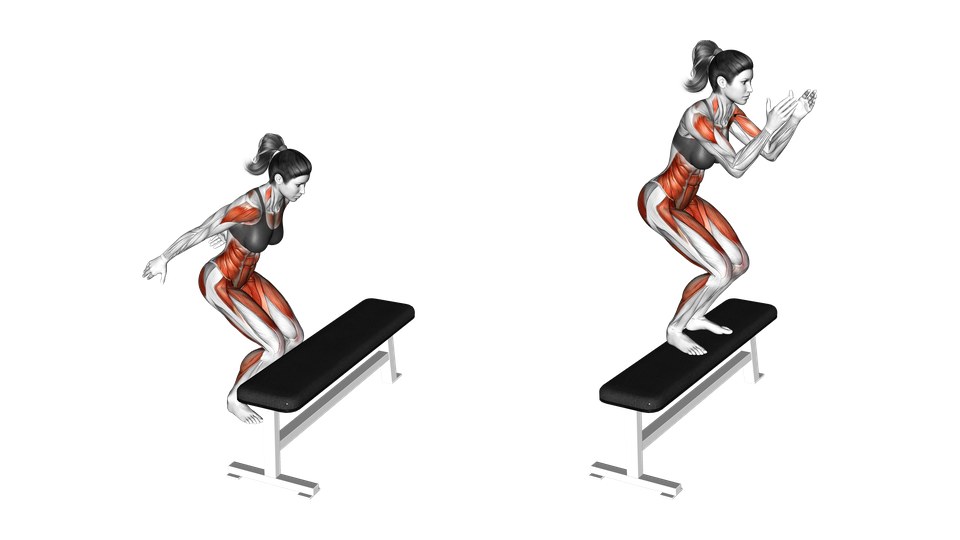
- Box jumpBegin on the floor and jump onto the platform. The raised landing surface replaces the drop-and-rebound sequence.
Frequently asked questions
What muscles do depth jumps work?
The quadriceps and gluteus maximus contribute to the knee and hip extension of the upward jump. The gastrocnemius and soleus contribute at the ankles. These are anatomical roles in the movement, not a measured activation ranking or a claim that this jump builds more muscle than another exercise.
How high should the platform be?
Start low enough to step off and control the landing before trying to rebound. Lower it if the drop makes you stumble, sink into a deep squat or lose the intended jump. A suitable height depends on your execution; a taller platform is not an automatic progression.
How is a depth jump different from a box jump?
A box jump begins on the floor and ends with a landing on top of the box. A depth jump begins on the platform, drops to the floor and rebounds upward from that contact. The second landing in this guide is on the floor, not on another box.
What is a simpler option before depth jumps?
Use a low-platform drop landing: step off, land on both feet, bend to absorb the drop and hold your balance without a rebound. If you are not comfortable with that entry, practise small two-foot jumps and settled landings from the floor first. The rebound can wait until you can control the landing.
Should I pause before jumping upward?
The version taught here turns the first floor contact into the upward jump without a deliberate stop. Do not chase a particular contact time by landing rigidly or rushing out of balance. A landing held without a rebound is the separate drop-landing option; after the final landing, stop and reset.
Sources
- Bordoni B, Varacallo MA. Anatomy, Bony Pelvis and Lower Limb: Thigh Quadriceps Muscle. StatPearls, 2023. https://www.ncbi.nlm.nih.gov/sites/books/NBK513334/
- Elzanie A, Borger J. Anatomy, Bony Pelvis and Lower Limb, Gluteus Maximus Muscle. StatPearls, 2023. https://www.ncbi.nlm.nih.gov/sites/books/NBK538193/
- Binstead JT, Varacallo MA. Anatomy, Bony Pelvis and Lower Limb: Calf. StatPearls, 2026. https://www.ncbi.nlm.nih.gov/sites/books/NBK459362/