
Drag curl
Also called barbell drag curl.
What is a drag curl?
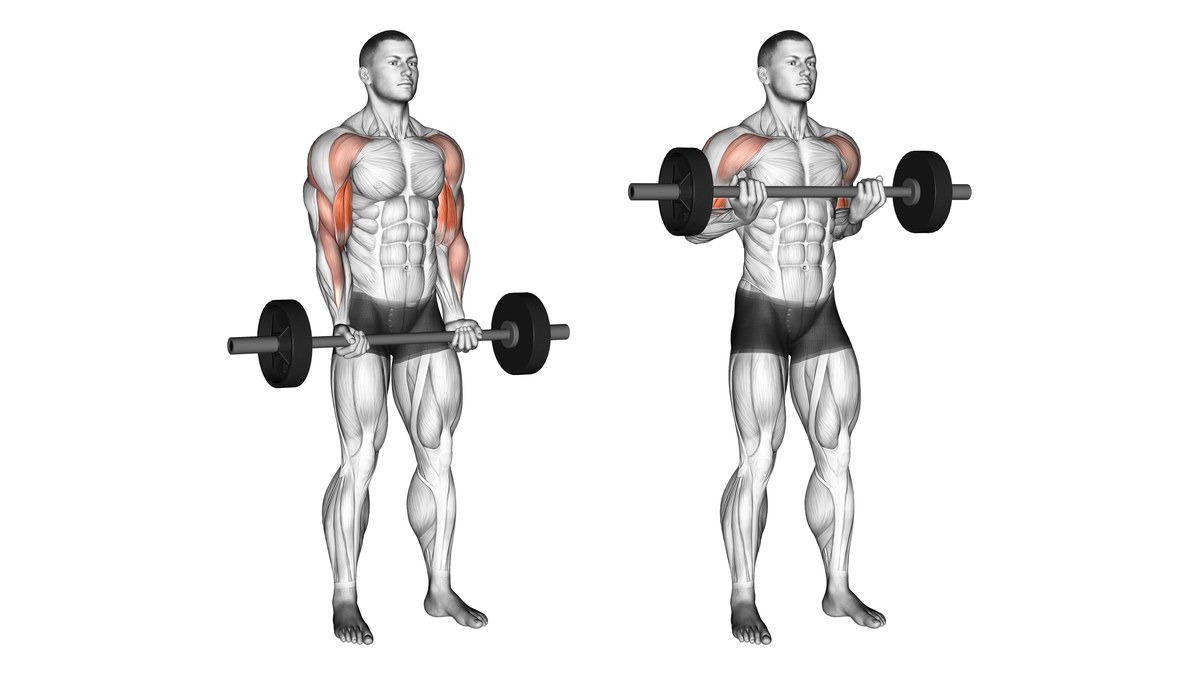
A drag curl is a palms-up barbell curl in which the elbows move behind the torso as the bar rises close to your body. That backward upper-arm movement distinguishes it from a curl that keeps the elbows near their starting position and swings the bar forward in an arc.
How do you perform a drag curl?
Set up
- Stand with a barbell in front of your thighs and take a palms-up grip around shoulder width. Use a light bar while learning the path.
- Stand upright with your knees relaxed, wrists aligned and room for the bar to pass close to your torso.
Execution
- Bend your elbows while moving them backward, bringing the bar up close to the front of your body.
- Let the bar rise only as far as the backward elbow path allows without shrugging or leaning.
- Lower the bar beside your torso as the elbows return toward their starting position.
- Finish with the bar near your thighs and reset your upright stance before the next repetition.
Common mistakes
Trying to keep the elbows pinned forward
Backward elbow travel is part of this exercise. Keeping them fixed changes the bar path into a conventional curl.
Forcing the bar to shoulder height
Stop at the height your own arm lengths allow without shrugging or swinging. The bar need not reach your shoulders.
Dragging the bar by leaning backward
Keep your chest in the same place and reduce the weight if your hips or torso have to drive it upward.
Where it fits in a session
Use it where your session calls for curl accessory work.
Choose the load for controlled repetitions from setup through the last return. Keep the same movement as the set becomes harder; reduce the weight if you have to change the path.
Muscles worked
Primary
Secondary
- None listed in this guide
Schematic surface view. Some muscles are partly visible or not shown.
These elbow flexors are listed together without an activity or growth ranking.
Variations
Frequently asked questions
How high should the bar go?
A practical endpoint is around the upper abdomen or lower chest, but it varies with arm lengths. Stop earlier if extra height requires shrugging, leaning or moving the bar away from the body.
Should the elbows move during a drag curl?
Yes. They move backward as you lift and return as you lower. This is a defining part of the drag curl, rather than an error to correct with a fixed-elbow cue.
Does the bar have to rub against your shirt?
No. Keep it close without scraping your body. A small gap is enough to follow the intended path.
Is it the same as a regular barbell curl?
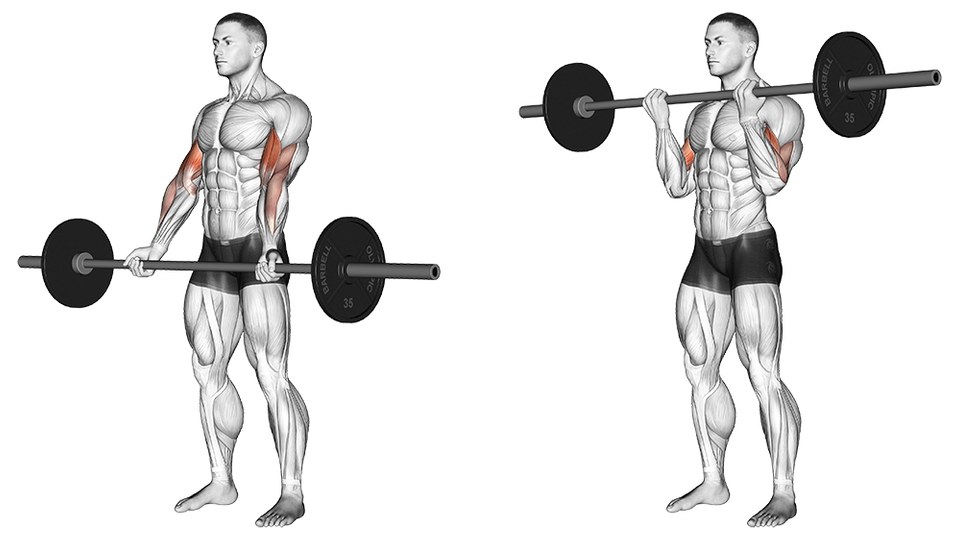
No. Both bend the elbows with a palms-up grip, but the drag curl deliberately moves the upper arms backward and keeps the bar near the torso.
What if the empty bar is too heavy?
Use a lighter fixed bar. Learn the close bar path with controlled repetitions before increasing the load.
Sources
- Tiwana MS; Charlick M; Varacallo MA. Anatomy, Shoulder and Upper Limb, Biceps Muscle. StatPearls. https://www.ncbi.nlm.nih.gov/sites/books/NBK519538/
- Plantz MA; Bordoni B. Anatomy, Shoulder and Upper Limb, Brachialis Muscle. StatPearls. https://www.ncbi.nlm.nih.gov/sites/books/NBK551630/
- Lung BE; Ekblad J; Bisogno M. Anatomy, Shoulder and Upper Limb, Forearm Brachioradialis Muscle. StatPearls. https://www.ncbi.nlm.nih.gov/sites/books/NBK526110/