
Barbell biceps curl
Also called barbell curl, barbell bicep curl, standing barbell curl, straight bar curl.
What is a barbell biceps curl?
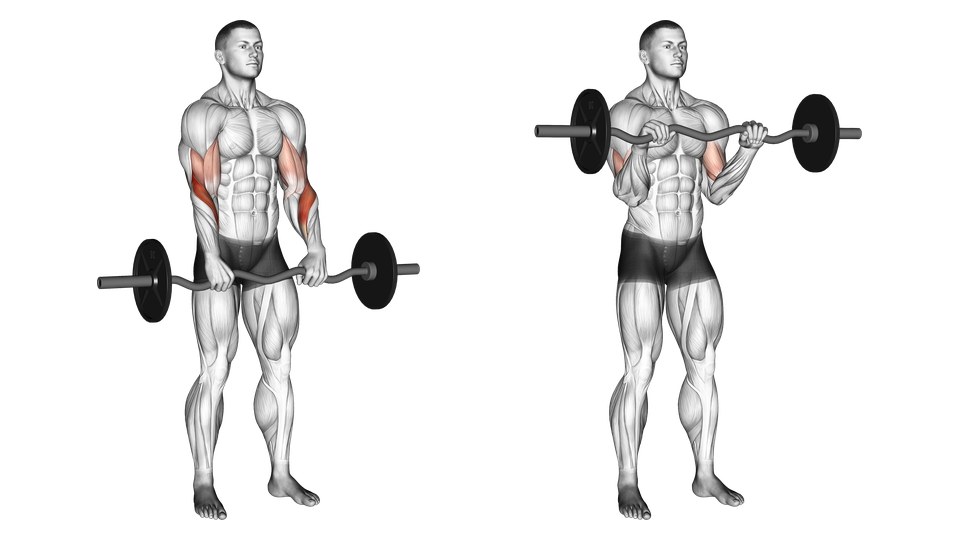
A barbell biceps curl is a curl taken with both hands on one bar, palms up, moving from straight arms to full elbow flexion while the upper arms stay down by the ribs. It trains the three elbow flexors, brachialis, biceps brachii and brachioradialis, rather than the biceps alone, and the muscles of the forearm work to hold the bar without moving it. The bar is what separates it from a dumbbell curl: it fixes both hands at one width and one rotation for the whole set, and it takes far more load than most people can put in each hand. A straight bar and an angled EZ-bar are both ordinary ways to do this movement, and choosing between them is a question of what your wrists tolerate rather than a technique rule.
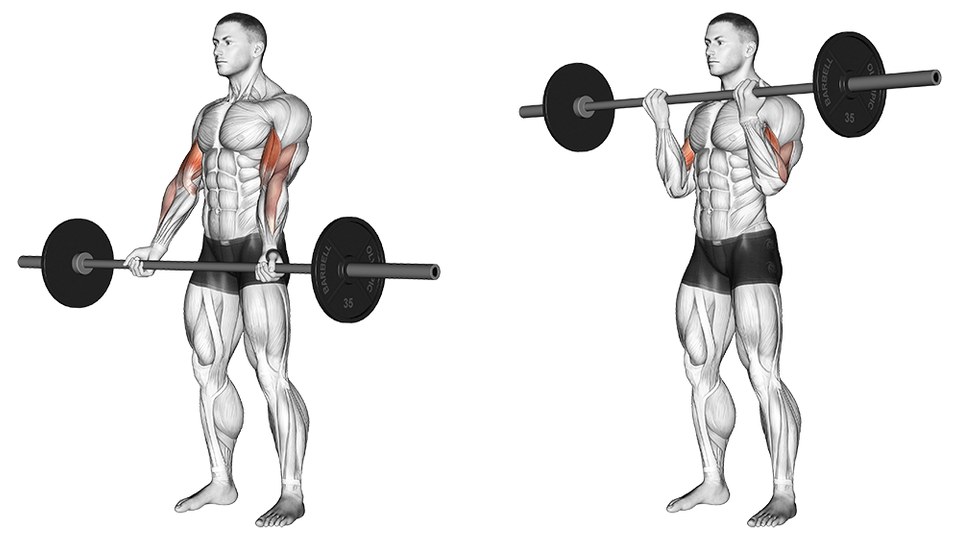
How do you perform a barbell biceps curl?
Set up
- Hold the bar with an underhand, shoulder-width grip and wrap your thumbs around it.
- Stand tall with your feet hip-width apart, arms straight and the bar against your thighs. Brace your midsection and keep your elbows by your ribs.
Execution
- Curl the bar toward your shoulders by bending your elbows. Keep your upper arms still by your sides, and do not swing or lean back.
- Keep your wrists straight and stop at the highest point you can reach without moving your elbows forward.
- Lower the bar under control until your arms are fully straight.
Common mistakes
Swinging the bar up with the hips and lower back
The barbell is the curl you can genuinely load, so it is the curl people bounce. A hip drive throws the bar through the middle of the rep, which is where the forearm is horizontal and the elbow flexors are working hardest, so the range you added the weight for is the exact range the swing skips. It also loads your lumbar spine in extension with a weight hanging out in front of you, which is a poor trade for an arm exercise.
Letting the elbows travel forward at the top
Once the upper arms lift, the shoulder starts doing the lifting and the bar tracks in toward the shoulder joint, where it takes almost nothing to hold. It feels like a bigger rep and it is a smaller one for the elbow flexors: the top of the movement becomes a rest rather than the hardest part.
Stopping short of straight arms at the bottom
Cutting the bottom off is how a weight that is too heavy hides. Half a rep still counts in your log, so the number on the bar keeps going up while the range comes down, and the position you are removing is the one where the elbow flexors are longest.
Forcing a grip width the straight bar cannot give you
A straight bar locks both hands at one spacing and in full supination at the same time. If that combination does not match how your forearms hang, the difference has to go somewhere, and it goes into the wrists. The fix is a different width or an angled bar, not training through it.
Flexing the wrists to finish the rep
Curling the wrists at the top moves the bar a few centimetres using the forearm flexors and the wrist joint while the elbow does nothing extra. You get a harder squeeze in the forearms, a loaded wrist in a bent position, and no more work for the muscles the exercise is for.
Where it fits in a session
Usually at the end of a session, after the pressing and pulling. Putting it first is defensible on an arm-focused day: of the curls, this is the one that takes real load, so it is the one that benefits most from being done while you are fresh.
Isolation work for a small muscle group, so the useful range is moderate reps taken close to failure with the elbows still, rather than a heavy low-rep single-digit set that turns into a hip swing. The barbell invites loading it, which is its advantage and its trap. A practical stopping rule: the set ends on the last rep you could do without your torso helping, not on the last rep the bar moved.
Muscles worked
Primary
Secondary
Schematic surface view. Some muscles are partly visible or not shown.
The brachialis, biceps brachii and brachioradialis all contribute to elbow flexion, while the wrist and finger flexors hold the bar. They are listed together without a force or growth ranking. Anatomical descriptions do not tell us each muscle’s share during a loaded curl, and the surface-EMG studies below did not measure the deeper brachialis. A palms-up grip does not switch off the brachioradialis.
What lifters actually do
About half of regular RepCount users have logged a barbell curl, and it appears in roughly one workout in nineteen, which is less often than either the dumbbell curl or the hammer curl. Its most frequent company is a hammer curl, in more than a quarter of the workouts that contain it; after that come pulldowns, cable rows, pull ups and barbell rows rather than pressing. Typical use is about three sets inside a session of roughly seven exercises. Lifters treat it as loaded arm work at the end of a pull day.
Most often trained alongside
Share of barbell biceps curl sessions that also include each exercise.
- Hammer curl27.7%
- Pulldowns27.5%
- Cable row20.5%
- Pull up16.6%
- Barbell row16.5%
Figures come from workouts tracked in RepCount.
Scientific studies on barbell curls
Studies can help separate bar choice and grip effects from claims about muscle growth. The comparisons below measure different things, and not every curl study uses the standing version shown here.
There is no clear growth winner between straight and EZ bars in these studies. A palms-up grip involves both biceps and brachioradialis. Full-range training has support for full-range strength, but the trial discussed here used preacher curls, not standing curls.
Is a straight bar better than an EZ-bar?
A study of 12 trained men found no statistically clear difference in biceps or brachioradialis electrical activity between straight-bar and EZ-bar curls. Both were performed standing, for ten repetitions at 65% of estimated maximum load.
The EZ-bar produced higher average activity than the tested dumbbell curl, but that does not establish more muscle growth. The study measured a single session, not changes in muscle size. It also did not measure wrist comfort or injury risk. Choosing a bar that lets you curl comfortably remains a practical choice rather than a proven growth advantage.
What the comparison can tell us
Each participant used all three exercises in randomized order. Researchers measured the right arm and compared the middle eight repetitions. The dumbbell version involved a different forearm-rotation pattern, so the comparison changed more than the equipment alone. The absence of a clear straight-bar versus EZ-bar difference is not proof of equivalence.
Does a palms-up grip take work away from the forearm?
Not necessarily. In a separate study of ten male bodybuilders, palms-up curls produced higher biceps and brachioradialis activity during the lifting phase than neutral or palms-down curls. The lowering phase did not show the same clear grip differences.
This was a cable study using bar and rope attachments, not a free-barbell trial. It challenges the idea that the brachioradialis only works well with a neutral grip, but cannot tell us its exact share of force in a barbell curl. It also did not measure the brachialis or separate growth of the two biceps heads.
Sources
What does research say about using the full range?
In a ten-week study, previously untrained men performed barbell preacher curls through either a full range or only the middle of the movement. Full-range training produced greater improvement on a full-range strength test. Muscle thickness increased in both groups, without a statistically clear difference between them.
That supports practicing the range in which you want to become stronger. It does not show that every partial repetition is ineffective. The partial group omitted both ends of the movement; it was not doing bottom-half repetitions. The preacher pad also changes shoulder position and loading, so this is supporting context for standing curls rather than a direct test of the technique shown here.
Study details and limits
Forty men completed the study: 15 trained through 0–130 degrees of elbow flexion, 15 through 50–100 degrees, and ten did not train. Training ran twice weekly, progressing from two to four sets. Ultrasound measured combined elbow-flexor thickness, not each muscle or biceps head separately. The abstract and results report slightly different growth percentages, so the guide gives the shared qualitative finding instead.
Variations
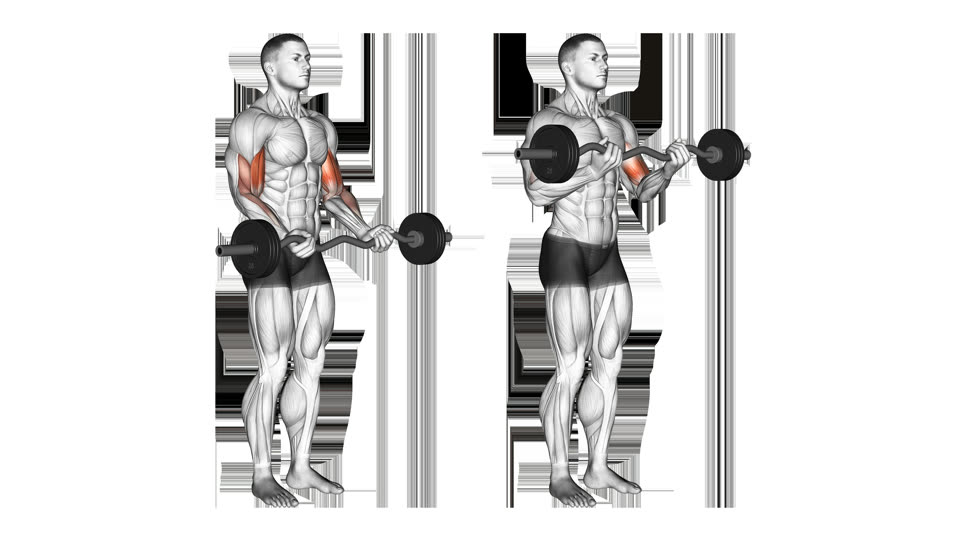
- EZ-bar curlAngled bar sets the hands part way between palms-up and neutral, which most wrists tolerate better than a straight bar.
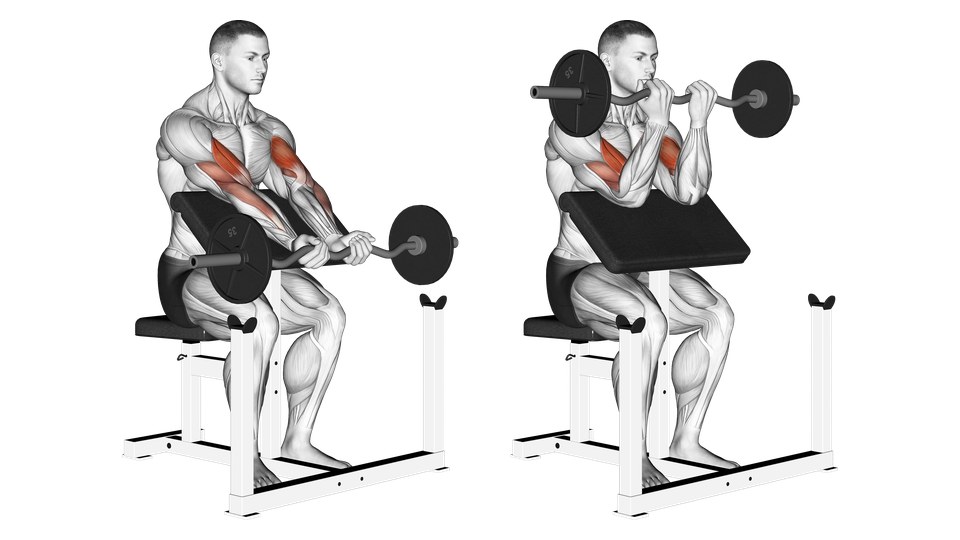
- Preacher curlUpper arms rest on a pad, so the elbows cannot travel and the stretched bottom position is the hardest part of the rep.
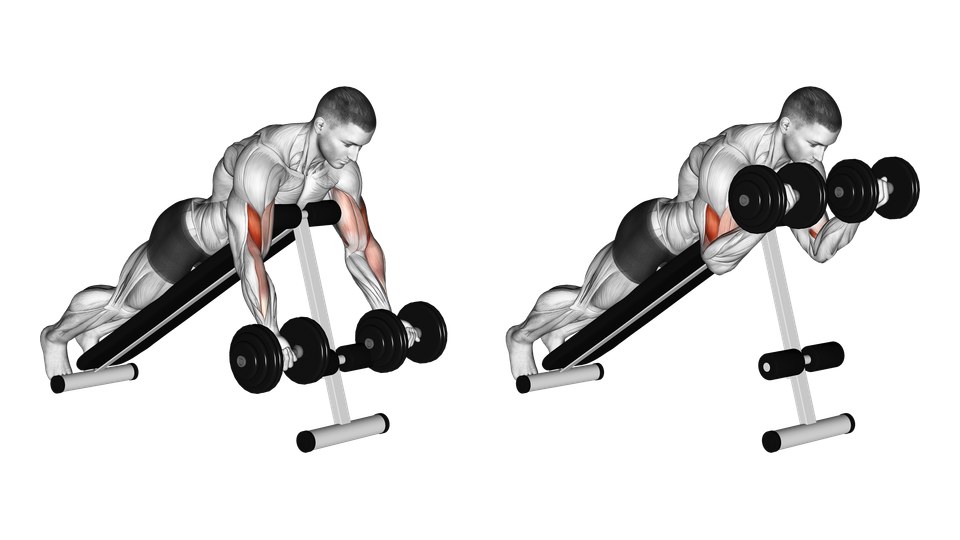
- Spider curlChest against an incline bench with the arms hanging straight down, which puts the hardest part at the top instead.
- Drag curl — Bar dragged up the front of the torso with the elbows going backwards. A different movement rather than a stricter version of this one.
- Reverse barbell curlOverhand grip. Often treated as its own exercise; the brachioradialis works in that forearm position as it does in every other.
- Close-grip barbell curl — Hands inside shoulder width. Changes where the wrists and elbows sit more than anything this page can vouch for.
- Wide-grip barbell curl — Hands outside shoulder width, with the same caveat in the other direction.
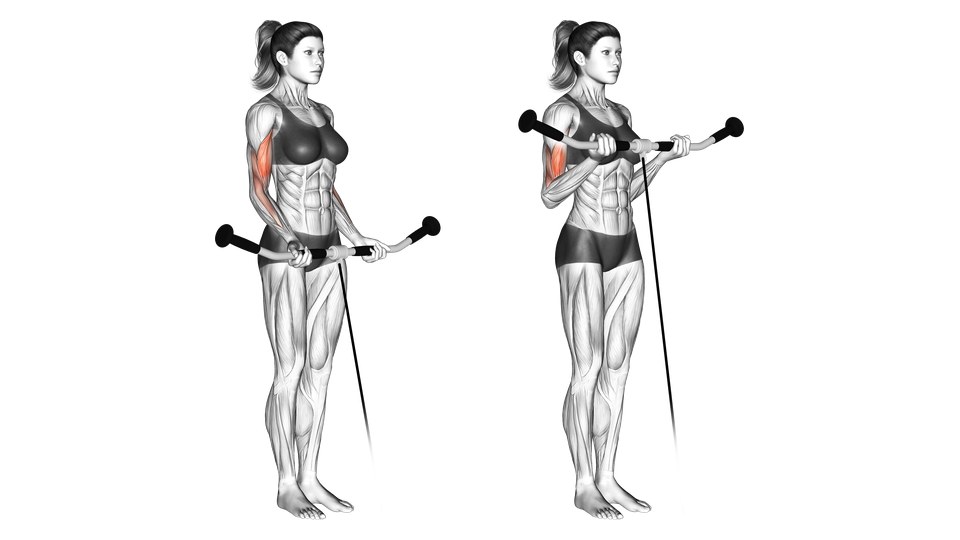
- Straight-bar cable curlCable pulls at an angle rather than straight down, so the top of the rep holds more tension than a free bar does.
Articles
Related tools
Frequently asked questions
What muscles does the barbell curl work?
The brachialis, biceps brachii and brachioradialis bend the elbow. The wrist and finger flexors help hold the bar. The biceps also turns the forearm palm-up, but its anatomical roles do not mean it is unimportant in a curl. The studies here measured activity in the biceps and brachioradialis, without establishing each muscle’s share of force.
Should I use a straight bar or an EZ-bar?
Use the bar that lets you curl comfortably and control the movement. A straight bar holds the forearms palm-up; an EZ-bar changes that angle. A small study found no clear biceps or brachioradialis activity difference between the two, but did not measure growth or wrist comfort. Neither bar has a proven growth advantage from that comparison.
How wide should my grip be on a barbell curl?
Wide enough that your wrists sit comfortably, which for most people is somewhere around shoulder width, and it is worth moving your hands a couple of centimetres either way to find it. You will read that a narrow grip builds one head of the biceps and a wide grip the other. This page is not making that claim: it is not something we have verified, and grip width has a much more obvious effect on where your wrists end up.
Is the barbell curl better than the dumbbell curl?
A bar fixes both hands at one spacing and rotation; dumbbells let each arm move and rotate independently. A small study found higher muscle activity with an EZ-bar than with its dumbbell version, but did not measure growth. That result cannot establish that barbells build bigger arms. Choose the setup you can control and progress comfortably.
Do barbell curls work your forearms?
Partly, and not in the way people usually mean. The brachioradialis, on the thumb side of the forearm, is an elbow flexor and is working through the whole rep. The muscles that flex your wrist and fingers are holding the bar without moving it. That is grip work, not wrist training, so a curl is not a substitute for training the forearm directly.
How often do lifters actually do barbell curls?
About half of regular RepCount users have logged one, and a barbell curl turns up in roughly one workout in nineteen, which puts it behind both the dumbbell curl and the hammer curl for how often it appears. More than a quarter of the workouts that contain it also contain a hammer curl, and after that the exercises around it are pulldowns, cable rows, pull ups and barbell rows. It is arm work on a pull day.
Sources
- Anatomy, Shoulder and Upper Limb, Biceps Muscle. StatPearls, NCBI Bookshelf. https://www.ncbi.nlm.nih.gov/books/NBK519538/
- Plantz MA, Bordoni B. Anatomy, Shoulder and Upper Limb, Brachialis Muscle. StatPearls, NCBI Bookshelf. https://www.ncbi.nlm.nih.gov/books/NBK551630/
- Anatomy, Shoulder and Upper Limb, Forearm Brachioradialis Muscle. StatPearls, NCBI Bookshelf. https://www.ncbi.nlm.nih.gov/books/NBK526110/
- Anatomy, Shoulder and Upper Limb, Forearm Compartments. StatPearls, NCBI Bookshelf. https://www.ncbi.nlm.nih.gov/books/NBK539784/
- Marcolin G et al. Differences in electromyographic activity of biceps brachii and brachioradialis while performing three variants of curl. 2018. https://pmc.ncbi.nlm.nih.gov/articles/PMC6047503/
- Pinto RS et al. Effect of range of motion on muscle strength and thickness. 2012. https://pubmed.ncbi.nlm.nih.gov/22027847/
- Coratella G et al. Biceps Brachii and Brachioradialis Excitation in Biceps Curl Exercise: Different Handgrips, Different Synergy. 2023. https://pmc.ncbi.nlm.nih.gov/articles/PMC10054060/