
Dumbbell hamstring curl
Also called dumbbell leg curl, lying dumbbell leg curl.
What is a dumbbell hamstring curl?
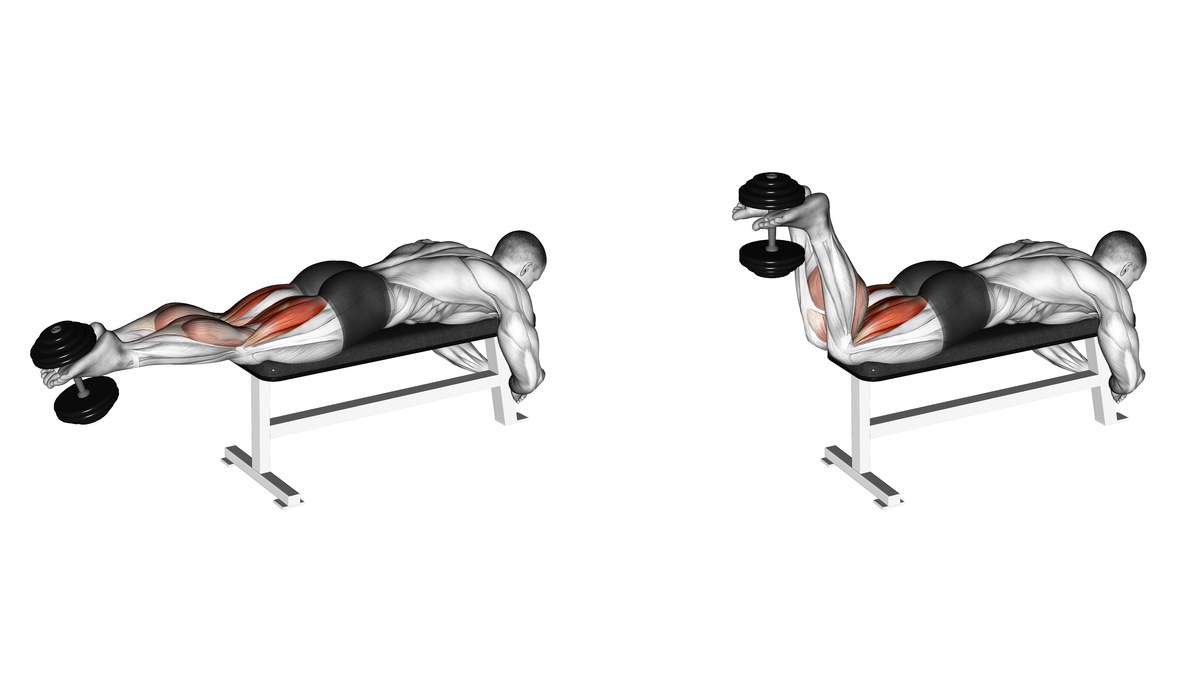
A dumbbell hamstring curl is a leg curl performed face down on a bench with one dumbbell held between both feet. You bend and straighten your knees while keeping your thighs supported. It trains the hamstrings without a leg curl machine.
How do you perform a dumbbell hamstring curl?
Set up
- Use a stable flat bench on level ground, a light fixed-weight dumbbell and a partner to help load and unload it. Leave the floor around the foot end clear.
- Lie face down with your torso and thighs on the bench and your knees just beyond its short end. Hold the sides and bend your knees so your feet point upward.
- Have your partner position the dumbbell handle between the inner arches of your shoes, with the upper head resting across both soles. Squeeze your feet together; your partner should keep supporting the weight until your grip is secure.
Execution
- Keep your thighs on the pad and slowly lower your feet until your knees are almost straight, stopping before the dumbbell touches the floor.
- Bend both knees to bring your feet upward, stopping when your lower legs are near vertical and you keep the dumbbell firmly held between your feet.
- Lower along the same path without swinging, then continue curling and lowering with your hips resting on the bench.
- Finish with your knees bent and have your partner take the dumbbell before you separate your feet or move off the bench.
Common mistakes
Continuing when the dumbbell starts to slip
End the set and have your partner take the weight. Do not spread your feet or twist to catch it while it is unsupported.
Lifting the thighs to swing the weight
Choose a lighter dumbbell if you cannot move it while your thighs and hips stay on the bench.
Curling the dumbbell onto the backs of the legs
Stop with the lower legs near vertical rather than chasing heel-to-glute contact. Keep the dumbbell clear of your body.
Where it fits in a session
Use as a knee-curl exercise in a lower-body session when a suitable bench, dumbbell and partner are available.
Rehearse loading and unloading with a very light dumbbell first. End each set before your feet lose their hold, and add weight only while the grip and movement remain controlled.
Muscles worked
Primary
Secondary
- None listed in this guide
Schematic surface view. Some muscles are partly visible or not shown.
The hamstrings at the back of the thighs bend the knees to lift the dumbbell.
Variations
- Lying leg curlUses a machine roller behind the lower legs instead of holding a dumbbell between the feet.
Frequently asked questions
What muscles does the dumbbell hamstring curl work?
It works the hamstrings at the back of the thighs. These muscles bend the knees as you lift the weight.
Do I need someone to help?
This guide uses a partner to place the dumbbell and take it at the end of the set. If you cannot load, hold and unload it securely, choose another curl setup, such as a lying leg curl machine.
What kind of dumbbell should I use?
Choose a light fixed-weight dumbbell whose handle and head fit securely between your feet. Avoid a slippery weight or an adjustable model with protruding parts or removable plates. Use another exercise if you cannot keep a firm hold.
How far should I curl?
On a flat bench, curl until your lower legs are near vertical, then lower toward almost straight knees. Shorten the range if the dumbbell would hit the floor or your legs, or if your feet cannot keep it secure.
Sources
- Hu Y, Raja A. Anatomy, Bony Pelvis and Lower Limb, Hamstring Muscle. StatPearls, updated January 31, 2026. https://www.ncbi.nlm.nih.gov/sites/books/NBK546688/