
Leg curl
Also called hamstring curl, knee curl.
What is a leg curl?
A leg curl is a machine exercise that bends the knee against resistance, performed lying face down, seated, or standing on one leg. It trains the hamstrings — biceps femoris with its long and short heads, semitendinosus and semimembranosus — with the gastrocnemius assisting, because that muscle crosses the back of the knee as well as the ankle.
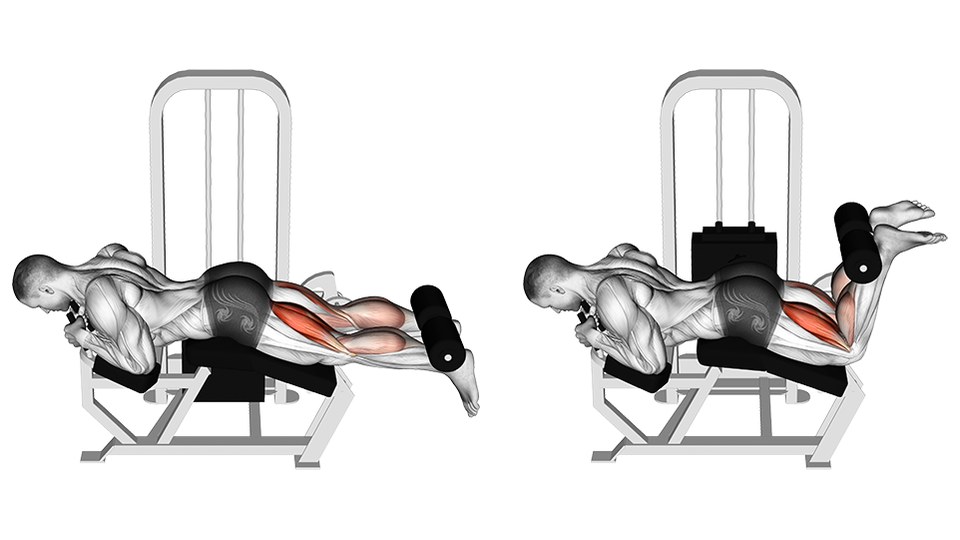
How do you perform a leg curl?
Set up
- Adjust the machine so its pivot lines up with the side of your knee and the roller rests just above your heels, not high on your calves.
- Lying machine: lie face down with your hips and chest against the pad, then grip the handles.
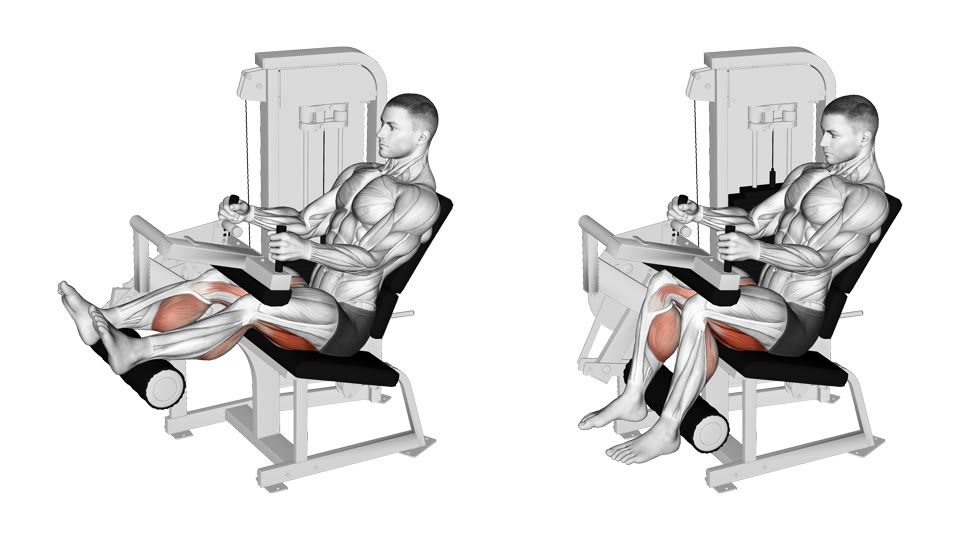
- Seated machine: sit with your back against the pad and lower the thigh restraint snugly so your legs stay in place.
Execution
- Start with your legs straight or nearly straight, keeping your hips and torso firmly against the pads.
- Curl your heels toward your backside in one smooth motion, as far as your knees comfortably allow. Do not jerk the weight.
- Lower under control until your legs are straight or nearly straight, keeping your hips and torso still.
Common mistakes
Letting the hips lift off the pad on the lying machine
Once the hips rise, part of the load is being taken by extending the hip rather than by flexing the knee, which is the one joint this machine is built around. It usually means the weight is too heavy.
Setting the ankle pad high, on the calf
It presses into muscle instead of tendon, which is uncomfortable enough to cut sets short, and it shortens the distance the pad travels.
Stopping short of a straight leg at the bottom
The lowering half is the half you have most control over, and cutting it short gives away range for nothing. Let the leg straighten at the bottom of every rep.
Choosing the machine by which one is free
Ankle position is the setting lifters argue about and it changes little. Hip position is the one that matters: if your gym has both machines, seated is the better default for size. See the scientific studies ↓
Where it fits in a session
Leg day, usually alongside the quad machines rather than in place of hip-hinge work.
A leg curl trains knee flexion. A Romanian deadlift or a good morning trains the same muscles at the hip. They are not substitutes for one another, and the seated-versus-lying result is a reason to think hip angle matters here rather than a reason to drop one of them. Moderate reps suit the machine; there is no need to load it heavily to make it work.
Muscles worked
Primary
Secondary
Schematic surface view. Some muscles are partly visible or not shown.
The hamstring group is three muscles, with biceps femoris carrying two heads. They are listed together rather than ranked: nothing we read ranks them for a leg curl, and the one trial that measured each of them separately found they responded differently depending on which machine was used. The short head of biceps femoris is the odd one out anatomically — it starts on the femur and so crosses only the knee, while the other three cross the hip as well, and that difference turns out to explain most of what the evidence below finds. The gastrocnemius is listed as a secondary mover because it crosses the back of the knee as well as the ankle and assists knee flexion; how much it assists depends on where your ankle is.
What lifters actually do
About two thirds of regular RepCount users have logged a leg curl, and one turns up in roughly one workout in eleven. It is almost never solitary work: two thirds of the sessions that contain a leg curl also contain leg extensions, about four in ten contain a leg press, and calf raises and squats each appear in around a third. Typical is three sets inside a session of about six exercises — a staple accessory on leg day rather than the centrepiece of one.
Most often trained alongside
Share of leg curl sessions that also include each exercise.
- Leg extensions66.3%
- Leg press38.6%
- Calf raises32.5%
- Squat32.5%
- Seated calf raises14.7%
Figures come from workouts tracked in RepCount.
What the evidence says
The two arguments about leg curls are where to point your toes and which machine to use, and the evidence answers them very differently.
Take the ankle first. The cue says to plantarflex — point the toes away — so the calves "deactivate" and the hamstrings do all the work, and to dorsiflex, pulling the toes toward your shins, only if you want to lift more weight. The opposite cue also circulates: dorsiflex to "optimise hamstring activation". Both cannot be right.
The point-your-toes premise is sound. The gastrocnemius runs from the femoral condyles to the heel, which makes it a two-joint muscle that plantarflexes the ankle and assists knee flexion (StatPearls). Whether its share of the work in a leg curl moves with the ankle is a separate question, and two studies answer that half directly. Marchetti and colleagues (2021, fifteen resistance-trained men) found lateral gastrocnemius activation higher with the ankle maximally dorsiflexed (p = 0.002 at a straight knee), and Lisboa and colleagues (2026, seventeen women aged 18 to 37) found the lateral gastrocnemius swelled after seated leg curls performed with a neutral ankle but not after the same sets performed plantarflexed. Point your toes and the calf does less. That much is real.
What does not follow is the second half — that the hamstrings therefore do more. Marchetti's own closing sentence is that "neither the knee position nor the ankle position may influence the activity of the hamstrings". In Lisboa's study hamstring swelling was greater than the resting control in both ankle positions but did not differ between them (mean difference 0.03 cm, 95% CI −0.16 to 0.24, effect size 0.2). And Cadeo and colleagues (2023) went further than either by training the comparison rather than measuring it once: two experiments, acute EMG in a group of trained and a separate group of untrained adults, then a 10-week programme in trained adults with each person's two legs randomly assigned, one plantarflexed and one dorsiflexed. They found no acute difference in hamstring EMG between ankle positions in either group (all p > 0.05), and after ten weeks a real increase in biceps femoris long head thickness (p = 0.026) and isometric torque (p = 0.03) with no effect of ankle position (p = 0.596). They had predicted the opposite, and said so in the paper.
Read Cadeo carefully in one respect: the abstract does not say how many people took part and the full text is paywalled, so we are citing a trial whose sample size we do not know. The same paper also carries a finding that cuts against the popular framing — the leg that trained dorsiflexed got through more total training volume for the same adaptation — although the authors read that in the cue's favour, as plantarflexion being efficient for people short on time.
Two studies cut the other way, against the reading above, and neither of them is a machine leg curl. Keerasomboon and colleagues (2025, twelve male volunteers) tested the Nordic hamstring exercise and found biceps femoris long head activity higher with the ankle plantarflexed than dorsiflexed, in the dominant leg. That is the popular cue's direction — but in an exercise where the ankles are held by a partner or a strap and force runs through the foot, which is not what a machine does. Kim and colleagues (2016, twenty-one healthy adults randomised into eleven dorsiflexed and ten plantarflexed) trained knee extension and flexion on an isokinetic dynamometer four times a week for three weeks and found the dorsiflexed group gained between 29 and 59% more in peak moment and total work. The full text would not open for us. Note which way it points: it is evidence against pointing your toes, not for it.
Taken together the ankle-position literature disagrees with itself, in opposite directions depending on the exercise. Nothing in it supports the confident version of the tip. Treat ankle position as a preference — if plantarflexing caps the weight you can handle or is simply uncomfortable, there is no measured cost to stopping.
Reasoning rather than a finding: removing a helper is not the same as adding stimulus. Shortening the gastrocnemius takes it out of the job, but the hamstrings still only have to produce the torque the weight demands, so what changes is the weight on the stack rather than the work the hamstrings do. Cadeo's volume result is what that would look like — the dorsiflexed leg moved more total load for the same adaptation — but no study here set out to test the interpretation. It is our reading of why the calf half of the claim holds and the hamstring half does not.
The machine question is where the evidence does hold up. Maeo and colleagues (2021, twenty healthy adults, none of whom had done systematic resistance training in the previous year) trained one leg seated and the other lying, 70% of one rep max, ten reps for five sets, twice a week for twelve weeks, with MRI before and after. Whole-hamstring volume rose 14.1% in the seated leg against 9.3% in the prone one. Biceps femoris long head +14.4% versus +6.5%, semitendinosus +23.6% versus +19.3%, semimembranosus +8.2% versus +3.6%, all p ≤ 0.010.
Three details usually get dropped when that result is quoted. The advantage landed entirely on the three heads that cross the hip; the short head of biceps femoris, which does not, grew the same either way (+10% versus +9%, p = 0.190) — exactly what you would predict if hip flexion is the mechanism, since hip angle cannot change the length of a muscle that does not reach the hip. Strength did not follow size: one rep max improved in both legs and the change did not differ between them (t19 = 0.442, p = 0.663). And the sartorius, another knee flexor, grew more with the prone training (+11.8% versus +7.8%). You will also see this study reported as "about 55% more growth", which is a relative comparison of two relative changes — 14.1% against 9.3%. Both are real numbers; the second phrasing makes a 4.8-percentage-point gap sound like something else.
The same group later set machine curls against Nordics. Maeo and colleagues (2024, forty-two healthy young men, fourteen per group, thirty-four sessions over twelve weeks) compared Nordic training against machine knee flexion. The machine work produced greater growth in the hamstrings overall (+18% versus +11%) and in biceps femoris long head (+19% versus +5%), both p ≤ 0.001, while the Nordic was the better of the two for knee flexors that do not extend the hip. The authors note the long head is the head most prone to strain injury. What they measured was muscle size, aponeurosis area and torque — not injury rates — so this says loaded knee flexion is not the lesser exercise for that muscle, and it does not say anything about how often anyone gets hurt.
Do not read it as your gym's leg curl against Nordics either. The machine arm was not a normal set: a seated machine modified to hold the hip at 120 degrees, deeper than the seat gives you, with the load lifted by two legs and lowered by one so that every rep was an eccentric overload, and the bottom of the range opened up week by week for the first five weeks. Both arms of the trial were built around the eccentric. What it shows is that loaded knee flexion at long muscle lengths beat the Nordic — the same mechanism as the seated-versus-lying result above — not that any leg curl does.
That leaves turning the toes in or out. The tip that internal rotation emphasises the inner hamstrings has an anatomical basis — the semitendinosus assists in rotating the leg internally (StatPearls) — and one study that measured it during a leg curl. Beuchat and Maffiuletti (2019) recorded medial and lateral hamstring EMG in twenty patients nine to fifteen months after ACL reconstruction using a semitendinosus-gracilis graft, meaning the medial hamstring being measured had had its tendon harvested. Internal foot rotation raised medial hamstring activity during prone leg curls (+8.7% MVC concentric, +5.9% eccentric, p < 0.01, d = 0.88–0.99) and external rotation lowered it, with effects that were not small. But foot position did nothing at all during the two other exercises they tested, there is no growth data, and the authors scoped their own conclusion to post-operative rehabilitation. Read as an interesting rehab finding it is solid. Read as general training advice it is one acute measurement in an atypical population.
Two trials here were read in full: Maeo 2021 and Maeo 2024, the twelve-week hypertrophy studies. Every other paper on this page was read as its published abstract.
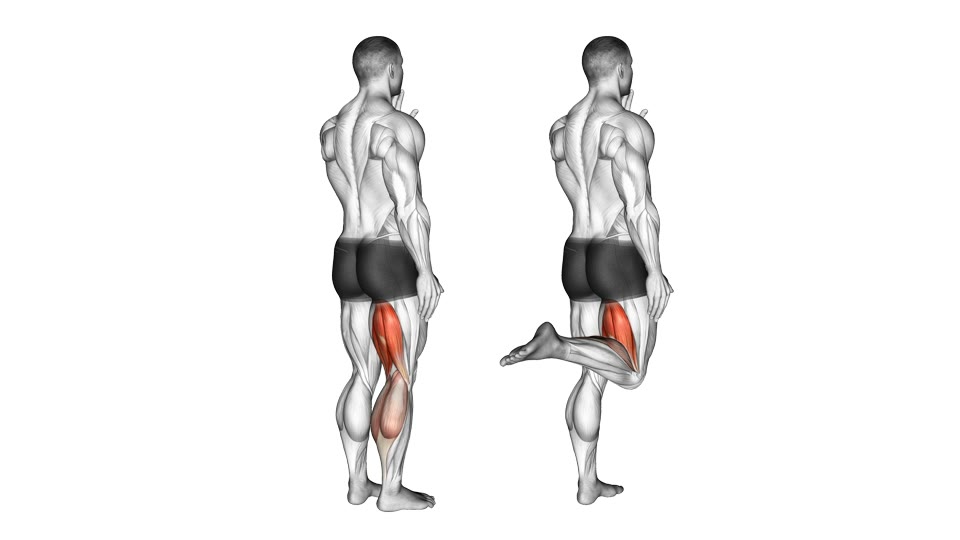
Three gaps worth stating. Nobody in this set compared standing or kneeling leg curls against anything, so if you use one, the honest answer is that it has not been tested. Nobody compared one leg at a time against both together either, so that is a preference; the illustration on this page shows both legs, which is not a recommendation. And every ankle-position study here measured activity, swelling, thickness or torque over weeks — none of them followed anyone long enough to say what any of it does to a physique or a hamstring injury rate.
Variations
- Seated leg curlHip stays flexed, which lengthens the three hamstrings that cross it. The version that grew more muscle in the trial that compared the two.
- Lying leg curlFace down with the hip extended. Built the same strength as the seated version and less size, in the same trial.
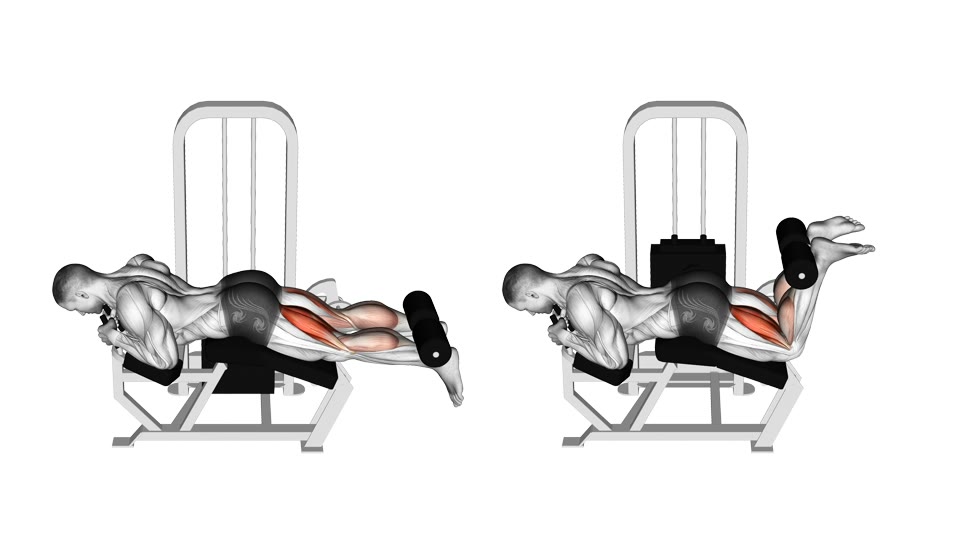
- Single leg curl — One leg at a time on the lying or seated machine, which lets each side be loaded to its own capacity.
- Kneeling leg curl — Machine version taken from a kneeling position. Untested in anything we read.
Articles
- A two-day full-body workout plan for a busy week
- A five-day PPLUL split with five saved routines
- A four-day upper/lower split with clear progression
- Good morning alternatives without a back bar
- Leg curl alternatives for gym and home
- Romanian deadlift alternatives for your workout
- A 3-day workout split you can set up and follow
Related tools
Frequently asked questions
What muscles does the leg curl work?
The hamstrings: biceps femoris, which has a long head and a short head, plus semitendinosus and semimembranosus. The gastrocnemius assists, because it originates above the knee and so helps flex it as well as plantarflexing the ankle. One anatomical detail matters for how the exercise behaves: the short head of biceps femoris starts on the femur and crosses only the knee, while the other three also cross the hip. That is why hip position changes what some of them do and not others.
Should you point your toes during leg curls?
It is a preference. Pointing your toes does reduce how much the calf contributes — that part is confirmed by an activation study and by an ultrasound study of post-exercise swelling. What does not hold up is the part people repeat it for. A 10-week trial that randomised one leg to train plantarflexed and the other dorsiflexed found no difference in hamstring muscle thickness or strength, and no difference in hamstring activity acutely. Two studies outside the machine leg curl did find ankle effects, and they point in opposite directions from each other. So use whichever position lets you train comfortably.
Is the seated leg curl better than the lying leg curl?
For muscle size, in the one trial that trained both, yes. Twenty untrained adults trained one leg seated and the other lying for twelve weeks: whole-hamstring volume rose 14.1% seated against 9.3% lying. But the advantage was confined to the three hamstrings that cross the hip — the short head of biceps femoris, which does not, grew the same either way — and strength gains did not differ between the legs at all. If your gym has both, seated is the better default for growth. If it has one, use it.
Do leg curls build hamstrings as well as Nordic curls?
In the study that compared them over twelve weeks, machine knee flexion produced more hamstring growth than Nordic training (+18% versus +11% overall, and +19% versus +5% in the long head of biceps femoris). The Nordic was better for the knee flexors that do not extend the hip. Two things to hold onto. The machine arm was not an ordinary set: the seat was modified to hold the hip deeper than a normal machine does, and the weight was lifted with two legs and lowered with one, so every rep was an eccentric overload. And the study measured muscle size and torque, not injuries. It says loaded knee flexion is not the lesser exercise for building the hamstrings; it does not tell you which prevents more strains.
Does turning your toes in or out change which part of the hamstring you train?
There is one study measuring it during a leg curl and its population was unusual: twenty patients recovering from ACL reconstruction using a graft taken from the medial hamstring being measured. Turning the foot inward raised medial hamstring activity, turning it outward lowered it, and the authors scoped their conclusion to rehabilitation. The underlying anatomy is real — the semitendinosus does assist internal rotation of the leg. But that is a single acute measurement in an atypical group, with nothing on whether it changes how a muscle grows. Not something to build a training decision on.
Should you do leg curls one leg at a time or both together?
Either. Nothing we read compares them, so it is a preference rather than a technique point. One leg at a time lets each side be loaded to what it can actually handle, which is worth knowing if one hamstring is plainly stronger than the other; both together is faster. The illustration on this page shows both legs, which is not a recommendation.
Do leg curls train the calves?
A little, and it depends on your ankle. The gastrocnemius crosses the knee, so it helps flex it. With the ankle neutral or pulled back it contributes measurably — one study found more lateral gastrocnemius activity with the ankle dorsiflexed, another found the muscle actually swelled after seated leg curls performed with a neutral ankle. Point your toes and that largely goes away. It is nowhere near enough to count as calf training either way.
Are leg curls worth doing?
About two thirds of regular RepCount users have logged one, and a leg curl turns up in roughly one workout in eleven. The logs show it as part of a leg session rather than as standalone work: two thirds of the sessions containing a leg curl also contain leg extensions, and about four in ten contain a leg press. That is the profile of a staple accessory, and it is one of the few hamstring exercises that loads knee flexion directly rather than through the hip.
Sources
- Cadeo GM, Fujita RA, Villalba MM, Silva NRS, Júnior CI, Pearcey GEP, Gomes MM. Myoelectric activity and improvements in strength and hypertrophy are unaffected by the ankle position during prone leg curl exercise — a within person randomized trial. Eur J Sport Sci. 2023. https://pubmed.ncbi.nlm.nih.gov/37194431/
- Marchetti PH, Magalhaes RA, Gomes WA, da Silva JJ, Stecyk SD, Whiting WC. Different Knee and Ankle Positions Affect Force and Muscle Activation During Prone Leg Curl in Trained Subjects. J Strength Cond Res. 2021. https://pubmed.ncbi.nlm.nih.gov/31469769/
- Lisboa F, et al. Ankle Position-Dependent Muscle Swelling During Seated Leg Curl: Ultrasonographic Insights Into the Hamstrings and Medial and Lateral Gastrocnemius. J Strength Cond Res. 2026. https://pubmed.ncbi.nlm.nih.gov/41609763/
- Keerasomboon T, Jamkrajang P, Limroongreungrat W, Chrunarm T, Soga T, Hirose N. Characteristics of Hamstring Electromyographic Activity and the Break-Point Angle during Nordic Hamstring Exercise at Different Ankle Positions. J Hum Kinet. 2025. https://pubmed.ncbi.nlm.nih.gov/42211804/
- Kim K, Cha YJ, Fell DW. Differential effects of ankle position on isokinetic knee extensor and flexor strength gains during strength training. Isokinetics and Exercise Science. 2016. https://doi.org/10.3233/ies-160617
- Maeo S, Huang M, Wu Y, Sakurai H, Kusagawa Y, Sugiyama T, Kanehisa H, Isaka T. Greater Hamstrings Muscle Hypertrophy but Similar Damage Protection after Training at Long versus Short Muscle Lengths. Med Sci Sports Exerc. 2021. https://pmc.ncbi.nlm.nih.gov/articles/PMC7969179/
- Maeo S, et al. Hamstrings Hypertrophy Is Specific to the Training Exercise: Nordic Hamstring versus Lengthened State Eccentric Training. Med Sci Sports Exerc. 2024. https://pmc.ncbi.nlm.nih.gov/articles/PMC11419281/
- Beuchat A, Maffiuletti NA. Foot rotation influences the activity of medial and lateral hamstrings during conventional rehabilitation exercises in patients following anterior cruciate ligament reconstruction. Phys Ther Sport. 2019. https://pubmed.ncbi.nlm.nih.gov/31277009/
- Anatomy, Bony Pelvis and Lower Limb, Hamstring Muscle. StatPearls. https://www.ncbi.nlm.nih.gov/books/NBK546688/
- Anatomy, Bony Pelvis and Lower Limb: Thigh Semitendinosus Muscle. StatPearls. https://www.ncbi.nlm.nih.gov/books/NBK539862/
- Bordoni B, Varacallo MA. Anatomy, Bony Pelvis and Lower Limb: Gastrocnemius Muscle. StatPearls. https://www.ncbi.nlm.nih.gov/books/NBK532946/