Dumbbell pullover
Also called dumbbell pull-over, DB pullover, bench pullover.
What is a dumbbell pullover?
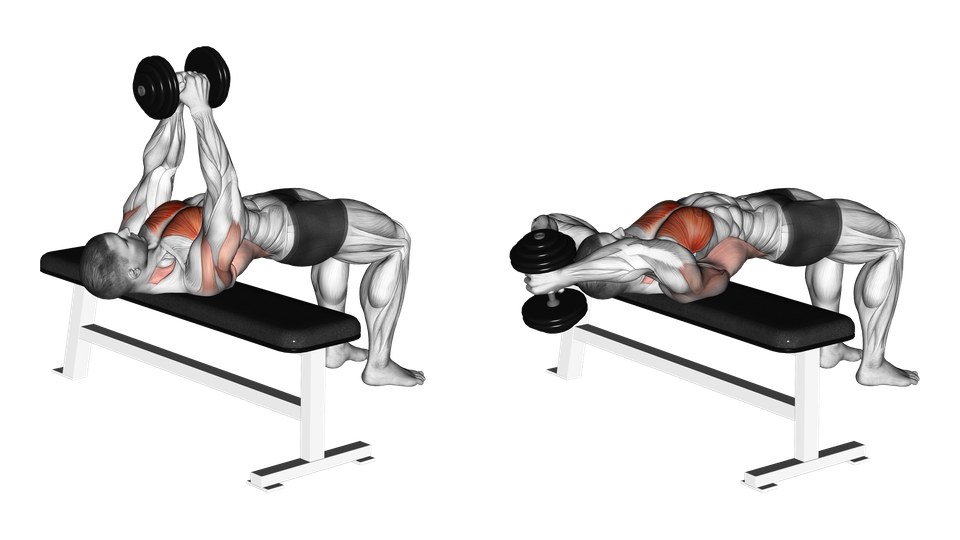
The dumbbell pullover is performed lying on a bench while moving one dumbbell in an arc from above the chest to behind the head and back. It involves both the pectoralis major and latissimus dorsi, with the teres major and long head of the triceps assisting.
How do you perform a dumbbell pullover?
Set up
- Lie lengthwise on a flat bench with your head supported, feet planted and one dumbbell held securely in both hands above your chest.
- Keep a small, fixed bend in the elbows and brace so the ribs and hips remain steady.
Execution
- Lower the dumbbell in an arc behind your head without changing the elbow bend.
- Stop when the shoulders reach a comfortable stretch or before the ribs lift to create more range.
- Bring the dumbbell back over the chest along the same arc.
Common mistakes
Bending and straightening the elbows
Changing the elbow angle turns the rep into a mixture of a pullover and triceps extension.
Arching to lower the dumbbell farther
Rib flare creates apparent range through the spine instead of the shoulders.
Holding the dumbbell by its handle with two loose hands
Support one end securely with both palms and thumbs around it so the weight cannot slip overhead.
Where it fits in a session
Usually used after heavier pressing or pulling as chest-and-back accessory work.
Use a load that allows a comfortable shoulder range without changing elbow angle or lifting the ribs.
Muscles worked
Primary
Secondary
Schematic surface view. Some muscles are partly visible or not shown.
Pullovers involve both the chest and lats, and available exercise references disagree on ranking one above the other. They are therefore listed together rather than presenting the movement as exclusively a lat exercise.
Variations
- Cable pullover — Uses a high cable while standing or kneeling, keeping tension through a different path.
- Straight-arm pulldown — Uses a cable from overhead while the torso remains upright or hinged.

Frequently asked questions
Do dumbbell pullovers work the chest or the lats?
They involve both. Exercise references often rank the chest first and the lats second, but technique and individual mechanics affect where the movement is felt; it is not accurate to call it exclusively one or the other.
How far should you lower the dumbbell?
Lower only to a comfortable shoulder stretch while your ribs and hips stay steady. More depth is not useful if it comes from arching the back.
Should your elbows bend during pullovers?
Start with a small elbow bend and keep it nearly fixed. Repeatedly bending and straightening the elbows changes the movement.
Should you lie across or along the bench?
Both setups exist. The exact version shown here lies lengthwise with the head, upper back and hips supported.
Sources
- Solari F, Burns B. Anatomy, Thorax, Pectoralis Major. StatPearls. https://www.ncbi.nlm.nih.gov/books/NBK525991/
- Jeno SH, Varacallo MA. Anatomy, Back, Latissimus Dorsi. StatPearls. https://www.ncbi.nlm.nih.gov/books/NBK448120/