Straight arm pulldown
Also called straight-arm lat pulldown, stiff-arm pulldown, cable pullover, straight arm cable pulldown.
What is a straight arm pulldown?
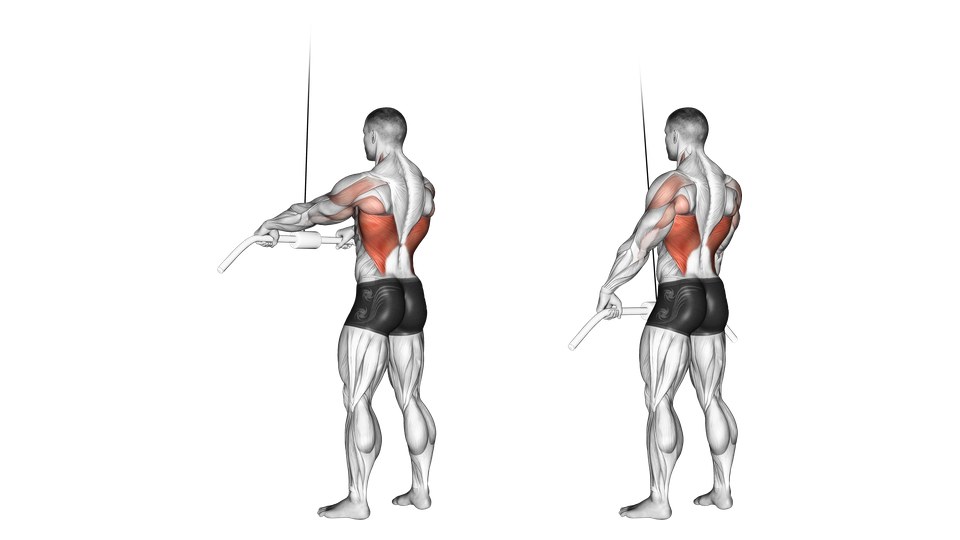
A straight arm pulldown is a cable exercise in which you pull a bar from above shoulder height to the thighs while keeping the elbows nearly fixed. The movement trains shoulder extension, led by the latissimus dorsi, without turning the rep into an ordinary lat pulldown.
How do you perform a straight arm pulldown?
Set up
- Attach a straight bar to a high cable, hold it a little wider than shoulder width and step back until the cable is taut.
- Lean forward slightly from the hips, brace your trunk and set a small elbow bend that you can keep throughout the rep.
Execution
- Sweep the bar down in an arc toward your thighs by moving your upper arms, not by bending your elbows.
- Pause when your hands reach your thighs and your shoulders cannot extend farther without your torso changing.
- Let the bar rise under control until your upper arms are beside your ears or your comfortable shoulder range ends.
Common mistakes
Bending the elbows into a pulldown
Changing the elbow angle adds a curl and turns the movement into a different cable pull. Keep the small bend you set at the start.
Using body weight to drive the bar down
Rocking the torso makes the cable move without the shoulders doing the full work. Hold the hinge still and reduce the load if needed.
Forcing the arms too far overhead
The cable only needs to reach the end of your comfortable shoulder range. Stop before the ribs flare or the shoulders feel pinched.
Where it fits in a session
Use it after heavier rows or pulldowns, or early in a session as a light way to practise driving the upper arms down.
The goal is a repeatable shoulder arc. Add load only while the elbow angle and torso position stay quiet.
Muscles worked
Primary
Secondary
Schematic surface view. Some muscles are partly visible or not shown.
The latissimus dorsi drives shoulder extension. The teres major, posterior deltoid and long head of the triceps can assist while the elbows stay almost fixed.
Variations
- Single-arm straight arm pulldown — Uses one handle so each side can move through its own path.
- Resistance-band straight arm pulldown — Uses a band anchored overhead instead of a cable stack.
Frequently asked questions
What muscles does the straight arm pulldown work?
It mainly trains the latissimus dorsi. The teres major, posterior deltoid and long head of the triceps can assist with shoulder extension.
Should the arms be completely straight?
No. Keep a small, comfortable elbow bend; the important part is that the angle does not change much during the rep.
Is a straight arm pulldown the same as a lat pulldown?
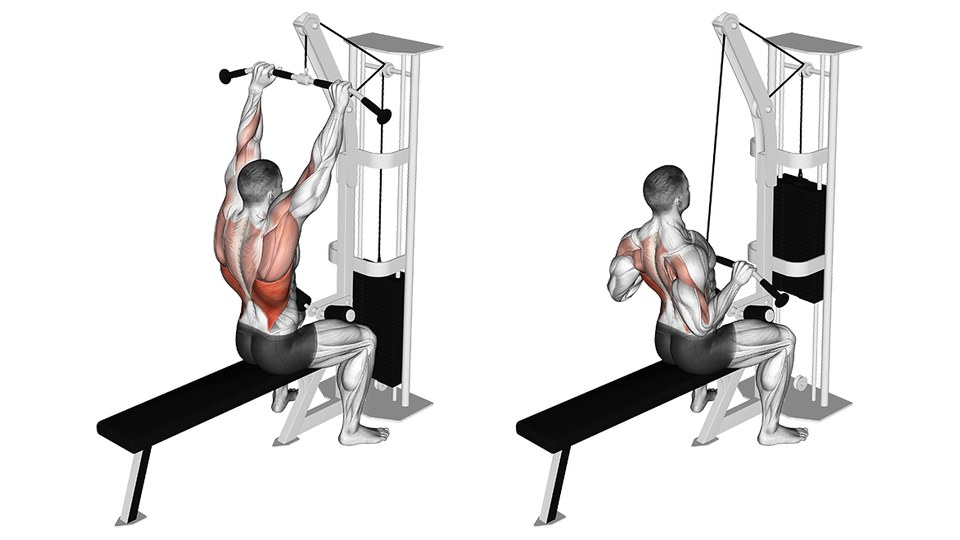
No. A lat pulldown bends the elbows substantially, while a straight arm pulldown keeps them almost fixed and moves mainly at the shoulders.
Sources
- Jeno SH, Varacallo MA. Anatomy, Back, Latissimus Dorsi. StatPearls. https://www.ncbi.nlm.nih.gov/books/NBK448120/
- Syros A, Rizzo MG. Anatomy, Shoulder and Upper Limb, Teres Major Muscle. StatPearls. https://www.ncbi.nlm.nih.gov/books/NBK580487/
- Tiwana MS, Sinkler MA, Bordoni B. Anatomy, Shoulder and Upper Limb, Triceps Muscle. StatPearls. https://www.ncbi.nlm.nih.gov/books/NBK536996/