Dumbbell skull crusher
Also called dumbbell skull crushers, lying dumbbell triceps extension, dumbbell lying triceps extension.
What is a dumbbell skull crusher?
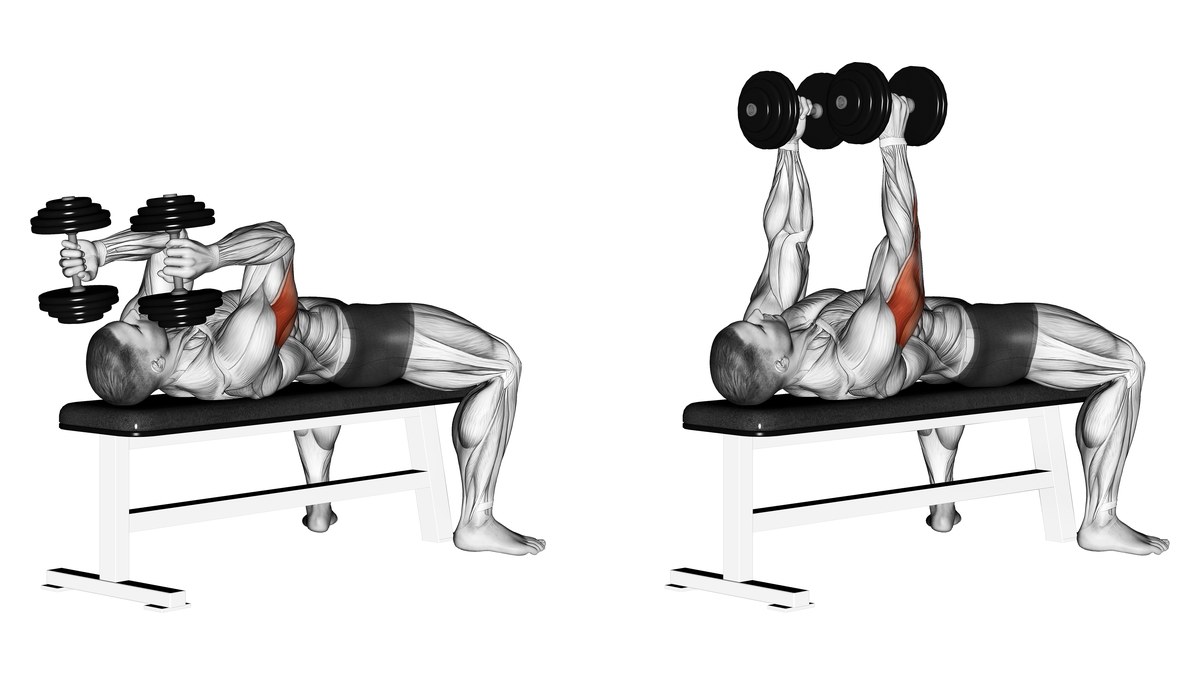
A dumbbell skull crusher is a lying triceps extension performed with a separate dumbbell in each hand. From a flat bench, you bend your elbows to lower the weights beside your head, then straighten the arms. The hands face each other instead of sharing a bar.
How do you perform a dumbbell skull crusher?
Set up
- Sit on a flat bench with two light dumbbells resting securely on your thighs. Lie back and bring the weights above your chest, with your head supported and feet planted.
- Face your palms toward each other and position the arms above your shoulders, angled slightly toward your head. Leave space for each dumbbell to pass beside your head.
Execution
- Bend both elbows to lower the dumbbells toward the sides of your head, keeping the upper arms near their starting angle.
- Stop before the weights touch your head or the bench, using a range you can control without widening the elbows abruptly.
- Straighten the elbows to bring the dumbbells back above you, keeping the two weights separate.
- After the last repetition, bring the weights toward your chest and return them to your thighs before sitting up carefully.
Common mistakes
Taking heavy weights over the face before learning the movement
Start light enough to manage the entry, repetition and exit. Ask for a controlled handoff if you cannot safely position the dumbbells.
Changing the arm angle on every repetition
Keep the upper arms near the angle you set. Avoid sweeping the whole arm back and forth to move the weights.
Letting the dumbbells collide
Allow each hand its own narrow path and leave space between the weights at the top.
Where it fits in a session
Use it where your session calls for triceps accessory work.
Choose the load for controlled repetitions from setup through the last return. Keep the same movement as the set becomes harder; reduce the weight if you have to change the path.
Muscles worked
Primary
Secondary
- None listed in this guide
Schematic surface view. Some muscles are partly visible or not shown.
The triceps brachii extends the elbow; no individual head is ranked.
Variations
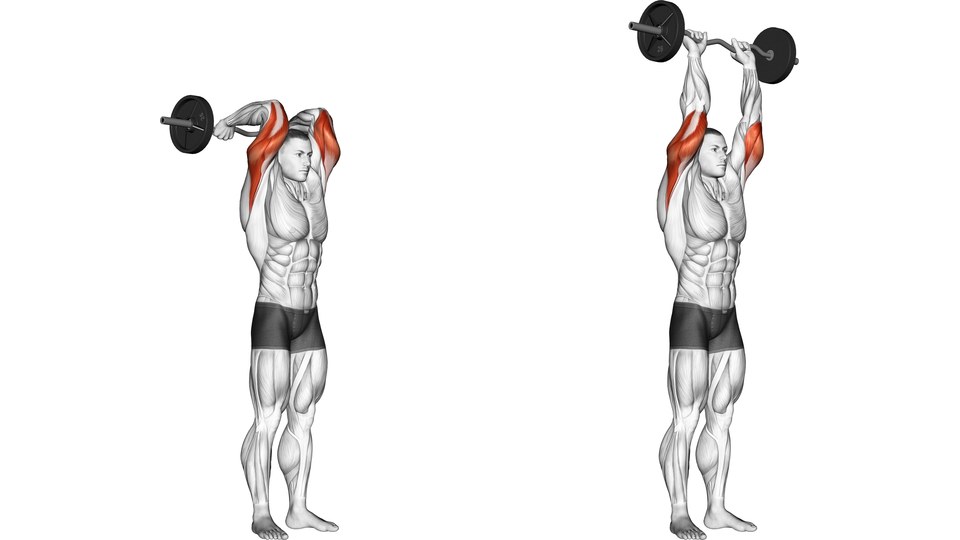
- Overhead triceps extensionKeeps the upper arms beside the head in an upright position rather than lying on a flat bench.
Frequently asked questions
Is this the same as a lying dumbbell triceps extension?
Yes. Both names describe this flat-bench elbow extension with independent dumbbells. Skull crusher does not mean the weights should touch the head.
Where should the dumbbells finish at the bottom?
Beside the head, with enough clearance to avoid contact. A slightly farther-back endpoint is an option if you can keep the upper-arm position controlled; do not force a particular depth.
Should the palms face each other?
That is the neutral grip taught here and shown in the illustration. Keep it through the repetition instead of turning the hands as the weights descend.
How is it different from the barbell version?
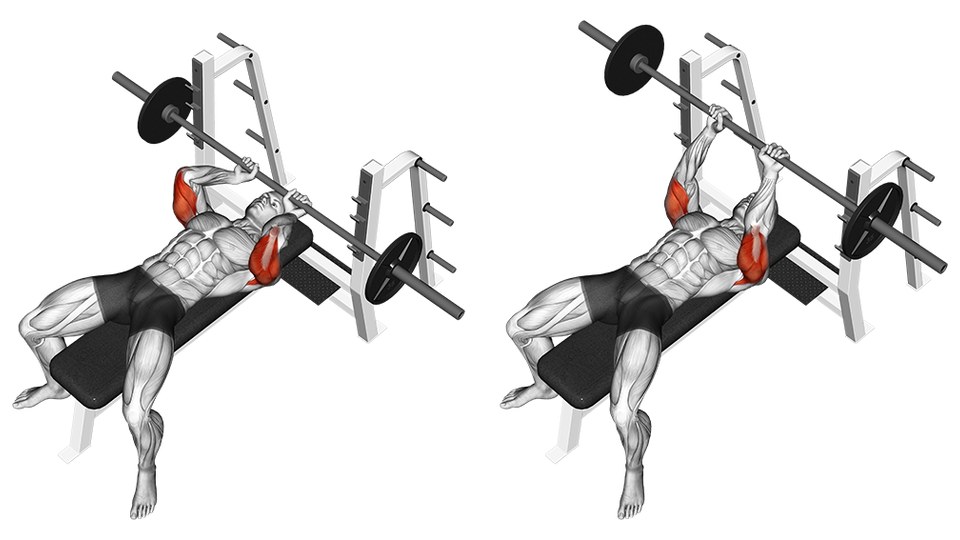
Each hand controls its own dumbbell, so the hands are not joined by a bar. Use a load you can manage evenly with both arms rather than copying your barbell weight.
What muscles does it train?
The triceps brachii extends the elbow. This page does not claim that one head is isolated or that dumbbells build more muscle than a bar.
Sources
- Tiwana MS; Sinkler MA; Bordoni B. Anatomy, Shoulder and Upper Limb, Triceps Muscle. StatPearls. https://www.ncbi.nlm.nih.gov/sites/books/NBK536996/