Lying triceps extension
Also called skull crusher, triceps extension.
What is a lying triceps extension?
A lying triceps extension, often called a skull crusher, is an elbow-extension exercise performed on a bench while the bar lowers toward or behind your forehead. It trains the triceps brachii, with help from the anconeus. It is distinct from the overhead triceps extension, or French press.
How do you perform a lying triceps extension?
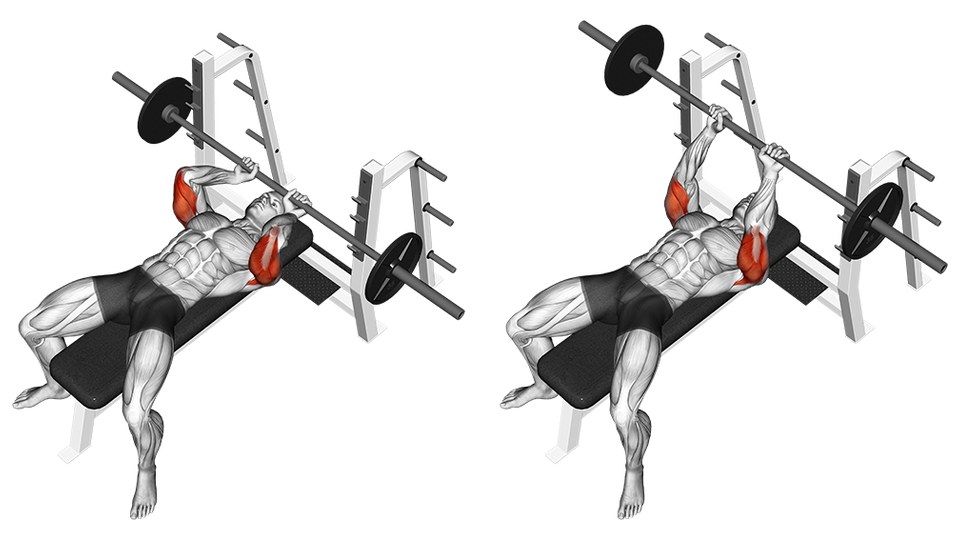
Set up
- Lie on a bench with your feet flat, hold an EZ-bar or barbell a little inside shoulder width and press it to straight arms.
- Set your ribs down and angle your upper arms slightly toward your head so the bar is over your forehead.
Execution
- Bend your elbows and lower the bar behind your head under control, keeping your upper arms still.
- Stop when your forearms meet your upper arms or your shoulders limit the range.
- Straighten your arms without letting your elbows widen.
Common mistakes
Letting the upper arms swing as you press, so the shoulder helps
Once the shoulder joins in, the muscles that pull the upper arm down finish the rep and the triceps stops being what completes it. The tell is a bar that keeps moving while the elbow angle barely changes. You have swapped exercises without noticing, usually in the last three reps, which are the ones you were doing the set for.
Flaring the elbows wider as the set gets hard
Widening the elbows turns the last reps into a close-grip press, which is a stronger position and a different exercise. The reps still get completed, so it feels like a good set — but the triceps did less of it than the rep count suggests, and the next session's weight is chosen from a lie.
Lying down and lowering the bar to your forehead with the upper arms straight up
With the upper arm vertical the weight sits directly over the elbow at the top of the rep, so there is almost nothing for the triceps to resist there — you rest at lockout and work only the bottom half. Angling the upper arms back far enough that the bar finishes over your forehead is what loads the whole rep, and it is also what stops the bar arriving at your face.
Loading it like a press
This is one joint moving through a short range, and the weight that lets you keep the upper arm still is the weight that trains it. Past that point the extra load is carried by the shoulder drifting, which is the first mistake in this list wearing a heavier plate.
Training through pain at the back of the elbow
Chronic pain at the point of the elbow that worsens when you actively extend it is the described presentation of triceps tendinitis, an overload problem. Reaching for the same bar next week is how a session's annoyance becomes a month off pressing. Change the implement or the arm position, drop the load, and if it keeps happening ask someone qualified rather than the internet.
Where it fits in a session
Late in an upper-body or push session, after the pressing, alongside a pushdown rather than instead of one.
Single joint, short range, small muscle: this does not need to be heavy to do its job, and heavy is exactly where the upper arm starts moving. Sets taken close to failure with a still upper arm beat a lower-rep set you have to heave. If you already do pushdowns, the case for keeping both is that the arm is in a different place, not that one is better — and it is what lifters already do, since a pushdown shows up in about a fifth of the sessions that contain an extension.
Muscles worked
Primary
Secondary
Schematic surface view. Some muscles are partly visible or not shown.
All three triceps heads extend the elbow; only the long head also crosses the shoulder, so arm position changes its length. The list is not a ranking of which head a particular variation grows most. The evidence section separates findings for specific cable exercises from the lying barbell version pictured here. Anconeus assists elbow extension.
What lifters actually do
Just over half of regular RepCount users have logged a triceps extension at some point, and it appears in about one workout in sixteen. Four of the five exercises it shares a session with most often are pressing or shoulder work: the bench press and lateral raises in roughly a third of those sessions each, then incline dumbbell press and dumbbell shoulder press. The fifth is a pushdown, which turns up in about a fifth of the workouts that contain an extension — so this is push-day arm work, and lifters do not treat it as the one triceps slot in a session. A session that contains an extension holds around seven exercises, about three sets of which are the extension itself.
Most often trained alongside
Share of lying triceps extension sessions that also include each exercise.
- Bench press31.5%
- Lateral raises31.2%
- Pushdowns20.8%
Figures come from workouts tracked in RepCount.
Scientific studies on triceps extensions
This guide covers lying and overhead extensions. The strongest comparison discussed here used overhead cable extensions and pushdowns, so its result needs to stay attached to those movements.
A twelve-week cable trial favored overhead extensions over pushdowns for triceps growth. It did not compare overhead extensions with lying skull crushers. Muscle-activity patterns from a dumbbell comparison cannot settle that separate growth question.
Does training with the arms overhead change growth?
Twenty-one adults trained one arm overhead and the other at their side for twelve weeks using a cable machine. MRI measurements showed growth in both arms, with greater increases overhead for the whole triceps, its long head and the lateral and medial heads measured together. Participants had not followed a resistance-training program during the previous year.
An earlier six-week study in nine novice women found increased long-head thickness with both positions and no clear difference between them. It used different partial elbow ranges and ultrasound rather than whole-muscle MRI. The studies therefore differ in more than their conclusions. Neither establishes a universal advantage for every overhead variation.
What about lying extensions versus overhead extensions?
A study in twenty-one trained men compared muscle activity during lying and overhead dumbbell extensions. Activity varied across parts of the movement and between lifting and lowering; the authors described similar patterns across the exercises.
The study did not track muscle growth or compare training programs that used one exercise with programs that used both. It cannot establish that the exercises produce equal growth, or that combining them is unnecessary. The cable growth trial above also leaves this question open because its comparison exercise was a pushdown.
Variations
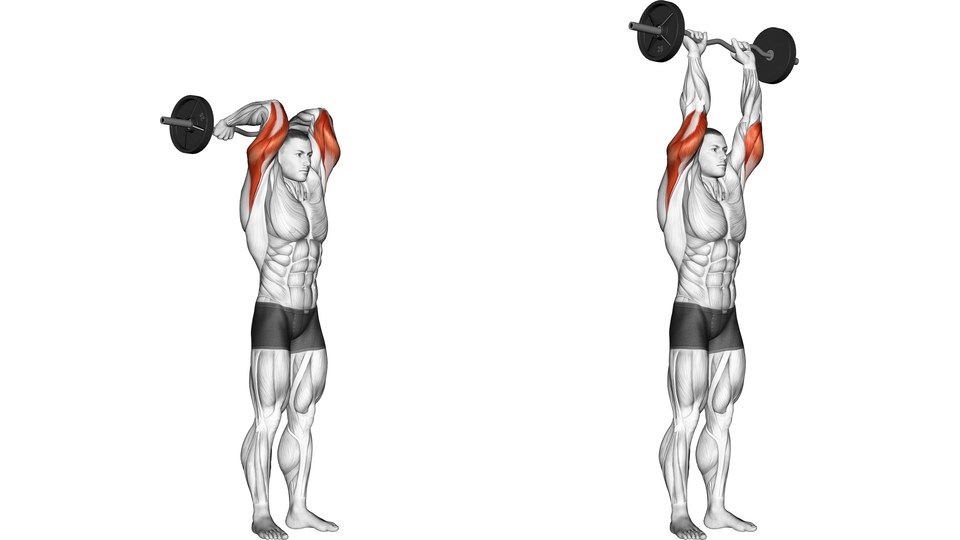
- Overhead triceps extension (French press)Keeps the upper arms beside the head and lowers the bar behind it; track it separately from the lying version.
- Lying barbell triceps extension (skull crusher) — The default form of the movement: on a bench, bar coming to or past the forehead.
- Lying EZ-bar triceps extension — Same movement on an angled bar, which lets the wrists sit at a less extreme angle.
- Lying dumbbell triceps extension — Palms facing each other, so each arm chooses its own path instead of being tied to a bar.
- Overhead dumbbell triceps extension — One dumbbell in both hands, arms beside the ears. Shoulder is flexed, so the long head starts longer.
- Single-arm overhead triceps extension — One arm at a time, seated or standing. The free hand can support the working elbow.
- Overhead cable triceps extension — Rope on a low or high pulley, facing away. Load stays on the muscle where a free weight goes light.
- Incline triceps extension — Lying on an incline bench, which tilts the upper arm back so the triceps still has something to resist at lockout.
Related tools
Frequently asked questions
What muscles do triceps extensions work?
The triceps brachii, with the anconeus helping. The triceps has three heads — long, lateral and medial — and all three converge into a single tendon that attaches at the point of the elbow, so all three extend the elbow on every rep. The anconeus is a small muscle sitting just past the elbow on the outside of the forearm; extending the elbow is its job too. Nothing in the anatomy ranks the three heads for one version of this movement over another, so this page does not rank them.
Are overhead or lying triceps extensions better?
The growth trial discussed below compared overhead cable extensions with pushdowns, not lying extensions. It favored overhead training in that comparison. A small dumbbell study compared lying and overhead muscle-activity patterns, but did not measure growth. These studies do not settle which of the two versions in this question builds more muscle.
Is a skull crusher the same thing as a triceps extension?
A skull crusher is one kind of triceps extension: the lying version, done on a bench with the weight coming down toward or past your forehead. Overhead extensions are the same movement with the arm somewhere else. The defining feature is that the upper arm is held still and the elbow does the work — the name only tells you where your arm is while that happens.
What is the difference between a triceps extension and a pushdown?
Where your upper arm is. In a pushdown it hangs at your side with the resistance coming from above; in a lying or overhead extension the arm is out in front of you or behind your head. The elbow joint does the same thing in both. The one anatomical difference worth knowing is that the long head of the triceps also crosses the shoulder, so the two put it at different lengths. Lifters often run both in the same workout rather than treating them as substitutes: in RepCount's tracked workouts, a pushdown appears in about a fifth of the sessions that contain a triceps extension.
Does the triceps extension work the long head?
Yes. The long head contributes to elbow extension and also crosses the shoulder, so arm position changes its length. In a twelve-week cable study, its volume increased with both overhead extensions and pushdowns, with a larger increase overhead. That result does not rank every lying, overhead or free-weight variation.
Why do my elbows hurt when I do skull crushers?
This page will not diagnose you, and the honest answer is that elbow pain has several causes. What the anatomy reference describes is that chronic pain at the back of the elbow which worsens when you actively extend the arm is the typical presentation of triceps tendinitis, a tendon overload problem. Pain that shows up in the same spot every time you do one movement is information rather than something to train through. Changing the implement, the arm position or the load is the usual first move, and a professional opinion beats a heavier set.
Are triceps extensions worth doing?
In RepCount's tracked workouts, just over half of regular users have logged one, and they show up in roughly one workout in sixteen. Four of the five exercises they most often share a session with are pressing or shoulder work: the bench press and lateral raises in about a third of those sessions each, then incline dumbbell press and dumbbell shoulder press. That is the profile of a standard push-day accessory — widely used, rarely the point of the session.
Sources
- Tiwana MS, Sinkler MA, Bordoni B. Anatomy, Shoulder and Upper Limb, Triceps Muscle. StatPearls. https://www.ncbi.nlm.nih.gov/books/NBK536996/
- Glover NM, Black AC, Murphy PB. Anatomy, Shoulder and Upper Limb, Radial Nerve. StatPearls. https://www.ncbi.nlm.nih.gov/books/NBK534840/
- Mitchell B, Whited L. Anatomy, Shoulder and Upper Limb, Forearm Muscles. StatPearls. https://www.ncbi.nlm.nih.gov/books/NBK536975/
- Maeo S, Wu Y, Huang M, Sakurai H, Kusagawa Y, Sugiyama T, Kanehisa H, Isaka T. Triceps brachii hypertrophy is substantially greater after elbow extension training performed in the overhead versus neutral arm position. 2023. https://pubmed.ncbi.nlm.nih.gov/35819335/
- Stasinaki AN, Zaras N, Methenitis S, Tsitkanou S, Krase A, Kavvoura A, Terzis G. Triceps Brachii Muscle Strength and Architectural Adaptations with Resistance Training Exercises at Short or Long Fascicle Length. 2018. https://www.mdpi.com/2411-5142/3/2/28
- Alves D, Matta T, Oliveira L. Effect of shoulder position on triceps brachii heads activity in dumbbell elbow extension exercises. 2018. https://pubmed.ncbi.nlm.nih.gov/28677940/